Bridgeport welcome


Bridgeport, Chicago, Illinois

Bridgeport is a neighborhood unlike any other in Chicago. Actually, there are two Bridgeports: the mythical, political Bridgeport that every Chicagoan hears about since starting school and the earthy, gritty Bridgeport that contrasts sharply with the mythical, political version.

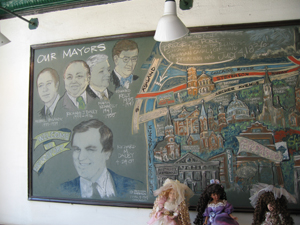
In grade school, we learned all about Bridgeport, which is the birthplace of five Chicago mayors, including the present Mayor Richard M. Daley (Richard da Second). Bridgeport didn’t invent machine politics; they merely perfected machine politics, reaching its apogee in Mayor Richard J. Daley (Richard da First). Bridgeport is also very near the geographical center of Chicago. Many south siders often went to the White Sox games at Comiskey Park in Bridgeport. When I was a student at Holy Cross School, no school field trip would be complete without first driving past Mayor Daley’s bungalow at 3536 S. Lowe Avenue. Bridgeport was the Mecca of the south side. Every Chicagoan made a pilgrimage to Bridgeport at some point in their life.

When I told my mother that I was planning to buy a house in Bridgeport, she cringed and told me that I would regret it. For some unknown reason, I was drawn to Bridgeport. Besides, this was the location of the only house I could afford using the GI Bill. But before I bought this house, I checked out the neighborhood first. I drove past the house several times, at different hours of the day and night. Every time I drove past my future home, the block was extremely quiet. I never saw any movement in this vicinity at any time. I was sure that I was moving into a good neighborhood. After all, this was Bridgeport. So, I bought the house, much to my mother’s disappointment, and I moved in.

This was when I saw the earthy, gritty side of Bridgeport for the very first time. You don’t really know a neighborhood until you move in, and you live there 24/7/365. It was only then that I saw the seedy side of Bridgeport. My house was situated next to an alley that ran alongside the length of my house, an alley that everyone in the neighborhood used as a shortcut. I always heard whoever walked through the alley talking, at all hours of the day. Then one day, I noticed that Bridgeport had a gang problem, and my house was right on the border between two gang turfs. My neighbor always tried to start a fight with me by pointing to my camouflage shirt, a remnant from my Marine Corps enlistment, and tell me, “Hey, man! The war’s over!” I would ignore him and walk past him quickly. It was about that time that I learned that there were two sides to Bridgeport. And I lived on the wrong side of Bridgeport! I lived on the side where the public housing projects were located, the only white projects in the whole city of Chicago!

While I lived in the Marquette Park neighborhood, I had developed certain habits and I thought I could continue them when I saw all the stores, shops, and restaurants that were available in Bridgeport. I really thought that I would enjoy all these places that were within walking distance of my house. I went to Lina’s Italian restaurant that was less than one block from my house because they served authentic Italian food. Or so I thought. When I entered the restaurant, I was greeted by Lina herself. I asked for the beef ravioli because I love authentic beef ravioli. Lina said, “It takes too long to make.” I said, “That’s fine. I’m not in a hurry tonight. I brought a book that I can read while I wait.” “Well, I’m not going to make ravioli just for you. Why don’t you order something else?” So, I did. But I went back a few times hoping to eat ravioli, but she always refused to make it.

I once needed a button sewn on my winter wool coat, so I went to a tailor on Halsted Street. The tailor said, “You want this button sewn on? Why don’t you buy yourself some needle and thread and sew it on yourself?” He didn’t understand that I didn’t want to sew it on myself and that I was willing to pay him to sew the button on for me. He continuously refused, so I left.

I went down the block to the barbershop that appeared to be in a continuous state of disrepair, since at least the 1960s, judging by the newspaper clippings on the wall. There were no customers in the store, so the barber was sitting in a chair. When I entered, he stood up and said, “How may I help you?” I told him that I wanted a haircut. Well, he wasn’t giving haircuts that day. So, I left.

Then, I went to the 11th Ward Office because I needed garbage cans for my house. They refused to give me garbage cans because I didn’t appear as a registered voter within their ward even though I had just moved there. I left without garbage cans. This was certainly a fine welcome to Bridgeport. I eventually adjusted to life in Bridgeport. You just had to learn not to have too high expectations.
DDR

Private Cloud


Private Cloud

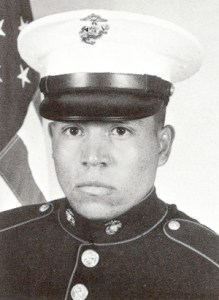
I met Leslie Cloud when I was in the Marine Corps Boot Camp in San Diego, California. He was proud of the fact that he was a Chippewa Indian from Wisconsin.

In boot camp we only knew our fellow Marines by their surnames because first names were unimportant. However, if we took a liking to someone, we introduced ourselves. Leslie approached me first. He said, “Hi, my name is White Cloud.” I started laughing because I immediately thought of the toilet paper by the same name. When I noticed he was staring at me with a menacing look, I stopped laughing. Then he laughed and said, “My name’s really Leslie.” I felt an immense sense of relief because for a second there I thought he would pound the laughter out of me.

We shared the same set of bunk beds, so that made us partners for many of our boot camp activities. In reality, he picked me for his bunk partner, although I’m not sure why. He said that I had to sleep on the top bunk, and the way he said it, I knew I didn’t have any other option.

I never really learned too much about his personal life, but occasionally he would say something that revealed his past. I was a regular Marine, and he was a reservist who would return to his reservation after boot camp. Sometimes he would reminisce about his life on the reservation, how he could hunt whenever he wanted. But other than that, he remained a mystery to me.

He had a sense of humor that today would be considered politically incorrect, but he always made me laugh. There were moments when I thought he was the funniest man in the world. Unfortunately, laughing was not allowed in boot camp. So, he tried to make me laugh at the most inappropriate moments. In the morning, we had to make our bunks and stand at attention. The goal was not to be the last one done, or you and your partner would be ordered to do pushups or another callisthenic exercise. The first day we were bunkmates, I thought I was making my bunk at breakneck speed. By the time I had finished tucking the hospital folds of the bottom flat sheet, Leslie began helping me with the top sheet. When I looked at his bunk, I was amazed that he had already made it. It was so perfectly made, too, that it passed the quarter-bouncing test when the drill instructor bounced a quarter on the bed to see if the sheets were tucked in tightly enough. “Where did you learn to make a bed like that,” I asked. With a wink of an eye, he said, “It’s an old Injun trick!” Then, he got serious and said that he had grown up in an orphanage.

When we were in infantry training, we shared a tent that we put up faster than any other team in the platoon. I realized that I had only assisted him while he did most of the work. We stood at attention for what seemed an eternity waiting for the next team to finish setting up their tent. While we were standing there, I asked, “How did you put up the tent so fast?” He looked at me with a straight face and said, “Injun-uity!” I had to contain my laughter so as not to be punished for not being at attention. The incident I remember most? I was looking at picture from my last trip to México immediately before entering boot camp. I had a picture of my grandmother with her long black hair with traces of gray in the traditional Mexican braids and her deep brown skin and broad cheeks. I saw Leslie looking at the picture, so I told him she was my grandmother. He solemnly said, “So you’re one of us.”

Toward the end of our boot camp training, we were informed that we had both been meritoriously promoted to Private First Class (PFC). He began calling me PFC Rodriguez, and I called him PFC Cloud. Those titles sounded so prestigious in boot camp when most recruits were only privates. However, during the promotion ceremony, I was promoted but not Leslie. He showed no outward indication of disappointment. I never found out why Leslie didn’t get promoted. When we said our good-byes after boot camp, I asked him for his address so we could stay in touch. He said no because he wouldn’t write to me anyway. And that was the last I ever heard of him.

DDR

Alva


Laredo, Texas

I don’t even remember his first name. But I always think of him whenever I play chess and/or drink a beer.

I met Alva when we were in the Marines stationed at Camp Pendleton, California. He was your typical Mexican from Texas. A true Texican. His first name was Rodolfo, but everyone called him by his surname. Alva was short and stocky, what would be called husky in the boy’s department. He was particularly handsome. In fact, he had one eye a little bigger than the other, his teeth were crooked, and he always had a bad haircut. What he lacked in looks, he made up for in personality. He was always the joker and he always had everyone in the shop laughing.

He retained the rank of private because he was always getting into trouble and so he would never get promoted. Drinking was at the root of all his problems. I never saw him sober even once. He was always drunk or suffering from a hangover. When we stood in formation, he would always teeter during inspection. I’m surprised that he never fell over at roll call because a few times he was leaning more than the Leaning Tower of Pisa. Despite all his flaws, he had a girlfriend whom he had met near the base. That is, until he got into a fight at the club and wasn’t allowed to leave the base for months. So he would drink at the club everyday, only leaving to check in with the sergeant.

Our superiors really came down hard on Alva. They controlled every aspect of his duty hours. We all thought they went beyond the call of duty. Finally, he told our commanding officer that he was tired of being harassed and he wanted everyone to leave him alone. He wanted to everything to go back to the way it was. He even told the CO that he had written his congressman. Why did Alva feel harassed? He would have to check in with the sergeant every hour just to make sure he was still on base.

One day, he went to the club to watch Monday Night Football and later returned emotionally distraught. He told us that the game was interrupted for a special announcement: John Lennon had been shot! None of us could believe it. But Alva was the one who was the most depressed by Lennon’s death. Alva seemed to drink less after that shocking assassination.

It was during this time that I learned about his special talent. He could play chess. That was surprising because he wasn’t the type of person who exuded intelligence of any sort. One day, he challenged all comers. He walked into the radio shop where we worked and announced, “Who’s the best chess player here? I challenge you to a chess match!”

Somehow he had heard that I used to play chess. It might have been from me because I used to like to tell people I used to like to play chess. I might have said that I used to play when I first arrived at Camp Pendleton and Alva remembered. He had a good memory. At first, I didn’t want to play because I hadn’t played since high school and I was afraid that if I started playing again I would get addicted to play chess again. But I couldn’t control myself and I accepted Alva’s challenge. Anyway, Alva won every game easily.

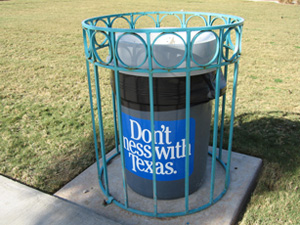
Eventually, I played chess with Alva regularly and he always beat me easily. To add insult to injury, he was always very drunk when we played. Okay, I was hooked. I wanted to beat Alva at chess. We played chess everyday in the shop. Whenever he made a particularly good move, he would say, “Don’t mess with Texas!”

I never beat him until I finally figured out his strategy! He had no strategy! He was always so drunk that he would only play the best move for the position. With each game we played, I improved my game. Finally, I figured out that if I planned my strategy at least five moves ahead, his best move for the position wouldn’t help him. Eventually, I was beating him on a regular basis. He wasn’t used to losing even though he never studied or practiced chess formally. He was truly amazed that anyone could beat him. And I was surprised that anyone so drunk could play chess so well. Oh, yes, and Alva’s congressman called up our commanding officer and Alva was no longer on restriction.

DDR

El Gallo de Oro


El Gallo de Oro, 2952 W. 63rd Street, Chicago, Illinois

When I lived at 3006 W. 64th Street, I always used to eat at this great Mexican restaurant that was exactly one block away. El Gallo de Oro, 2952 W. 63rd Street, 773.737.8101, has been there since at least 1981 when I moved back to Marquette Park after being honorably discharged from the Marines.

This Mexican restaurant serves real Mexican food cooked by real Mexicans to other Mexicans who patronize the restaurant. That’s how you can tell if a Mexican restaurant is really good: by how many Mexicans eat there. I remember once going to Milwaukee and my girlfriend suggested that we eat at a Mexican restaurant, either La Perla or La Fuente, but she didn’t know which one was better. We ate at the one where all the Mexicans ate! And it was great Mexican food! So, are you wondering which restaurant was better? Well, I honestly can’t remember because I drank a few too many bottles of Negra Modelo. Anyway, El Gallo de Oro has great Mexican food, and I say this after having come back from having eaten Mexican food in many Mexican restaurants and Mexican homes in Mexico. Well, lately, I’ve been going to different Mexican restaurants in the Chicagoland area, or Chicagolandia as I like to call it since we have so many Spanish speakers here, and I’ve been ordering the enchiladas de pollo. Today, I tasted the enchiladas at El Gallo de Oro, and they were ¡sabrosísimas! This is a great Mexican restaurant.

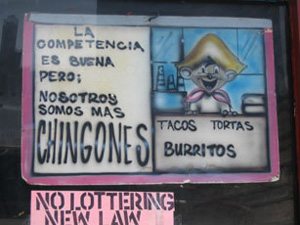
When I still lived in the neighborhood, I ate there several times a week. Of course, everything I needed in the neighborhood was within a two-block radius. The cleaners, the gas station, the locksmith, the used bookstore, my barber Aldo of Italy, and of course, El Gallo de Oro. I went to the locksmith exactly once, but it was nice to know that he was always available even though I dreaded the day that I would actually need him. Aldo of Italy cut my hair once a month before I ate at El Gallo de Oro. Aldo always loved speaking to me in Spanish while he cut my hair until I fell asleep. Anyway, again, I loved the attitude of the Mexican cooks at El Gallo de Oro. They were typical Mexicans who loved to brag about their food and service. I especially loved their sign in the window: “La competencia es buena, pero nosotros somos … ¡más chingones!” In English, “The competition is good, but we are … ” Okay, I’m not sure how to translate the last two words, but you could tell who was Mexican and who wasn’t by how they reacted to the sign. Of course, at that time the FCC let a lot of profanity get aired on all the Mexican radio stations. So the sign remained in the front window for many years until about two years ago. I rather miss that sign. That’s the thing about Mexicans. They have chutzpah!

One time, I told my father, brothers, and sister that I had a special surprise for them for our Thanksgiving dinner that year. They were so curious that I caved in to all their questions and told them my surprise beforehand. “We are eating Thanksgiving dinner at … ” and I paused for dramatic effect … “El Gallo de Oro!” “But we want turkey,” my sister shouted. “Yo quiero guajolote,” said my father. “Un momento,” I said. “El Gallo de Oro is serving turkey burritos on Thanksgiving Day!” After a little grumbling, they finally agreed to my Thanksgiving dinner plans! Everyone got to eat turkey, I got to eat at El Gallo de Oro, and my father got to eat so many jalapeño peppers that sweat poured from his forehead profusely and he had to keep asking for more and more water. Well, El Gallo de Oro managed to satisfy yet another finicky Mexican family–again!

DDR

Marquette Park Track Club


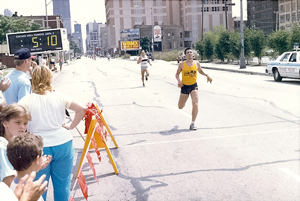
Proudly wearing the Marquette Park Track Club colors of black and gold!

When I returned to Chicago after three years in the Marine Corps, I moved back to Marquette Park. I lived at 3006 W. 64th Street for six years before I moved to Bridgeport. I loved living so close to the park because then I could go running every day. While in the Marines, I began running seriously after I ran a marathon in California. I thought that if I trained well enough, I could become a good runner. I joined the Marquette Park Track Club after running the Roy Bricker Memorial 5 Mile Race where I placed third in my age group. Roy Bricker was the best runner that the club ever produced. All thanks to Coach Jack Bolton whom all his runners adored. The club would meet every weeknight at 5:30 p.m. rain or shine, snow, or sleet. Jack never missed a practice.

Jack Bolton came from Ireland many years before, but he never lost his Irish brogue. We all loved it. Some of the runners imitated him lovingly. He was a world-class miler back in Ireland and when he came to the U.S. he coached high school teams in Chicago. He always had great runners running for him.

When I first joined the club in 1981, all the practices began with six laps (one mile) on the cinder track at Marquette Park. Jack would lead the pack, and everyone had to stay behind him. This was a group warmup. Jack’s philosophy for this warmup was twofold. 1. Runners learned to run in a pack and 2. Runners learned to run at someone else’s pace, as sometimes happens in a race. In later years, Jack’s ankles gave out on him, and he didn’t run the warmup with the club anymore.

Jack especially loved working with younger runners. He was known for the female runners that came out of his club system. In fact, some high school girls would join Jack’s club in order to develop as runners and qualify for running scholarships at the universities of their choice. Most girls achieved their goal. Of course, many boys also received running scholarships, too.

What everyone loved about Jack was his eternal optimism. He always believed that one of his runners would win the race outright, no matter how overwhelming the odds. I once entered a race and learned at the starting line that Jack had predicted that I would win. I wanted to live up to his expectations, but I had a difficult day and faded halfway through the race. But Jack was always touting some up-and-coming runners from his club. He was usually right, too.

Click here to read an article that I wrote about Jack Bolton for the CARA Finish Line the January/February edition of 1985:

http://davidrodriguez.us/docs/bolton.html 

DDR