Tony


Back of the Yards, Chicago, Illinois

I met Tony Jr.–his full name was Anthony Borkowski Jr.–when I worked at Derby Foods, 3327 W. 47th Place, home of Peter Pan Peanut Butter and Derby Tamales. His father, Anthony Borkowski Sr.–also called Tony–wanted his son to work while he attended school at DeVry. Tony Sr. thought his son was getting too lazy by just going to school and not working. Tony Jr. was already twenty-two, but still had not graduated from college. He was a student at the University of Illinois Circle Campus–before it became the University of Illinois at Chicago (UIC)–and belonged to a fraternity, so he partied a little too much for his father’s liking. So Tony Jr. transferred to DeVry and started working at Derby Foods.

Tony Jr. towered over me whenever we talked. He had dark blond hair and wore round wire-rimmed glasses. He looked flabby, but was actually rather muscular. He could do any job at Derby Foods, including unloading the 135-pound bags of raw peanuts from the railroad boxcars (something I could only do for more than a few days at a time because that job exhausted me). He was always on time for work because his father always woke him and they went to work together, even if Tony Jr. had been out partying all night. Tony Sr. would pull off the blankets and announce, “Time to go to work!” with his heavy Polish accent. If Tony Jr. still didn’t get up, his father would push him out of bed and shout, “If I have to go to work, you have to go to work!” Some mornings, Tony Jr. was a walking zombie.

Tony Sr. was a miniaturizad version of his son who never missed a day of work because he loved his job. He was quite a character in his own right, a man who was quite liked by everyone because he was friendly, had a good sense of humor, and could take a joke. Of course, people often tired of his standard greeting that always made him laugh, but no one else. In the morning, he would greet the women by saying, “Hey, good looking! What you got cooking?” No one ever responded to his question, so he would answer it himself with either, “Chicken! You wanna neck?” or “Bacon! You wanna strip?” The first time someone heard Tony Sr. say that, they laughed. Then after about the third time, they were just tired old jokes. After about the hundredth time, those lines became funny again when he used them on new employees. But everyone humored him because he was such a friendly guy.

On the other hand, he was disliked because he was a foreman and always wanted to earn his annual bonus by increasing productivity on the peanut butter production line. Number one on his agenda at work was that his peanut butter production line produce at least 100%. Sometimes, he would work harder than his workers rather than just stand there idly and merely supervise. He also was concerned about job security–so much so that he never told anyone how to start up the peanut butter processing machinery. He was so afraid that he would be replaced if someone else learned his trade secrets, so he would come in early Monday morning before anyone was at the factory to start everything up. He even did this while he was on vacation.

But back to Tony Jr. who was promoted from laborer to mechanic because he was intelligent, a DeVry student, and had great clout because his father was a foreman. He would have preferred to remain a laborer while he was in school, but his father insisted he get ahead at Derby Foods in case he wanted to make a career of it. Because of his father’s encouragement, Tony Jr. spent less time drinking and more time studying. It was about this time that Tony Jr. and I became fairly good friends at work. Sometimes we would go out to lunch together. The very first time we went, I had to laugh for two reasons. First, he said we should drive to the hot dog stand that was a block away, but he pointed out that we only had thirty minutes for lunch, so it was actually a very practical suggestion. Second, I laughed when I saw his car. He drove this tiny little Honda Accord. When I explained to him why I laughed, he told me that since he was so tall and husky, he had to shop around for car in which he would fit comfortably. The Accord offered him the most room. He was always very practical like that.

Once he was so deathly ill that he didn’t come in at 3:30 a.m. as he usually did. The shift started at 7:00 a.m. and there was no sign of Tony Sr. who had not called in sick. Since he had never missed a day of work, not even due to illness, everyone thought he had died. Even Tony Jr. was MIA. The assistant foreman drove to the Borkowski home and Tony Jr. answered the door. His father was so sick that he had overslept. Tony Sr. immediately got dressed and went to Derby Foods rather than reveal how to start up the machinery to his assistant foreman. The plant was then up and running, albeit a little later than usual.

And no one learned how to start up the machinery until about two months before Tony Sr. retired. Tony Sr. insisted that it would take a lifetime to learn what he would attempt to teach in a mere two months. In order to avoid another plant startup fiasco due to illness, the plant superintendent decided that Tony Sr. would train three people to learn the startup procedure. Tony Sr. then started bragging, “See how important I am at Derby Foods. It takes three people to replace me! Maybe I shouldn’t retire.” But everyone insisted that he retire.

One day, Tony Jr. asked me for help with a composition he was writing for his composition class. I was surprised he asked me because I was not known for my intelligence at Derby Foods. In fact, everyone thought of me as the kid who dropped out of high school in order to work in a factory. Anyway, I told Tony Jr., “Why do you want my help? I only have a GED! You’re a college student!” I really thought I had him there! But no! He said, “You’re a published writer!” Okay, he had me there. I had some local publications. Whenever I was at Derby Foods, I often forgot about my accomplishments. But the main reason he wanted my help was because he had once seen me reading a grammar book. I can read grammar books the way most kids read comic books. This really impressed him, so he asked me for help. Needless to say, he got an A on his composition!

DDR

Medieval road trip


Evanston, Illinois

One of the most memorable Spanish classes I ever took was a Medieval seminar on Spanish literature at UIC. There were only four students in the seminar. The professor, Reinaldo Ayerbe-Chaux, taught the course with great enthusiasm. So much so that I wanted to write my doctoral dissertation on some Medieval text. One of our writing assignments involved transcribing a Medieval text written on parchment into Spanish. I don’t know why, but I was truly fascinated by this project. The language of the parchment was archaic but comprehensible. The alphabet was moderately different from the modern Spanish alphabet. Some parts of the text taxed my brain for me to decipher the writing and then comprehend what was stated. Little did I realize that this was good training for me as a Spanish professor when I would have to decipher student compositions with illegible handwriting before I could interpret the student’s intended message. But, hey, I love puzzles!

Well, the highlight of our seminar came at the end when we went on our field trip to the University of Wisconsin, Madison. Their Spanish department had the largest collection of Medieval Spanish texts in the world. However, most of them were on microfilm. Professor Ayerbe-Chaux said we just had to go to the university and see the collection for ourselves. I offered to drive our class to Madison, Wisconsin, in my minivan, which he thought was a good idea. Of course, UIC paid for my gas.

Professor James Compton, who is now retired, also wanted to go with us since he had graduated from there. Maybe I’m just too easily amused, but I had a lot of fun on this trip. I enjoyed looking at all the Medieval texts even if they were only on microfilm. Professor John Nitti gave us copies of two of their publications, which I shall someday read. But the highlight of the trip for me was meeting the faculty. Professor Compton was happy to see his dissertation adviser Lloyd Kaston once again. He was now professor emeritus, but he still had an office in the Spanish department, and he still was actively transcribing Medieval texts. When we went to his office, he just happened to be napping. He was ninety-something years old, so he was entitled to nap whenever he wanted! Well, I got to see four generations of faculty in the same room!

I will always remember this seminar because Professor Ayerbe-Chaux gave the entire class, all of us, copies of a book by Don Juan Manuel that he had published. He had read the original texts by Don Juan Manuel and then transcribed them. He was even gracious enough to autograph the book for me!

DDR

Let’s all go to class


Morton College

That sounds like a very good idea, in theory anyway. The first day of the semester, I always give The Speech about how to excel in my Spanish class. Number One on the list is coming to class each and every day. Why? Well, class, you should come to class because attendance is 15% of your overall grade. I like seeing my students in class, and if you come to class, you might actually learn something. Most students do come to class just because it’s required. Others, however, think attendance should be optional and nothing I say will persuade them to come to class more frequently.

A few years back, a student enrolled in my class who took skipping class to a new level. He showed up the first day of class and then I didn’t see him again for two weeks. I couldn’t figure out why he would miss so many classes.

One day, as I was reading the university newspaper, I noticed a guest opinion piece in the editorial section titled, “Let’s all go to class,” in which the author stresses the importance of attending class. In fact, he keeps harping on it even though he missed a lot of classes the previous semester to sleep, play video games, and almost finish writing late papers for his English class.

In principle, I agreed with the idea that all students should attend class, but something about this piece made me suspicious. The author was named Patrick. So I immediately remembered him. That’s one thing you should know about me. I don’t often remember names unless your name is David, Catherine, Adam, Yolanda, Patrick, Poindexter, or Allouissius.

So I suddenly realized that the author Patrick was the student whom I had only seen on the first day of class and then never again. About two weeks later, he showed up to class again and I asked him if he was the author of the guest opinion. He blushed and admitted that he was, in fact, the author. I asked him if he had ever considered following his own advice. He looked at me as if it had never occured to him! I didn’t see him in class again for another two weeks. His attendance the rest of the semester was very sporadic and somehow he managed to pass the course!

DDR

R & G Are Dead


1044 W. Harrison Street, Chicago, Illinois

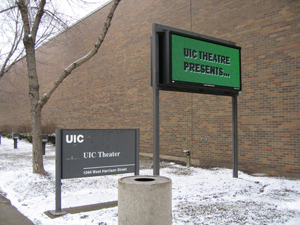
Today I went to the UIC Theater to see Tom Stoppard’s Rosencrantz and Guildenstern Are Dead. I really wasn’t sure what to expect because I had no idea what the play was about other than I knew that the title characters came from Shakespeare’s Hamlet.

Well, last week I saw Hamlet at the UIC Theater and I liked the production so much that I decided that I would see Stoppard’s play today. Okay, so I’ll never make a living writing reviews, but I thought today’s play started out rather slowly. There were some witty interchanges between Rosencrantz and Guildenstern, but sometimes it didn’t hold my interest. Well, I actually dozed off for a couple minutes in the beginning of the play.

I supposed it wouldn’t have been so bad if I weren’t sitting in the very front row in the middle right in front of the actors. So there I was front and center. When I woke up, Rosencrantz was staring at me. I felt so embarrassed! After that I tried not to fall asleep again. But I dozed off again–at least two more times. However, no actor noticed me this time.

So about the play, well, since it is a spinoff of Hamlet and it was also produced by the UIC theater department, I was happy to see the same actors reappear. Some of Hamlet’s scenes were repeated for Stoppard’s play. It was very interesting, even though I fell asleep a few times.

DDR

Learning Spanish


Morton College, Cicero, Illinois

I don’t know why, but I always wanted to learn Spanish. Although Spanish was my first language, I wanted to study Spanish formally in school. I wanted to read and write in Spanish, too, in addition to English. Both my father and mother spoke Spanish, but they grew up in different regions of Mexico so they each spoke a dialect that was different enough from each other, whichsometimes confused me. But I knew enough Spanish to communicate with just about anyone. When selecting my classes freshman year at Divine Heart Seminary, I picked Spanish I. The counselor looked at me suspiciously, which I didn’t understand why at the time. It never occurred to me that anyone would think I was trying to get an easy A. After the first Spanish class, Señor Mordini, the Spanish teacher, asked me why I was in Spanish I. I panicked, thinking that he wouldn’t let me take Spanish. I told him that I wanted to learn to read and write Spanish. He told me that I didn’t belong in that Spanish class. He was moving me ahead to Spanish II. I resisted. I told him that I wasn’t ready, but he insisted, and since I would still be in a Spanish class, I agreed. In my sophomore year, I enrolled for Spanish III and French I. No one understood why I wanted to study two foreign languages. I had always wanted to know many languages. I learned a lot of Spanish with Señor Mordini, more than enough to read and write in Spanish. Plus, I was learning French, too.

At Thanksgiving break of my sophomore year , my mother finally agreed to let me leave the seminary; I never wanted to attend the seminary in the first place. However, she didn’t let me enroll in a private Catholic high school as I had expected. I attended a Chicago public school in the Canaryville neighborhood called Tilden Technical High School. Since I transferred in the middle of the academic year and from a private school to a public one, the counselors had problems scheduling classes for me. I insisted that I wanted to take Spanish. The counselor told me, “But you know Spanish!” I said, “But I can’t read and write Spanish.” I persisted and the counselor finally put me in Spanish IV. I was very disappointed the first day of Spanish class because the Spanish teacher taught verb conjugations that most high school students learn in the first year. This class was really behind. After the first Spanish class, the Spanish teacher took me down to the counselor’s office and said that I knew too much Spanish to be in her class. She was afraid I would intimidate the rest of the students. I insisted that I wanted to take Spanish. I even offered to go into a higher level class, if necessary, but that was the highest-level Spanish class, even though they were so far behind. I really wanted to learn to read and write Spanish I told them. They insisted I already knew Spanish. “No, I don’t,” I said. “Why do I have to take English?” I asked. “I already know English.” “You don’t know English!” the counselor told me. “That’s the same reason I want to take Spanish. I don’t know Spanish,” I said. Well, I lost that argument, but the counselor couldn’t figure out how to fill the void left by the Spanish IV class that I wasn’t allowed to take. I said I wanted to take French. “But why?” the counselor asked in disbelief. “You don’t have to take a foreign language. This school doesn’t have a foreign language requirement!” “I want to take French,” I insisted. “I took French I this term at my last school.” Finally, the counselor looks for a French class. “You’ll have to take French III,” she said. “It’s the only French class that fits in your schedule.”

I was glad to at least have a chance to learn a foreign language. At first, I was afraid to say I wasn’t ready for French III, but then I remembered how far behind the Spanish IV class was. However, I wasn’t ready for what I was about to experience. The first day of class, I walk in and greet my classmates, “Bon jour!” My classmates stared at me with their mouths hanging open. It was as if I were speaking a foreign language to them. I soon discovered why. Our French teacher Mr. Hansen never actually spoke French in class. Ever! He didn’t actually teach anything, either. He was a rotund, middle-aged man with gray, balding hair who never had very much energy. He showed up to class on time wearing a suit and tie and sat at his desk at the front of the class while the class discussed everything going on in their personal lives. If Mr. Hansen found the conversation interesting, he would occasionally join in. The students didn’t mind since he wasn’t a very demanding teacher. I started at Tilden near the end of November and in December, the students were worried about their French III grade because the marking period was rapidly approaching. Mr. Hansen reassured us that we were all passing. Then, he made the big announcement. After Christmas vacation, the teachers were going on strike, so we wouldn’t have classes for about a month or two. After the strike, Mr. Hansen planned to have his annual heart attack and he wouldn’t return to school until after spring break. And he kept his word, too. The succession of substitute teachers taught us French just as competently as Mr. Hansen even though none of them had ever studied French! When Mr. Hansen returned to school in April, he said he would have to test us in order to give us our final French grade. The class panicked. No one wanted to study. Then Mr. Hansen announced that in order to get an A, you had to bring in your French-English dictionary to class. I just happened to have mine with me–I always brought it with me just in case we actually studied French in class by some unexpected miracle–and all the class glared at me in disgust. Well, I had my instant A, but the rest of the class was worried. This was French III and no one had ever bought a French-English dictionary! Silly me! I bought mine immediately after the first day of French I!

Then, my mother bought a house near Marquette Park and I had to transfer to Gage Park High School the next year. When scheduling my classes, I knew better than to ask to study a foreign language. So, I didn’t enroll for one. Sometime during the end of the year, the Spanish teacher, Señor Martinez from Ecuador, came to one of my classes and asked me to step into the hallway. He was recruiting Spanish-speaking students for a special Spanish class that he himself would teach the next year. I told him about what had happened to me at Tilden, and he reassured me that this class would be different. So, against my better judgment, I enrolled in his class. The next year, I was actually excited to go my Spanish class because I would finally learn to read and write Spanish fluently. On the first day of class, I see a lot of my friends who are native Spanish speakers. The classroom is filled with Mexicans, Puerto Ricans, Ecuadorians, Filipinos, and others. Then, Miss Brewer walks into the classroom and announces that she is our teacher! What? She wasn’t a native speaker of Spanish. The entire class was disappointed. What happened to Señor Martinez? Miss Brewer repeated that she was our Spanish teacher and that was the end of the discussion. That would have been fine except for the fact that most of the class spoke better Spanish than her. But she insisted that she knew Spanish because she had spent a month in Puerto Rico the previous summer. Spanish was our worst class for most of us that year. Apparently, no one in the class knew Spanish, according to Miss Brewer. Hardly anyone got an A for the class and a few native Spanish speakers actually failed!

When I finally arrived at UIC, I was hesitant to take Spanish, but I told myself, “It’s now or never!” I took a Spanish placement test, which is multiple choice. I scored very poorly because I would choose the answer according to what I remembered hearing in Spanish. Apparently, much of what I had heard was improper usage. Then, I had to take another placement exam in the Spanish department. I was told to write in Spanish about why I wanted to study Spanish. It had been years since I had written letters in Spanish to my Tía Jovita in México. I surprised myself when I wrote. Some things came back to me instinctively. I was placed in the first semester in a class for bilingual speakers. Finally, I would learn to read and write Spanish!

DDR