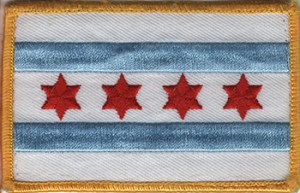
Chicago flag


My uniform patch of the Chicago flag

Everyone recognizes the Chicago flag, but not all Chicagoans know what our beautiful Chicago flag represents. Once I was eating lunch with my friend Mike when some tourists from France saw the patch of the Chicago flag on our uniforms. They wanted to know what the symbols on the flag meant. I’m embarrassed to admit that I didn’t know what the three white stripes represented back then. Mike explained all the symbols to the French tourists, much to their satisfaction. They were genuinely impressed that they had finally met a Chicagoan who knew what the Chicago flag represented. The French tourists left the restaurant, and Mike and I continued eating lunch. When we asked for the check, the waitress told us that the French tourists had paid for our meal. Talk about the value of a little knowledge!

So, the three white stripes represent the three sides of Chicago: south side, north side, and west side. Notably, there is no east side of Chicago. That’s Lake Michigan! The two blue stripes represent the two bodies that help define Chicago: the Chicago River and Lake Michigan. However, I have also heard that the two blue stripes represent the two branches of the Chicago River. Don’t you just hate it when there are two competing explanations? Each red star represents an important historical event in Chicago history: the 1812 Fort Dearborn Massacre, the 1871 Chicago Fire, the 1893 World’s Fair, and the 1933 World’s Fair.

In our era of politically correctness, the Fort Dearborn Massacre has been renamed The Battle of Fort Dearborn. It’s only a matter of time before this “encounter” gets softened even more. What’s next? The Fort Dearborn Cultural Exchange?

Now that you know the meaning of the Chicago flag, help share your knowledge of the city of Chicago and the Chicago flag to any tourist–whether from a foreign country or another state of the USA–who visits.


DDR

Language jokes


Dr. D. laughing in Spanish.

As you may have noticed, I like jokes. Here’s a riddle. What do you call a person who speaks two languages? Bilingual. What do you call a person who speaks three languages? Trilingual. What do you call a person who speaks one language? American.

A Swiss man, looking for directions, pulls up at a bus stop where two American tourists are waiting.
Entschuldigung, koennen sie deutsch sprechen?” he asks. The two Americans just stare at him.
Excusez-moi, parlez vous francais?” he tries.
The two men continue to stare.
Parlare italiano?” No response.
Hablan ustedes español?” Still nothing.
The Swiss man drives off, extremely disgusted. The first American turns to the second and says, “Y’know, maybe we should learn a foreign language.”
“Why?” says the other. “That guy knew four languages, and it didn’t do him any good.”

A man tells his friend, “I’m going to learn German.” His friend says that German is a hard language to learn. The man replies, “How hard can it be? I’ve heard three-year-olds speaking it.

“I’m glad I wasn’t born in France.” “Why’s that?” “I don’t speak French!”

A man gave his wife a parrot. The next day, they’re eating dinner and the man notices that the parrot isn’t in its cage. He asks, “Where’s the parrot.” The wife says, “We’re having it for dinner.” “What? That parrot spoke three languages!” “Well, why didn’t it say something?”

A student fell asleep during an English professor’s lecture on pronouns. Upset, the professor wakes up the student by asking him to name two pronouns. The student replies, “Who? Me?” “Very good,” says the professor.

This linguistics professor was lecturing the class. “In English,” he explained, “a double negative forms a positive. In some languages, such as Spanish, a double negative is still a negative.” “However,” the professor continued, “there is no language wherein a double positive can form a negative.” Immediately, a voice from the back of the room piped up: “Yeah … right …”

DDR