Accents


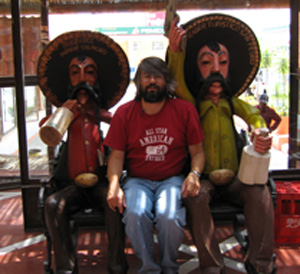
On the road in México

Accents are a funny thing. An accent separates or distinguishes you from another person or group when you speak. For as long as I can remember, I have always had an accent. In kindergarten, I spoke broken English since I only spoke Spanish at home. So, I had a Mexican accent. But when I went to Mexico, I had a gringo accent when I spoke Spanish. Then, I met my friend Patrick McDonnell in the second grade, and I spoke with a little bit of an Irish brogue. Since I attended a Lithuanian Catholic grade school, I picked up a few Lithuanian words. In high school, classmates made fun of the way I talked, so I only talked when necessary. I remember reading books aloud to practice my pronunciation. I was trying to eliminate any trace of an accent. Unsuccessfully, I might add.

When I enlisted in the Marines, I met people from all over the United States for the first time in my life. It was the first time someone told me that I had a Chicago accent. I was surprised when I met someone new, and he said he knew I was from Chicago because I had no accent. My accent adapted unconsciously so it would fit in. And I did fit in. During my enlistment, I spoke with the accents of Brooklyn, Texas, Queens, Boston, Virginia, Oklahoma, and California. But I didn’t do this on purpose. I just somehow blended in with everyone around me.

When I began teaching Spanish, I also unconsciously adapted the accent of the people around me. So, depending on to whom I spoke, I would speak like them. I’m not sure what my authentic original voice sounds like anymore. A colleague once said, “I was trying to figure out what dialect you were. Now I know you’re Mexican because you said, “Mande.”

I suppose if I listen to myself carefully, I hear all these different accents in my voice from different places.

DDR

Rocio and me


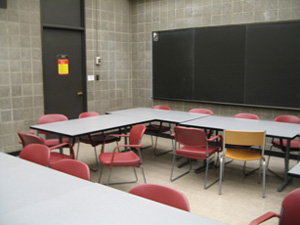
One of the many classrooms in which I taught.

Over the years, I’ve had some interesting students in my Spanish classes. The one I remember most vividly was a Mexicana named Rocío. I met her when I taught Spanish at Daley College. She dyed her hair this obviously fake black color, even though you could tell her hair was naturally black. She wore black lipstick and painted her fingernails black. She had multiple piercings on her ears, lips, nose, and who knows where else. She always wore black clothing except for her t-shirt. I gathered that t-shirts were very important to her. Perhaps even sacred. You see, she always wore a Marilyn Manson t-shirt. Did I say “a,” as in only one, t-shirt? The semester was fifteen weeks long and we met twice a week. We met for class thirty times that semester and she never wore the same Marilyn Manson t-shirt twice! I always try to keep an open mind when I meet new people, but when I saw her in class, I had the feeling she would be at least a little rebellious. Whenever I called on her, she always gave the correct answer, and she usually scored the highest exam grades in the class. And this may sound strange, but we had a mutual respect for each other. For the oral presentation, she prepared the best presentation of the class. She also taught me a few things that I didn’t know about Frida Kahlo. And about being open-minded toward everyone regardless of our initial perception of them.

DDR

Teaching college Spanish


Morton College, Cicero, Illinois

Well, after thinking about the first entry for the College Spanish category for a long time, I guess I should tell you a little about myself. I have been teaching college Spanish since 1995 and I still haven’t decided if I would like to do this for a living. Don’t get me wrong. I genuinely enjoy teaching Spanish. In fact, I have taught at Morton College in Cicero, Illinois, Richard J. Daley College in Chicago, Illinois, Columbia College Chicago, and now, at the University of Illinois at Chicago (UIC). I could have taught at many other institutions, but they usually offered me Spanish classes to teach well after I already had a full-teaching schedule.

I enjoy interacting with the students and I chose to teach college-level Spanish because I would rather deal with adults who take responsibility for their own actions. What I enjoy most about teaching college students is that I often find myself learning just as much, if not more, as the students. Some Spanish grammar was never clear to me until I had to explain it to a class of baffled students who had so many questions about the grammar lesson before us. Once I figure out a way to explain a grammar point, it becomes clearer to me. Occasionally, not all students will understand my explanation, but at least one student in class who did will explain in his or her own words to the other students, usually quite successfully. Well, in some roundabout way I managed to teach the lesson, and I, too, learned something about Spanish and teaching.

DDR

¡Hola!


From Yahoo! News

¡Hola! I love teaching college Spanish! I have taught at several colleges in the Chicago area. I would like to help college students who need help learning Spanish–whether it’s to speak Spanish fluently or to merely pass the foreign language requirement. Hopefully, my teaching will also serve as a cultural exchange where students learn about some Hispanic issues and learn to differentiate them from the negative stereotypes.

However, current events have also stirred my emotions lately, so I will also comment on such cultural issues as the immigration debate, language differences, and xenophobia in the U.S., among other issues. Recent controversies have caused me to recall many incidents from my own life in the U.S. as the son of Mexican immigrants who came to the United States legally. I will explain all that later. As always, I have mixed feelings about immigration and occasionally suffer from identity crisis. I often wonder how Mexican I am. Or for that matter, how American I am.

I was at the immigration marches in Chicago while I was working as a police officer. And, yes, I did have mixed feelings during those marches. On March 10 and May 1, 2006, there were more Mexicans in Chicago than in Cancún. México has come to America! I don’t think most people were prepared to admit that there were that many Mexicans in the Midwest.

DDR