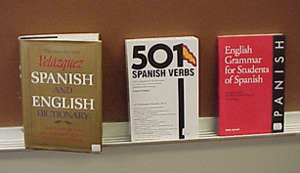
Spanish textbooks


Spanish books

Sometimes Spanish textbooks inadvertently include words that invoke negative connotations or just plain poor choices.

For example, I’ve seen some books include “tonto” in the glossary as meaning, “silly” or “foolish.” Yes, it does mean that, but in general, no Spanish-speaker uses that word unless they really want to insult someone. “Tonto” is practically a swear word in almost every context.

I always warn students not to use this word, and if they do, they should be prepared to be punched. I saw one book explain the diminutive of words like “casa” changing to “casita,” and “hijo” changing to “hijito.” That’s all well and good, but then the textbook gave the example of “mamá” changing to “mamacita.” In real life, no Spanish speaker would call their mother “mamacita.” The only time you really hear “mamacita” is when the vato on the corner is flirting with a girl walking by and he says, “¡Oye, mamacita! ¡Qué chula estás!

Another book bothered me with its choice of negative examples. I prefer something that offers positive reinforcement, but, no, this textbook in explaining comparisons of inequality stated, “Estos estudiantes son más estúpidos que esos estudiantes.” What kind of thing is that to say in a classroom? “These students are stupider that than those students.”

I used one textbook with all these ambiguous illustrations that didn’t really clarify the lesson at all. In one of the drawings for the lesson on reflexive and reciprocal sentences, one cowboy is removing the boot off the foot of another cowboy! Every class of mine that looked at the drawing always laughed when we did the exercise. I would just tell them it was a scene taken from Brokeback Mountain.

DDR

Olivia Maciel


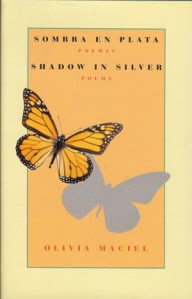
Sombra en plata por Olivia Maciel

Olivia Maciel is a poet who was born in Mexico City, but has lived in Chicago a long time. She has written several collections of poetry over the years. She writes poetry in Spanish, but her books include an English translation on the facing page. I recently read two of her collections: Sombra en plata [Shadow in Silver], Chicago, Swan Isle Press, 2005, and Luna de cal [Limestone Moon], Chicago, Black Swan Press, 2000. All her books are available for purchase on Amazon.com.

I first met Olivia in one of my graduate classes at UIC. We took several classes together while earning our master’s degrees. She graduated from the University of Chicago with a Ph.D. When Octavio Paz died, she published an article about her reactions to his death that appeared in the Chicago Tribune. We occasionally bump into each other at UIC because we are both Spanish lecturers there. I really enjoy talking to her because she’s so creative. Sometimes, she begins writing poems as we speak. She says that I inspire her when we talk. I asked her if she would hire me as her muse.

DDR

What should we call you?


Morton College, Cicero, Illinois.

My Spanish classes are always nervous about how they, the students, should address me. When I first started teaching at Morton College in 1995, I always told my students to call me David in Spanish, as opposed to David in English. Whenever someone called me Profesor in Spanish, or worse yet, Señor Rodríguez or just plain Señor, I corrected them and insist that everyone call me David in Spanish. But no matter how many times I corrected students, not everyone called me David.

Last year, I stopped telling students what to call me. Now, I respond to whatever name they call me. If they call me Señor or Señor Rodríguez, I know that they recently studied Spanish in high school. So within any one class period, I may be called David (in English or Spanish), Diego, David Diego, Profesor Rodríguez, Señor Rodríguez, or just plain Señor. Señor in Spanish means “mister” or “Lord”, which reminds me of when I was little and I prayed, “Señor nuestro, que está en los cielos …”

I really don’t want my students to treat me like God. I don’t handle power and authority very well. Señor also used to bother me because it made me feel so much older to be called Señor Rodríguez, but now I kind of like it. 🙂 Perhaps, I’m finally mellowing out.

I did have one Spanish class that always called me Dr. D. and I kind of liked that. The students really enjoyed calling me Dr. D., too, because it made me sound cool. Every single time any student spoke in class, he or she would insist on calling me, “Dr. D.” before speaking. After a while, I would walk into the classroom and say, “Dr. D. is in da house!” And they loved it!

DDR

Again I traduce


On the southwest side of Chicago

I was curious as to who was actually reading my Blog. So, I did some snooping around, I mean some investigating. For some unknown reason, I keep getting hits from Russia. I can’t quite figure it out. My most viewed Blog entry is the one about Enrico Mordini, my Spanish teacher at Divine Heart Seminary. I guess I should go back and actually finish writing it and editing it since so many people are reading it. Now I feel embarrassed that I didn’t fix it up sooner. Another thing that really surprised me was the fact that people in Spanish-speaking countries are also finding my blog. I was wondering how they would read it since I mostly write in English. I went to the referring page and found that an automated translator could actually translate my blog into Spanish with a link on the search engine page. Wow! I mean, ¡Ay, ay, ay! The webpage is automatically translated into Spanish, but in very poorly-written Spanish at that. Upon reading the translation, I realized that people in Spanish-speaking countries will think that I don’t know Spanish!

Let me give you a sample of some of these translations. Well, it actually starts out quite well. The title at the top of my blog is David Diego Rodriguez, Ph.D. without an accent mark on the “i” of Rodriguez because otherwise all these strange characters appear and distort my last name thanks to the mysteries of computers and the Internet. However, the translator actually put the accent mark where it belongs! The rest of the translations are rather sad. For example, under my name I write, “¡Hola! ¡Yo hablo español e inglés!” For some strange reason that phrase is translated as, “¡Yo hablo español electrónico español!”, which somehow fails to convey my original message. I suppose if someone really wants to read my blog, they will gladly plod their way through this computer-generated translation.

When my Spanish students write compositions, I ask them to do the best they can. I ask them to write the composition in Spanish right from the start. I know that the student will make plenty of mistakes, but that’s part of the learning process. Sometimes the original text is upstaged by all my corrections in red ink. That’s fine by me if they make a valiant effort to write in Spanish. However, I do not want a student to write the composition in English and then translate it into Spanish. That’s double the work! And of course, I can always tell when they write it in English and then use an internet or computer translator. Well, the output hardly resembles proper Spanish. In fact, in many cases, I cannot even decode what the student wanted to say in the first place. All the words are in Spanish, but the composition is incomprehensible! I always ask the student to rewrite such a composition, “but in Spanish this time.” About the only word that doesn’t lose anything in translation is the English word “no” that also happens to translate to “no” in Spanish. Even an automated translator gets this translation right!

DDR

Robin


Great America, Gurnee, Illinois

I have had a few memorable Spanish students since I began teaching, but some are more unforgettable than others. Some I vaguely remember. For example, one female student, I don’t even remember her name. Or anything else about her. I only remember that she was petite, had black hair, caramel-colored skin, and she always sat in the front row, right in front of me. Well, I actually remember two things about her that were quite memorable. Once after class, she told me that the Spanish word for Muslim, “musulmán,” was the same as in her language. However, I don’t even remember what language she told me she spoke. But I remember our conversation quite vividly.

The other incident that I remember occurred on Halloween. I usually bring chocolate for my students on Valentine’s Day and candy on Halloween. I started passing out candy when I noticed that UIC students sometimes wore costumes for Halloween. I enjoy giving them candy. I’m not sure why, but I do.

Anyway, on Halloween, I passed out candy at the beginning of class and put the rest on my desk in case the students wanted more. Everyone was on time, except for the student I’ve been describing. She came about ten minutes late and was about to sit down at her desk right in front of me. Suddenly, she noticed the candy on my desk and stopped to take some–without even asking! She didn’t even greet me, and she was taking my candy! “Buenos días,” I told her. But she still didn’t greet me.

Her back was to the class, so I noticed that she was wearing the red and yellow uniform shirt with a big “R” for Robin, Batman’s crime-fighting partner. Finally, I said, “It’s okay for you to take some candy since you came in costume.” She gave a puzzled look.  “It’s Halloween and you’re wearing a costume,” I said. “This isn’t a costume. I just like wearing this shirt,” she said. Well, the class and I laughed at this. She just stared at me blankly and sat down. And sure enough, she wore her Robin shirt several more times during the rest of the semester.

DDR