Estudiantes


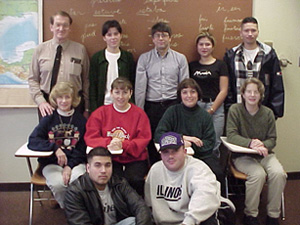
Morton College Spanish Class

The other day, one of my Spanish students asked me if he could be my friend on Facebook.com. Of course, I said yes. And we are now friends on Facebook. I’ve always gotten along with my Spanish students. That’s because I love my students. But not in the sexual harassment civil lawsuit kind of love. I’ve been teaching college Spanish for about twelve years now, so I remember a lot of students from over the years. Some students kept in touch with me for a while after taking my class and then eventually disappeared from my life. Other students occasionally run into me by chance. Some I will never forget.
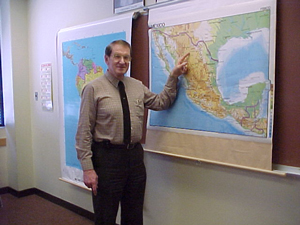
Elwood Chipchase, Morton College, Cicero, Illinois

I remember Elwood Chipchase and his wife Grace took Spanish 101 and 102 with me at Morton College. He was a minister in Cicero, Illinois, and his congregation was mostly Mexican. He was seriously studying Spanish so could better communicate with his parishioners. Both he and his wife were the students most dedicated to learning Spanish. At first, he didn’t tell me that he was a minister or why he was learning Spanish. One day, he asked me why when he asked Mexicans about their mother, they kind of paused before answering. Sometimes they gave him a pained look, as if they were offended. I asked Elwood how he asked them. He would greet them, ask them how they were, and how their spouse was in Spanish. Then he would ask about their mother, “¿Y tu madre?” I thought about it a while. Why would they hesitate to respond? Elwood’s Spanish was clear enough to understand. Then it dawned on me. But I felt uncomfortable explaining my theory to him since he was a minister. The problem is that all Mexicans refer to their mother as mamá or mami. The only time they use madre is when they swear at someone, as in, “Chinga tu madre.” Well, he was grateful for my explanation and said he would change his choice of words. The next week he reported that everyone responded more warmly to his inquiries.

DDR

What should we call you?


Morton College, Cicero, Illinois.

My Spanish classes are always nervous about how they, the students, should address me. When I first started teaching at Morton College in 1995, I always told my students to call me David in Spanish, as opposed to David in English. Whenever someone called me Profesor in Spanish, or worse yet, Señor Rodríguez or just plain Señor, I corrected them and insist that everyone call me David in Spanish. But no matter how many times I corrected students, not everyone called me David.

Last year, I stopped telling students what to call me. Now, I respond to whatever name they call me. If they call me Señor or Señor Rodríguez, I know that they recently studied Spanish in high school. So within any one class period, I may be called David (in English or Spanish), Diego, David Diego, Profesor Rodríguez, Señor Rodríguez, or just plain Señor. Señor in Spanish means “mister” or “Lord”, which reminds me of when I was little and I prayed, “Señor nuestro, que está en los cielos …”

I really don’t want my students to treat me like God. I don’t handle power and authority very well. Señor also used to bother me because it made me feel so much older to be called Señor Rodríguez, but now I kind of like it. 🙂 Perhaps, I’m finally mellowing out.

I did have one Spanish class that always called me Dr. D. and I kind of liked that. The students really enjoyed calling me Dr. D., too, because it made me sound cool. Every single time any student spoke in class, he or she would insist on calling me, “Dr. D.” before speaking. After a while, I would walk into the classroom and say, “Dr. D. is in da house!” And they loved it!

DDR

Again I traduce


On the southwest side of Chicago

I was curious as to who was actually reading my Blog. So, I did some snooping around, I mean some investigating. For some unknown reason, I keep getting hits from Russia. I can’t quite figure it out. My most viewed Blog entry is the one about Enrico Mordini, my Spanish teacher at Divine Heart Seminary. I guess I should go back and actually finish writing it and editing it since so many people are reading it. Now I feel embarrassed that I didn’t fix it up sooner. Another thing that really surprised me was the fact that people in Spanish-speaking countries are also finding my blog. I was wondering how they would read it since I mostly write in English. I went to the referring page and found that an automated translator could actually translate my blog into Spanish with a link on the search engine page. Wow! I mean, ¡Ay, ay, ay! The webpage is automatically translated into Spanish, but in very poorly-written Spanish at that. Upon reading the translation, I realized that people in Spanish-speaking countries will think that I don’t know Spanish!

Let me give you a sample of some of these translations. Well, it actually starts out quite well. The title at the top of my blog is David Diego Rodriguez, Ph.D. without an accent mark on the “i” of Rodriguez because otherwise all these strange characters appear and distort my last name thanks to the mysteries of computers and the Internet. However, the translator actually put the accent mark where it belongs! The rest of the translations are rather sad. For example, under my name I write, “¡Hola! ¡Yo hablo español e inglés!” For some strange reason that phrase is translated as, “¡Yo hablo español electrónico español!”, which somehow fails to convey my original message. I suppose if someone really wants to read my blog, they will gladly plod their way through this computer-generated translation.

When my Spanish students write compositions, I ask them to do the best they can. I ask them to write the composition in Spanish right from the start. I know that the student will make plenty of mistakes, but that’s part of the learning process. Sometimes the original text is upstaged by all my corrections in red ink. That’s fine by me if they make a valiant effort to write in Spanish. However, I do not want a student to write the composition in English and then translate it into Spanish. That’s double the work! And of course, I can always tell when they write it in English and then use an internet or computer translator. Well, the output hardly resembles proper Spanish. In fact, in many cases, I cannot even decode what the student wanted to say in the first place. All the words are in Spanish, but the composition is incomprehensible! I always ask the student to rewrite such a composition, “but in Spanish this time.” About the only word that doesn’t lose anything in translation is the English word “no” that also happens to translate to “no” in Spanish. Even an automated translator gets this translation right!

DDR

¡Hola!


From Yahoo! News

¡Hola! I love teaching college Spanish! I have taught at several colleges in the Chicago area. I would like to help college students who need help learning Spanish–whether it’s to speak Spanish fluently or to merely pass the foreign language requirement. Hopefully, my teaching will also serve as a cultural exchange where students learn about some Hispanic issues and learn to differentiate them from the negative stereotypes.

However, current events have also stirred my emotions lately, so I will also comment on such cultural issues as the immigration debate, language differences, and xenophobia in the U.S., among other issues. Recent controversies have caused me to recall many incidents from my own life in the U.S. as the son of Mexican immigrants who came to the United States legally. I will explain all that later. As always, I have mixed feelings about immigration and occasionally suffer from identity crisis. I often wonder how Mexican I am. Or for that matter, how American I am.

I was at the immigration marches in Chicago while I was working as a police officer. And, yes, I did have mixed feelings during those marches. On March 10 and May 1, 2006, there were more Mexicans in Chicago than in Cancún. México has come to America! I don’t think most people were prepared to admit that there were that many Mexicans in the Midwest.

DDR