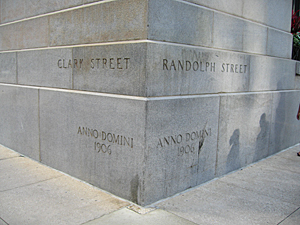
Traffic crash scene at the corner of Clark and Randolph.
Oftentimes, I will meet one of my present or former Spanish students unexpectedly. I’m always happy to see them again, but I usually meet them long after I’ve forgotten their names.
Once I was at the McDonald’s Playland near Midway Airport with my twin sons when they were about four years old and one of my former students greeted me with a loud and friendly, ¡Hola! I was happy to see her again, but this time she was with her young son and she was happy with her life.
Once while I was on duty as a police officer working in a patrol car, I was assigned to park my squad car with the blue lights flashing so other cars wouldn’t crash into a car that had crashed into the Cook County / City Hall building downtown. This must have been a slow news day because all kinds of cameramen came by to film the car that had crashed into the building while I just sat there in my squad car watching everyone come and go.
Then, I noticed that one cameraman was looking at me as he walked past. I couldn’t help but notice him, too. Then, we both recognized each other! He was in my Spanish class at UIC! He also recognized me. We kind of looked at each other with a look that could only mean, “This is what you do for a living?” I never imagined him as a cameraman. And he definitely never imagined me as a police officer.
Another time I was downtown where an employee of Dunkin Donuts was a theft victim. As I walked into Dunkin Donuts, one of my students saw me. We greeted each other and that was about it. However, I realized afterwards that he saw me in full police uniform walking into a Dunkin Donuts. How cliche! I was actually responding to a radio assignment, but I appeared to be acting like a typical cliché police officer going for coffee and donuts.
Last Saturday, as I was leaving the Burger King in Mount Greenwood with my twins, I saw a former Spanish student in the parking lot. We said hello to each other and then I noticed that he was with Mark Pera who is running for Congress so they gave me a flyer and asked me to vote for him. I responded that I would think about it. When I got home, just by chance, Mark Pera’s campaign office called me and asked me to vote for him. I told the caller that I had just seen him, but she didn’t believe me.
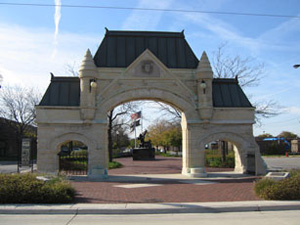
After we moved from Pilsen, our family moved to Back of the Yards where my tío Simón and tía Maricela lived. They lived at 4546 S. Marshfield and we moved to 4545 S. Hermitage. Back of the Yards was named thusly because it was literally located behind the International Union Stockyards if you headed southwest from downtown.
They were made famous, or infamous depending on your point of view, in Upton Sinclair’s novel The Jungle. In grade school, the Lithuanian nuns always mentioned the novel proudly because the protagonist was Lithuanian. They always talked about the man who drowned in the unpaved street and when I finally read the novel I convinced myself that I had deduced exactly where he drowned. The Stockyards where ever-present in our consciousness because many of our parents worked there in one of the meat-packing plants, we had to drive past them to go downtown or to the lakefront, or mainly, because of the pungent odors produced by a fertilizer company ironically named Darling and Co. The stench produced in the fertilizer-making process was inevitable if the wind blew in the direction of our neighborhood–even if we were indoors. My friend Patrick McDonnell used to take me there to play because it was the ideal playground for boys with over-active imaginations. But we had to look out for security guards, Patrick told me, and run if we saw them in order to avoid getting shot by their pepper guns. Luckily, we never saw any. One day Patrick told me where there was a swimming hole and we went swimming there. It was dirty, smelly water, but Patrick talked me into jumping in. The next day when I told one of our neighbors where I had gone swimming, he laughed uproariously. He finally told me we swam in the pool that they used to wash the pigs before they were slaughtered! Well, we never swam there again.
Our neighborhood was typical of any Chicago neighborhood in that there was a surplus of neighborhood bars. There was at least one bar on every corner. But there were some corners that actually had two or three bars. And usually there was at least one or two bars in the middle of the block. The whole theory behind having so many bars was that if the man of house went out to tipple a few beers, everyone would know where to find him. Every payday, I had to make the rounds of the bars within a two-block radius to find my father before he spent too much of his salary before he got home. Later, I got the brilliant idea of taking my shoeshine box with me when I looked for my father in the bars. I would first go to the bars where I absolutely knew my father would not be and ask for him. Some of bar patrons whom I thought were surely upright citizens would see my shoeshine box and then ask me for a shoeshine. I made some pretty good spending money this way. One day, my father didn’t recognize me because I didn’t get to him in time and he paid me for a shoeshine. And he gave me a generous tip, which I dutifully gave to my mother when we returned home.
The neighborhood served as a port of entry for many ethnic groups. When we moved there in the 1960s, the Mexicans were just starting to move in, but there were plenty of us to go around. I had friends who were Lithuanian, Polish, German, Irish, Italian, and of course, Mexican. I remember going to many a friend’s house and not hearing any of their parents speaking very much English. In my neighborhood, there were three parishes within four blocks of my house. I attended Holy Cross Church because they also had a grade school. There was also Sacred Heart of Joseph that was the Polish parish also with its own school. Immaculate Heart of Mary was the Mexican parish, but they didn’t have their own school, which is why we attended Holy Cross. The main reason I attended Holy Cross School was because it was the closest Catholic school in the neighborhood. In fact, we lived right across the street from the school.
I remember my first day at Kindergarten. My tía Maricela and her daughters Lourdes and Jane came for my mother and me and we all walked to school together. After school, I went out to the schoolyard with my cousin Jane who was in my class. We saw her mother, but my mother wasn’t there for me and I started crying. How would I get home, I wondered, even though I only lived across the street. My tía Maricela told me not to cry. My mother showed up a few minutes later. She said that she had forgotten all about picking me up and I started crying again. The next morning, my mother woke me up to go to school. I was surprised. I said, “I have to go again?” I didn’t realize that Kindergarten would get so involved. But I agreed to go only if my mother remembered to pick me up this time.
Back then, no one sent their children to a Chicago public school if they could afford to send them to a private school. Holy Cross had Lithuanian nuns and they were very strict, but it was an education that lasted me a lifetime. I remember we had to go to mass everyday before we went to school. Back then the masses were still in Latin, but I liked the old masses better. Of course, I rarely go to mass now, but I haven’t forgotten what it is to be Catholic. I still feel guilty if I even think of committing a sin. Anyway, some of the Holy Cross students, namely the Mexicans, began attending mass at Immaculate Heart of Mary because the priest said the mass in Spanish. Well, this didn’t go over well with our Lithuanian nuns. They insisted that we attend mass at Holy Cross and started taking attendance at mass by keeping track of the envelopes that we gave during the offering at mass. We had to sit with our class at the 9:00 a.m. mass. Attendance was mandatory! Unless we could bring documentation that we were hospitalized or that something more serious had occurred to us. Because of this new rule, I often went to mass twice on Sundays. My mother would send me off to mass at Holy Cross and when I returned home, we would all pile into the car, go to Immaculate Heart for the Spanish mass, and then do our Sunday visits.
Our neighborhood was very territorial. Everyone knew where everyone belonged. Territorial transgressions where sometimes retaliated with physical violence. I remember once during our school lunch, my brother and I went to the candy store that was more or less between Holy Cross School and Sacred Heart School. My brother left the store before me. When I went out, I noticed my brother was crying. It so happened that two students from Sacred Heart had beat him up. As the older brother, it was my moral obligation to defend my little brother. So I chased the two kids and I started punching them and telling them never to hit my brother again. Just then, a nun from Sacred Heart grabs me by the collar because I’m a stranger in a strange land. They take my brother and me to their principal’s office. One phone call to my school and my brother and I are in really big trouble so I try to be polite to the nuns. Luckily, I didn’t accidentally punch the nun who grabbed me. All we got was a lecture! But not a very good one. The principal, also a nun, said my brother and I reminded her of Cain and Abel. I couldn’t help it, but I absolutely had to correct her. I told her, “Cain killed his brother. I was defending my brother!” The principal told me not to talk back and she released us.
Mexicanismos are words or phrases in Spanish that are unique to México, but may not be familiar to other Spanish speakers, also known as Hispanophones. French speakers are Francophones and English speakers are Anglo-Saxophones.
Anyway, in Mexico, people use words and phrases that are unique to that region and are commonly misunderstood by other Hispanophones. At UIC (University of Illinois at Chicago), we have graduate students who come from all over the Spanish-speaking world, most of whom specialize in linguistics. They can spot the dialect and region of most Spanish speakers almost immediately. Some have trouble identifying me because I have my American accent and I use words and phrases from almost every dialect that I’ve ever heard. I’m like a sponge in this regard. Sometimes, someone will throw their hands up in the air and just ask me where I’m from. They’re often surprised to hear that my parents were from México. My cousin’s husband thought I spoke with an Argentine accent. Once, a friend and I were speaking, and then I didn’t hear something she said. So, I said, “¿Mande?” and she said, “¡Ajá! You’re from Mexico!” That simple little mande gave me away as a Mexican.
Once, at the end of the semester, a professor from Argentina told us that she would bring us a torta for the last day of class. To most Mexicans and me, a torta is a type of sandwich that is served on a bun with meat and other condiments. I didn’t eat before class because I wanted to be polite and eat everything that was offered to me. Well, she came to class with a torta, but it was a cake, as in a pastry for dessert. I left the classroom hungry that day.
Another time, I brought some Thanksgiving leftovers to UIC for lunch. A graduate student from the Basque Country in Spain asked me what I was eating. I told her guajolote and camotes. She didn’t know what I was talking about. For her turkey was pavo not guajolote and yams or sweet potatoes were patatas not camotes because they didn’t differentiate between the various kinds of potatoes in Spain.
I have a friend who grew up in Seville, Spain, and we once had a minor misunderstanding. He told me that his car had broken down: “Se me estropeó el coche.” Being the nice guy that I am, I wanted to be helpful, so I offered him a ride: “¿Quieres un aventón?” I could tell by the tone of his voice that he was a little upset when he replied, “¿Y yo qué te hice?” You see, to a Mexican, un aventón is a ride, but to just about any other Spanish speaker un aventón implies some kind of physical violence. I explained to him that I only wanted to help him by giving him a ride to wherever he wanted to go, and I am happy to say that we are still friends to this day.
Another graduate student from Spain taught a class that had many Mexican American students. She frequently used the word coger, meaning “to get” or “to pick up” when she spoke not realizing that to Mexicans coger is a profanity that refers to the act of sexual intercourse that begins with the letter “f.” So, one day, she talked about picking up her dog: “Cogí mi perro.” She was surprised when the class began to laugh until someone explained to her what she had said.
While I was in México, I learned a few more mexicanismos. My cousin used the diminutive “-is” instead of “-ito, -ita.” For example, she went to see her “amiguis” instead of her “amiguitas.” Before we went to visit my cousin David Rodríguez in Celaya, everyone refered to him as Davis.
In the U.S. we have Spanglish, which is the mixture of English and Spanish, but I only thought it existed north of the Rio Grande (In Mexico, they call it El Río Bravo). For example, you take an English word like “to check” and make it Spanish: chequear, instead of comprobar or some other Spanish word that already exists. Anyway, they have a similar word in Mexico: checar. Several street venders approached me and called me jefe, showed some product they were selling, and said, “Checa esto.” Or “Check this out,” in English. So, this word is a little different than the Spanglish word chequear because it’s a mexicanismo. Or maybe it should be called inglañolismo.
I always thought of an aquarium as un acuario, but to my cousin in Celaya it was el pecero. I had never heard the word before, but I knew exactly what he meant. Then when I was in Mexico City, when people talked about taking the bus they still called it el camión, but now a lot of people also called it el pecero. That made perfect sense because if you look at the buses with their large windows, they do look like aquariums with people swimming inside instead of fish.
If you park your car in México City, you’re likely to meet el viene viene. He is a self-appointed parker of cars and is often found on public streets and grocery store parking lots. He doesn’t officially work for anyone. He’s just there–and everywhere else. You can’t miss him. He pops up out of nowhere waving his salmon-colored mechanic’s rag as you park your car. As you back up, he tells you how far you can back up by saying “Viene, viene.” When you get out of your car, he’s standing next to you with hand, and you’re supposed to give him a tip of two pesos or so.
Then, there’s also the aguinaldo that is a bonus that most employees receive before Christmas and before el Día de los Reyes to buy holiday gifts or pay off debts. At Christmas, children received candy bags. They were told, “Come get your aguinaldo!”
I am bilingual. I know Spanish and English. I like to think that I speak, read, and write two languages very, very fluently. However, I always have the vague feeling that I don’t communicate like a native speaker in either language. Sometimes people tell me that I speak English with an accent, which I don’t doubt at all.
As I was driving through to Mexico to visit my family, I had no trouble communicating with anyone. Except at the border where I applied for an auto permit to drive in Mexico. The clerk asked me something that I didn’t understand. She repeated it three times, but I understood everything else she said, except for one word. She asked if I drove a Pontiac. But she pronounced Pontiac in Spanish, and I didn’t recognize the word immediately. Finally, her colleague pronounced Pontiac in English and I understood. This taught me that I had to adjust my way of listening since I would be listening to different dialects.
Once I reached Celaya, I had no trouble communicating with anyone. I met my family, and we understood each other perfectly. Ditto for my relatives in Mexico City. They mentioned other family members who had come from the U.S. who spoke no Spanish at all. However, a few relatives discreetly mentioned my accent, of which I have always been painfully aware. I wanted to buy some Mexican T-shirts for my sons at the mercado and my cousin told me to be quiet and she would do the haggling. If they heard me speak, they would think I was tourist, and we wouldn’t get a fair price. On the one hand, I had an American accent, but on the other, several people mentioned that I spoke Spanish extremely well. Well, that’s me to a tee. I abound in paradoxes. I speak Spanish with an accent, but very well. A few people mentioned that I stuttered through plenty of conversations while speaking Spanish. I pointed out that I stutter in English, too. But I was incredibly happy that I could communicate in Spanish in Mexico!
One difference I noticed when I entered México was that EVERYONE speaks Spanish–as opposed to Chicago where only half the people speak Spanish. México is like a totally different country!
I may be Mexican, but I’m not a real Mexican who grew up in México. When I checked into a hotel in Matehuala, I realized that my name, David Diego Rodriguez, even though it sounds Spanish, is really American. My name if I were really, really a Mexican, would be David Diego Rodríguez Martínez. But so far, I’m blending in here in Mexico. Or at least, I’ve convinced myself that most people don’t really notice that I’m from America. I found this Internet Café in Celaya and it has accent marks and ñ just like a real Spanish keyboard!
Well, I must go now. My time is up at the Internet Cafe. Hasta pronto.



 Chicago USA