

I’ve learned that with my Ph.D. and five bucks I can buy a cup of coffee at Starbucks. I’ve also learned research skills that allow me to circumnavigate the Google-verse. I can find anything and everything on the Internet—everything except a job.
I’ve been searching unsuccessfully for a tenure-track position in Spanish for twelve years now. However, I’m not bitter at all. Actually, I’m sure I’m on the verge of finding a job very soon. In 1995, I was awarded a tenure-track position at a community college near my home. This was the ideal job for me. As a community college student myself, I would have been the perfect role model for most community college students. I was supposed to teach some combination of English and Spanish courses because I had one M.A. in English and one in Spanish. I immediately applied to a doctoral program in Hispanic Studies so I could move up another step on the salary scale. Sadly, when the college board of trustees met, they decided that my position wasn’t necessary, and the college couldn’t afford to pay another salary. I had lost my tenure-track position before I even taught my first class! And I have continued my fruitless job search ever since.
Now why did I want a Ph.D. again? Well, since I was in grade school, I wanted to be the most educated person in the world. I remember I once asked my seventh-grade teacher, Sister Laverne, “What’s the highest degree you can get?” And she immediately responded, “Ph.D.” with a sense of awe and reverence. “I’m going to get one of those someday,” I told her. In my heart, it was more like a solemn vow, an eternal quest for knowledge. I would someday be Dr. Rodríguez! However, I never wanted to be a medical doctor. I get squeamish if someone describes medical procedures in too much detail.
There were a few bumps, detours, and stalls on the road to becoming Dr. Rodríguez. My parents groomed me for the life of a manual laborer. As a high school student, I was already a full-time factory worker and couldn’t graduate. Well, it’s hard to get into college if you drop out of high school. Go figure! But I got my GED. I’d hate to think that I wasted six years in high school! Then, I worked in a peanut butter factory for twelve years with a brief three-year stint in the Marines Corps in the middle. I’d say that was a significant detour to becoming Dr. Rodríguez. I must admit that while I was in the Marines, I enrolled in an English composition class at Fallbrook Community College, but ended up dropping out because the composition professor critiqued my writing. Didn’t she know that I would someday be Dr. Rodríguez?
Dr. Rodríguez was ever-present in my thoughts as I continued reading and writing. I always fondly recall my conversation with Sister Laverne. I didn’t even know what a Ph.D. was back then. (And now, I’m not sure what to do with it!) There was no escaping those constant reminders of my becoming a doctor. My initials are DR! Every time I bought a house, I kept initialing DR. My license plate, the same one that I’ve had since the 70s, begins with my initials: DR.
When the peanut butter factory closed, I tried my luck as a standup comedian. I was fairly good, but I couldn’t handle the Bohemian lifestyle of the starving artist. I needed a steady, good-paying job. Okay, I admit it. Over the years, I’ve developed an addiction to food.
So, I became a police officer because the job paid well and offered good benefits. Being a police officer wouldn’t be so bad if there weren’t so many criminals. In 1987, the Chicago Police Department encouraged everyone to go back to college to get a bachelor’s degree in order to qualify for future promotional exams. Well, at first, I resisted going back to school. But the very first time I had to work the midnight shift, with the realization that I would have to work midnights every third month, I made up my mind to finally graduate from college and find another line of work. So, I enrolled at Richard J. Daley College and earned my A.A. in two years while working full-time on the afternoon shift. When I went back to school, I was able to request working the straight afternoons and avoid midnights altogether. I loved the fact that Chicago’s Mayor was Richard M. Daley, and I attended the college that was named after his father Richard J. Daley.
When I transferred to the University of Illinois at Chicago, I also transferred to a police district closer to home. So, I lived and worked in Bridgeport, the home of Mayor Richard M. Daley. As luck would have it, I was the new officer in the district so I would have to work assignments that the seasoned veterans didn’t want. As the new guy, I had to sit in an unmarked car guarding the mayor’s house because most police officers didn’t want to be anchored to one place for the entire shift. I, on the other hand, loved guarding the mayor’s house, sitting there reading the assigned texts for my classes. I was the perfect officer for the post because the mayor didn’t like the officers to watch TV while on duty. I loved to read, and I always studied to get good grades. When the mayor would leave his house, I had plenty of time to put away my book before he saw it. For a while there, I really loved being a police officer! I must admit that I loved the job, but I hated working most of my weekends.
Well, I graduated with a double major in English and Spanish. And since I could study most of my shift, I also graduated Phi Beta Kappa. I applied for a few jobs after graduation, but I was unsuccessful. When the mayor was reelected, I just had to take advantage of my situation. I applied to graduate school for both English and Hispanic Studies at the University of Illinois at Chicago, since they offered many classes that would fit my schedule. I applied for two graduate programs because I desperately wanted to go to graduate school. I wasn’t sure which program would accept me and I really didn’t care as long as I could become a graduate student. I wanted to guard Mayor Daley’s house with a purpose. The mayor’s security detail loved having me in front of the mayor’s house because I was always wide awake and guarding the mayor.
Well, I did get accepted to graduate school! To both programs! I agonized over which program to choose. I loved English and American literature, but I realized it would be more difficult finding a job with an English degree. I made up my mind to choose the Hispanic Studies program because I loved Spanish literature, and I could probably find a job with a Spanish degree since I was bilingual. But why should I be forced to choose between the two programs? Suddenly, one afternoon, while I was guarding the mayor’s house, it occurred to me, like an epiphany. Since I could read all day while I’m at my police job, I could enter both programs! And so, I did.
When I graduated with two MAs in 1995, I was hired by the community college, even though I never actually got the job. But I was still in a doctoral program for Hispanic Studies. Mayor Daley was reelected again, and I was finally on the road to becoming Dr. Rodríguez in earnest.
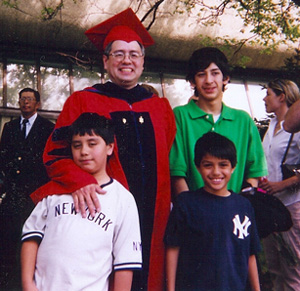
When I earned my Ph.D., one of my police partners bought me a nameplate for my uniform that said, “Dr. D. Rodriguez” as a graduation gift. At first, I was hesitant about wearing it, but then I wore it proudly. The supervisors and top brass who saw the nameplate were impressed. All my police colleagues began calling me “Dr. D.” Whenever someone asked me a question and I knew the answer. Someone would invariably say, “That’s why he’s the Doctor!” Of course, there were playful jokes, too. One police officer would always tell me about his aches and pains, and then ask me for a prescription for painkillers. “I’m not that kind of doctor,” I’d tell him. “But if it’ll make you feel better, I’ll read you some poetry.” No one ever took me up on the poetry reading.
I’ve been teaching for twelve years now. I really love the interaction with the students, even when we argue over silly matters. I’m the greatest teacher in the world! (But aren’t we all?) Most students seem to enjoy my classes and often ask me what I’m teaching next semester. Sometimes, I say things that make the students laugh, so I write them down. I’m thinking of going back on stage. I’m not joking!
Well, I’ve given up looking for a tenure-track position. So if some university or college wants to offer me a position, I may accept it, but only if I don’t have to go through another interview with a search committee. I’ve learned to accept the fact that I’m a retired police officer after a mere twenty years of service: I came, I saw, I retired. I really enjoy teaching so I’ll continue teaching as a lecturer at the University of Illinois at Chicago. However, I am proud to have earned a Ph.D. I once made a pilgrimage to the UIC Library to visit my doctoral dissertation. As I wrote it, I often wondered if anyone would ever read it. Imagine my surprise when I discovered that not only had it been checked out a few times, but someone had also marked some passages! So now, I flaunt my degree whenever possible. I use Dr. or Ph.D. next to my name whenever possible. My PBK newsletter comes addressed to Dr. David Diego Rodríguez. I can’t wait to start getting bulk mail addressed to Dr. Occupant or Dr. Neighbor. I started a blog titled, “David Diego Rodriguez, Ph.D.” at davidrodriguez.us. I love being Googled. If I ever accidently bump into someone on the mean streets of Chicago and they say, “Watch it, asshole!” I’m going to say, “Hey, that’s Dr. Asshole to you!”
 Chicago USA