My Spanish classes are always nervous about how they, the students, should address me. When I first started teaching at Morton College in 1995, I always told my students to call me David in Spanish, as opposed to David in English. Whenever someone called me Profesor in Spanish, or worse yet, Señor Rodríguez or just plain Señor, I corrected them and insist that everyone call me David in Spanish. But no matter how many times I corrected students, not everyone called me David.
Last year, I stopped telling students what to call me. Now, I respond to whatever name they call me. If they call me Señor or Señor Rodríguez, I know that they recently studied Spanish in high school. So within any one class period, I may be called David (in English or Spanish), Diego, David Diego, ProfesorRodríguez, Señor Rodríguez, or just plain Señor. Señor in Spanish means “mister” or “Lord”, which reminds me of when I was little and I prayed, “Señor nuestro, que está en los cielos …”
I really don’t want my students to treat me like God. I don’t handle power and authority very well. Señor also used to bother me because it made me feel so much older to be called Señor Rodríguez, but now I kind of like it. 🙂 Perhaps, I’m finally mellowing out.
I did have one Spanish class that always called me Dr. D. and I kind of liked that. The students really enjoyed calling me Dr. D., too, because it made me sound cool. Every single time any student spoke in class, he or she would insist on calling me, “Dr. D.” before speaking. After a while, I would walk into the classroom and say, “Dr. D. is in da house!” And they loved it!
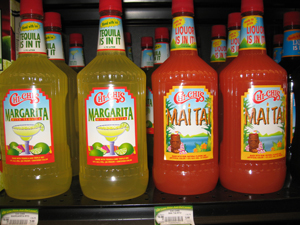
Yes, I mean Chi Chi’s as in the restaurant and not chichis in Spanish as in … Well, you know what I’m referring to. That’s right, female breasts. In English, they would be boobs, boobies, etc. So, I always wondered why the Puerto Rican golfer liked to be called Chichi Rodriguez–of course, I had a few unsavory ideas of my own.
As a Mexican, I have to ask: Why would anyone name a restaurant Chi Chi’s if they don’t specialize in dairy products? So, one day, I’m driving down LaGrange Road in Orland Park with my three sons and I notice that I’m rapidly approaching Chi Chi’s restaurant and I instinctively start thinking about chichis (in Spanish) and some of my female grade school classmates who had big chichis. The girls who envied them called the girls with the big chichis, chichonas. Suddenly, I remember that I’m driving in my minivan with my sons and we’re rapidly approaching Chi Chi’s. Since I’ve driven this way many times before, I know the restaurants in the area fairly well. I dread what is soon appearing. As soon as we’re in front of Chi Chi’s, we will be right across from Hooters! I feel so guilty about exposing my sons to this. I tell my sons not to look out the window. I’m embarrassed because I have my sons with me, and I’ve been having impure thoughts about chichis. What kind of father am I? I have brought my sons to this place where we have Chi Chi’s to the left of us and Hooters to the right! Of course, they’re too young to appreciate this cosmic moment.
I love the movie Napoleon Dynamite with Jon Heder so much that I’ve seen it at least twenty times. I saw it for the first time because my oldest son wanted me to rent it from Blockbuster. I thought I would end up seeing it all by myself as when I’ve rented other movies for him that he really, really wanted to see, like the Lords of Dogtown–and I ended up watching it alone, which I really loved by the way!
Anyway, I knew I had to own Napoleon Dynamite on DVD! When it first came out on DVD, it was only available at a clothing store called Hot Topic. Once I bought it, my twins started watching it repeatedly because they loved the movie, too. Well, I couldn’t walk by the TV without stopping to watch Napoleon and his misadventures. So, I watched it repeatedly along with my sons. Once we watched the movie all the way to the end and I told my sons not to start it over until I had read the credits; I don’t why, but I like to read the credits to see who the key grip is. (This goes back to the days of my youth when my friends Jim, Vito, and I would go to show and sit through all the credits so we could applaud for the key grip.) So, after the credits were completely over–yes, I read them all–there was another scene in which Kip marries LaFawnduh! My sons and I were pleasantly surprised!
Of course, this made me wonder what other surprises were in store for us on the rest of the DVD. Surprise, surprise! Not only does the DVD have subtitles in Spanish and French, but the movie is also dubbed in Spanish! I started watching it with Napoleon speaking Spanish, but my non-Spanish-speaking-Mexican sons wouldn’t watch it in Spanish!
Anyway, sometimes the topic of the movie Napoleon Dynamite comes up in Spanish class because the new student Pedro at Napoleon’s high school is Mexican. I often tell my students that they should watch the movie in Spanish someday. I was planning to watch it all the way through in Spanish one day. Since I’m always open to suggestions in Spanish class, last week, a student recommended that we Napoleon Dynamite in Spanish. I agreed if we didn’t use the subtitles. They resisted, but I insisted. Then, we reached a compromise: We would watch the movie dubbed in Spanish with Spanish subtitles. Since the students were fourth semester Spanish students and most had already seen the movie, I knew they would understand the action and plot development of the movie. I was amazed at how much the students laughed!
Napoleon Dynamite is much funnier in Spanish, especially when Napoleon says, “¡Idiota!” I was wondering how they would translate words like “liger,” which is half-lion, half-tiger. Well, Napoleon says that he’s drawing his favorite animal, “el legre,” which is “medio león, medio tigre.” However, lost in the translation is, “But my lips hurt really bad!”, which is translated as, “Pero mis labios están resecos” and Pedro’s “Maybe I’ll build her a cake or something.” The Spanish used is standard Spanish and doesn’t really capture the slangy colloquialisms of high school teenagers.
Also, the subtitles don’t always match the Spanish dubbing. In the beginning Napoleon says, “¡Rayos!”, but in the subtitles, we read, “¡Cielos!” Obviously, there were two translators at work. Overall, the Spanish captures the feel of the original movie. I would recommend for all Spanish teacher to watch this movie with their high school or college students in Spanish. It was definitely a very entertaining way to reinforce some of the Spanish lessons learned in class.
Be careful with those translations! While I was still a police officer, I would have to take people to Mercy Hospital for medical treatment. Of course, that meant I spent plenty of time waiting in the triage area of the emergency room.
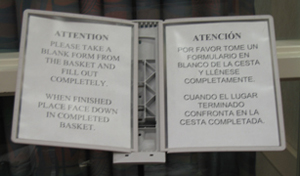
Since I love to read, I would read everything in sight. One notice to patients who were signing in always bothered me. In English, it read: “Attention. Please take a form from the basket and fill out completely. When finished place face down in completed basket.” Okay, the notice wasn’t exactly written in perfect English, so perhaps that’s why the translator had difficulty translating it into Spanish. However, no matter how many times I read the Spanish translation, I could never make any sense of it. And no one ever bothered to correct it.
Finally, after reading it for two years or so, I wrote it down: “Atención. Por favor tome un formulario en blanco de la cesta y llénese completamente. Cuando en el lugar terminado confronta en la cesta completada.” How, I wondered, did the translator arrive at this translation? And, what were the translator’s qualifications?
This reminds me of my Spanish student Elwood Chipchase who one day began telling me about July Churches. He was going on and on about July Churches and I had no idea what he was telling me. Finally, I had to ask him, “What are you talking about?” Well, it turns out that I didn’t understand him because he had translated the name of the Spanish singer Julio Iglesias into English!
I recently read the book ¡Ask a Mexican! by Gustavo Arellano. Even though I consider myself to be of the Mexican persuasion, I learned so much about Mexicans! I didn’t realize how little I knew about Mexicans despite the fact that I am Mexican. Well, after reading this book, I underwent another identity crisis about my being American and mi mexicanidad. I am fully fluent in Spanish and English, but I don’t feel that I speak either language like a native speaker! Perhaps that’s just me being me whenever I read about Mexicans writing about Mexicans.
Anyway, this politically incorrect book provides “questions and answers about our spiciest Americans” such as: Why aren’t there Mexicans on Star Trek? Will Mexicans eat anything without hot sauce? How come so many Mexicans send their money to Mexico? Why do Mexicans swim in the ocean with their clothes on? What part of illegal don’t Mexicans understand?
I really enjoyed reading the book because I learned a lot of new swear words in Spanish that only Mexicans use because they invented them. Mexicans are known worldwide for using the most profanities of all Spanish speakers in their everyday speech–I really should learn this new vocabulary so that I may curse fluently the next time I go to Mexico.
Actually, there’s a very good chance that I’ll probably meet a Mexican before I come back home tonight, so I should memorize these words immediately. I find it ironic that people who don’t speak Spanish listen to the busboys, landscapers, or laborers swearing at each other and then think that Spanish is a beautiful language. I’ve listened to these Mexicans “communicating” and at least every fourth word is a profanity! However, the language does sound beautiful and elegant because they are speaking a romance language.





 Chicago USA