I would especially like to thank my father Diego for being my father. He’s holding my baby brother Joey in the picture and I’m standing next to him. Seated are my brothers Danny, Rick, my sister Delia, and my brother Jerry. My mother isn’t in the picture because she was the photographer. She loved taking pictures of the family!
I can honestly say that the happiest days of my life were when I was a boy living with my family before my parents got divorced. Both my parents were always there for me, although we did have a few misunderstandings. My father taught me some carpentry and how to use tools. I would always help him fix his cars because he was a mechanic at the Curtis Candy factory. He was proud to be a mechanic. My father respected anyone who was a good carpenter or mechanic by calling them maestro. Thanks to my father, I’m now able to perform many fix-it projects around the house.
As a father myself, I often think of all the things my father did with us and I try to do some of the same things. Sometimes, just being with his children was enough satisfaction and joy for my father, especially after my parents divorced. Even if we’re not doing anything together, I’ll often sit in the same room with my sons just to be with them. Occasionally, we’ll start an unexpected entertaining conversation.
My father always asked me for suggestions for trips we could make, and no matter how crazy I thought the idea was, he would take us on the trip. He never made any excuses for not going. So, now I follow my sons’ suggestions. One time, my oldest son was writing a report on Mount Rushmore, and we all became interested in the report. My son suggested that we go to Mount Rushmore, and we went the following June. Every time I go on vacation with my sons, I always think of my father.
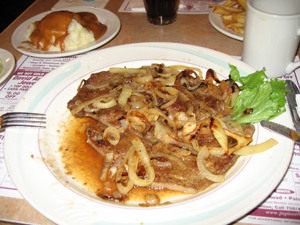
I think we can all agree that liver and onions is not a very popular dish in America. Otherwise, someone would have opened a fast-food restaurant with a drive-thru specializing in liver and onions by now. This will never happen but imagine the possibilities! For me, this would be great since liver and onions is one of my all-time favorite dishes. Luckily, it’s available at many restaurants. It’s easy to prepare and I’ve even made it myself a few times.
Even when I was little, I loved liver and onions. My mother prepared it frequently because she loved liver and onions. I inherited her love of liver and onions. Sometimes my mother would make it just for her and me. Beef liver was usually unbelievably cheap. I guess few people liked eating liver back then, but no part of livestock was wasted. As The Jungle famously quoted one of the meatpacking plants, “We package everything except the squeal!”
Unfortunately, my younger brothers wouldn’t eat liver and onions if they knew exactly what they were about to eat. So, my mother would explain that we were about to eat some exotic dish. As we sat down at the table, my mother would always say something like, “Hoy vamos a comer tigre.” “Today we are eating tiger.” “Hoy les preparé algo muy sabroso. ¡Tiburón!” “I made you something delicious today. Shark!” And my little brothers would eat up the liver and onions that they so detested.
Once, we all sat down for dinner and my mother announced, “Hoy vamos a comer ballena.” “Today we are eating whale.” And so, we all started eating whale. On this day, I found the whale especially delicious. I was the only one who knew we were eating liver, sans onions to create the effect that we were eating whale. Have you ever eaten something that was especially delicious, and it really hits the spot. Perhaps I was suffering from an iron deficiency that day. Well, on this occasion, the liver tasted especially good despite lacking onions. I asked for seconds and thirds. My brothers continued eating it. Until I blurted, “The liver came out really good today!” My mother gave me a pained stare. And my brothers yelled, “Yuck, I hate liver!’ And they all stopped eating. My mother yelled at me because my brothers would have kept eating if they still believed they were eating whale.
This reminds me of something that happened recently with my son Alex recently. We were at Old Country Buffet, and he came back to the table with what he thought were chicken fries. He said they were really good! When I went for seconds, I saw where he got the chicken fries. He was actually eating calamari. I love calamari, so I got some for myself. Alex was surprised that I would eat chicken fries. I told him what he really ate was calamari. He insisted on knowing what exactly calamari was. When I told him it was squid, he stopped eating his chicken fries!
I guess sometimes you’re better off not knowing what you’re eating.
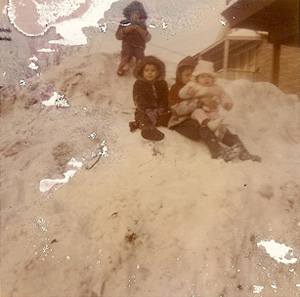
The Chicago snowstorm is more than just a meteorological event. For my brothers and me, this was the perfect time to go out to play in the snow, make snowmen, and build snow forts. We enjoyed staying out all day in the snow if possible. My mother would send me to the store so we could stock up on milk and bread. She was afraid the stores would run out of milk whenever she saw the first snowflake falling. I had to buy at least two gallons of milk and bread. We were tortilla eaters. We never really ate bread at home unless there was a snowstorm. So, I had to buy as many loaves of bread as my mother could afford. We would eat sandwiches and toast for weeks after a snowstorm. My brother Jerry and I used to go knocking door to door with shovels to see who wanted us to shovel their sidewalk. We would earn some money that way. We watched Ray Rayner to see if our school would close for a snow day. But it never did. All the teachers at Holy Cross were nuns who lived in the convent next to the school and most of the students lived within a three-block radius anyway. Ray Rayner would announce school closing after school closing, but he never called out Holy Cross Grade School! Going to school really cut into our snow playtime.
So, it’s snowing now and has been snowing since early this morning. I’m hoping for an e-mail from UIC telling me they’re calling it a snow day. But they can’t close the campus because they also have a hospital. UIC has never shut down the campus for a mere snowstorm. Not even the Big Snow of 1967. So, I better get up early tomorrow morning so I can shovel my car out and drive to school. I don’t mind going to school in the snow. I’ve lived in Chicago my whole life, so I enjoy the snowfall. I enjoy shoveling the snow. As an adult, that’s how I now play in the snow. And I love it!
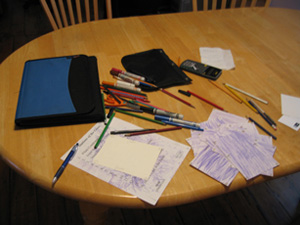
When I was in grade school, we used construction paper for just about every art project. I’m reminded about this because my son Adam was working on a school project and was coloring white sheets of paper with a purple marker. If he would have asked me for advice, I would have brought out an aging pad of construction paper that I’ve had for years (mainly because my sons never think of using construction paper) in order to speed up his project. Could it be that because he’s been trained to do many homework assignments on the computer he no longer thinks of using his dear old dad’s techniques? On the plus side, he has become very independent and he is intelligent enough not to need my help for his homework very often.
When I was in grade school at Holy Cross, art class was a very special time of day. If a student misbehaved, he or she was deprived of participating in art class and would have to sit in the corner with his head placed down in his or her folded arms for the duration of art class. And take it from me, that was no fun at all.
Okay, okay, I was deprived of art class one time or two or three, but I was framed! Each and every time! When we had art class, we always–I do mean always always–started with one sheet of construction paper. Usually, it was manila-colored, but for those special art projects we could get several sheets of construction paper–each a different color!
I remember one class, Sister Francine told us told us to hold the sheet of construction paper–I can still smell it!–vertically. Meaning standing up and not lying down. She even showed us the sheet of construction paper in the upright position from the front of the classroom and then she walked between every aisle between all the desks to ensure that every third grader in the class had the construction paper in the correct position. I was certain that the health and wellbeing of every American citizen depended upon our completing our art project successfully because Sister Francine’s face reddened every time she observed a student with the construction paper in the wrong position.
Finally, every student had the paper vertically in front of them on the desk, including Claudia who sat next to me. Sister Francine then instructed us to fold the paper vertically, from left to right. Not from right to left, but left to right. She repeated several times, in such a stern voice that I thought I would crack from the tension that was building up in the classroom. But lo, I correctly folded my sheet of construction paper in half vertically, as instructed, and I even passed Sister Francine’s eagle-eyed inspection. I was spared from her wrath for the moment. However, she turned to Claudia and Sister Francine blew a gasket! Claudia had folded her construction paper–not vertically–but horizontally! Widthwise instead of lengthwise! Much to Claudia’s embarrassment, Sister Francine led her up to the front of the classroom to show her construction paper folded horizontally. She was the only student who could not–no would dare to defy a direct order from Sister Francine–follow instructions.
I don’t even remember what art project we did that day, but I do remember how badly Claudia felt. Now that I think of it, why did I like art class so much?
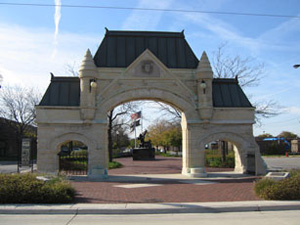
I just finished rereading The Jungle by Upton Sinclair. This is a book I knew about since about the third grade because the Lithuanian nuns also mentioned it at Holy Cross School. The nuns always wanted to remind us that we didn’t always have life so easy. They would often describe the squalid living conditions of our neighborhood, The Back of the Yards, and the horrendous working conditions at the Union International Stock Yards. They stressed that education was the best way to improve our lives and that we should excel in grade school, to get into a good Catholic school, to prepare us for college. I always recall the incident about the boy who drowns in the street. Several nuns over the years described that scene. And we were so lucky to live in a neighborhood with concrete sidewalks, paved streets, and a sewage system. No one from our neighborhood ever drowned in the street–that I know of.
When I worked at Derby Foods, we didn’t have a union even though Chicago has always been known as a union town. And I didn’t realize it at the time, but we didn’t need a union because all the other factories around us were unionized. Our factory paid us above-average wages and we worked under better-than-normal working conditions. They followed bidding by seniority for different job openings in the factory.
Regardless, I hated working there because I was a lowly manual laborer. The money was good, but I was unhappy about not being able to go to college. I continued working there because … because–just because. When I started at Derby Foods, about three-hundred people worked there. But over the years, the company kept modernizing by buying machinery that would replace employees. By the time I had eight years on the job, I was still near the bottom of the seniority list of about 134 employees due to the lack of hiring because of the worker displacement caused by the new machinery. Since I was at the bottom of the list, I had to work an undesirable work schedule. In food production, the plant and machinery must be cleaned and sanitized on a regular basis. Well, I had to work the third shift from 11:00 pm until 7:00 am. Regardless of what anyone says, the human body never fully adapts to a nocturnal life. The schedule was bearable until Saturday when I would get off at 7:00 am but I would have to return at noon to clean and sanitize the plant at 11:00 am. Everyone else who worked the Saturday shift worked either days or afternoons, so they didn’t complain. Besides, they enjoyed working for time and a half because it was a Saturday.
I complained about my schedule to my foreman, the shift foreman, and the manager. No one thought it was a problem. I had no union with whom to file a grievance, so I called the federal labor law organization, and they told me that my employer was not violating any federal laws by requiring me to return to work an eight-hour shift within four hours of working an eight-hour shift. Well, I was happy that I tried everything possible to improve my working conditions.
Then, it dawned on me! I’ll read The Jungle! I’ll find scenes in the novel that compare to my present working conditions! So, during my breaks and down time in factory, I read the paperback edition of The Jungle that I always carried in my back pocket. When I was done, I was so grateful to be working for Derby Foods! I never realized how good I had it compared to the Stockyard workers in the early 1900s. Because of that book, federal laws were enacted, the Pure Food and Drug act in 1906 for one, to improve the lives of millions worldwide. The unions in Chicago and nationally became stronger. I had forgotten the lessons of my dear Lithuanian Catholic nuns at Holy Cross School. But upon rereading The Jungle, I was grateful, nay, thankful, to be working for Derby Foods. I never complained about my employer ever again.



 Chicago USA