Riverview


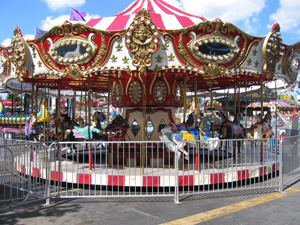
Most Holy Redeemer Church Carnival, Evergreen Park, Illinois

Riverview will always remain my all-time favorite amusement park! Of course, nostalgia has a lot to do with it. Every time I recall Riverview, I always remember the best days of my childhood.

This was an amusement park right in the city of Chicago and it was easily accessible by car or public transportation. What I remember most about it is the circus atmosphere about it, something today’s modern theme parks seem to lack. They had a tattooed lady, a bearded lady, world’s smallest man. But we never actually went in there because my father said that we couldn’t afford the tickets.

There was Aladdin’s Castle fun house with its distortion mirrors and the maze that scared the heck out of me when I was six. And half the fun was getting there. My father usually drove us to Riverview, but occasionally, we would take the bus and El to get there. When I was older, I realized that my father took us way out of the way just so we could ride the El, but we always had fun. Of course, my mother never went when we took public transportation. I think my father had the most fun on these trips.

My little brother Dicky was about four the first time he went to Riverview. He got scared when we rode the El and realized we were about two stories off the ground. We thought he wouldn’t have fun at Riverview because he would be too scared for all the fun rides. We took him on the age-appropriate Merry-Go-Round, but he cried. Then we took him on the Caterpillar, which was basically like train on the Tilt-a-Whirl tracks. During the middle of the ride, a canopy covered all the cars. Dicky started screaming and kicking when we were under the canopy. I tried to calm him down, but he didn’t stop screaming until the ride was over. I thought we wouldn’t have any fun at Riverview.

I tried to think of rides that he would like, but I was sure they would all scare him. Back then, there were no size restrictions, such as having to be a minimum height to get on a ride. So even though Dicky was only four, he was able to ride the Silver Flash roller coaster that went around the amusement park. I thought for sure that Dicky would start crying immediately, but no, he loved the ride and laughed his head off the entire ride. So we rode roller coaster the rest of day, even though I would have liked to ride the Caterpillar a few more times. I never could figure out Dicky. On the way home, he was no longer afraid to ride the El.
DDR

Al


On the road somewhere in the USA.

In the 1960s, Chicago was very much a segregated city. Neighborhoods were categorized by race and/or ethnicity. When people moved to Chicago, they pretty much stuck to their own kind. This was in an era before anyone could foretell the coming of Political Correctness and everyone called every race and ethnic group by their corresponding slur.

Sometimes, people would be offended by such name calling, but oftentimes, most people merely accepted it as part of life in Chicago. Those neighborhood boundaries could only be crossed when going to work or when shopping, as long as no one over-stayed their time where they didn’t belong. No one ever commented on these inequities back then. That was Chicago.

When I lived in Back of the Yards, no blacks ventured there except to go shopping at the stores on Ashland Avenue between 45th Street and 51st Street. There was name calling and such, but basically there was never any trouble.

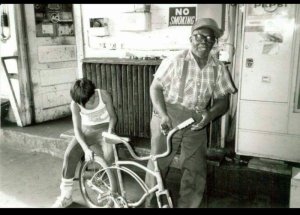
Al at the Sinclair gas station.

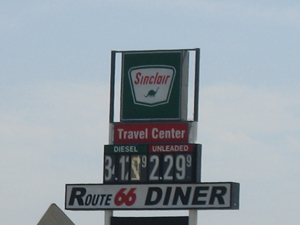
When I lived at 4546 S. Marshfield Avenue, there was a Sinclair gas station, whose logo was a green dinosaur, on the corner across the street. It had one gas pump that was directly in front of the building on the sidewalk. Whenever I needed air for my bicycle tires, I went across the street for it. As a ten year old, I often needed help fixing my bicycle when my father wasn’t home, so I would go to the gas station where Al would help me.

Al had the reputation for being the very best mechanic around, not just in our neighborhood, but anywhere. Everyone respected him for his mechanical skills and brought their cars to him if they needed repairs. Al also dispensed free mechanical advice to anyone who asked for it. After a while, no one even noticed that he was black. That’s right, a black man was working at our gas station beyond the allowable shopping district boundaries. But it was acceptable because he was at work. However, Al was accepted amicably by all the neighborhood residents. He was a hero to all my friends and me because he could fix our bikes no matter what was wrong with them. And he never charged us anything.

Al in action!

I used to like to hang out with him when I had nothing to do. He just seemed like the wisest man on earth because he could fix just about anything anyone brought in. I would ride my bike over and sit on his bench and watch him fix flat tires. He explained everything he did to me every step of the way. I was always fascinated by the machine that removed the tires from the rim. It was loud and menacing, but Al had tamed it to obey his every command. When business was slow, which was rarely, he would sit next to me on the bench and we would talk small talk. “How’s it going, buddy?” “Great! How are you, Max?” We were buddies. Then all Sinclair gas stations started giving out free passes to the Riverview amusement park with a gas fill-up. Since we were buddies, Al gave me enough passes for my entire family and my father took us to Riverview several times. Al was really popular with all the boys after that.

There was an older boy on the block that I often avoided. I always afraid of this boy because he was rotten to the core and he often scared me. He had that look that threatened physical violence to anyone who returned it. Then one day, he told me that Al was black. Looking back, I’m not even sure if I ever even noticed. He was just Al the mechanic at Sinclair to me. He was a very nice guy and he was always very helpful to me.

Anyway, this boy told me that Al was a “nigger.” I didn’t understand what he was talking about. He explained to me that Al was inferior to us because of his skin color. We rode our bikes to the corner and Al was standing in front of the gas station. The boy told me to call Al a “nigger.” I refused because Al was my friend. We stopped our bikes directly across the street from Al and the boy insisted that I shout “nigger” to Al. I just couldn’t. I knew that Al could hear our conversation, but he acted as if he were oblivious to us. Then the boy said he would beat me up if I didn’t call Al “nigger.” He punched me in the arm really hard, he gave me his patented menacing look, and said, “Then call him a Fudgecicle!” I refused at first, but then I was so afraid to get beat up. So I half-heartedly said, “Fudgecicle.” Al didn’t betray any form of acknowledgement that he had heard me. I felt so bad. I was sure my friendship with Al was over. But I didn’t get beat up.

The next day, I felt too guilty to visit Al as I usually did. After a few more days, I went back to the gas station and I tried to act as if nothing had happened. Al greeted me as he usually did. And we had our normal conversation of small talk. As if nothing had ever happened! Al was such a great friend!

DDR