What a riot


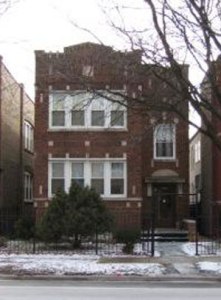
2509 W. Marquette Road, Chicago, Illinois

When I lived near Marquette Park, there was a lot of racial tension. The neighborhood suffered from panic as the blacks moved closer and closer due to white flight. When my mother bought our house at 2509 W. Marquette Road, the neighbors said, with a sigh of relief, “At least you’re not black.” But we weren’t completely accepted by many in the neighborhood.

No matter where you lived in Chicago back in the 1970s, there would be someone who resented you, regardless of your race. In 1966, Dr. Martin Luther King Jr. had marched in Marquette Park was greeted by whites who threw bricks, rocks, and bottles at the marchers. We moved to Marquette Park in 1973 and people still talked about the Doctor King march. I was a typical teenager in that I wasn’t fully aware about the political events in Chicago or our neighborhood.

So, one Saturday in 1975, I was driving home from work at Derby Foods. When I got close to my house, all the streets were blocked off by the police and I couldn’t drive home. Helicopters flew overhead. I drove around until I found a side street that wasn’t closed. I managed to park my Firebird about four blocks from my house.  I had no idea why there were so many police officers in our neighborhood, nor why all the streets were closed.

As I walked home, I could hear people chanting in the direction of my house. When I reached Marquette Road, there were hundreds, if not thousands, of people lining both sides of the street. Reverend Jesse Jackson had led a protest march, but I had just missed it. The street was littered with rocks and bottles. A black man and a boy drove up Marquette Road and people threw rocks and bottles at his car shouting racial epithets. The car sped off westbound where he was greeted by more projectiles.

I had a tough time crossing Marquette Road to get home. When I finally got to my house, there were hundreds of people standing in front of my house. I couldn’t reach my front door, so I watched until the march was over and most of the people left. My younger brother told me how he saw police officers on horses near California Avenue. Someone blew up a cherry bomb near the horse and scared it so that it stood on its hind legs. Someone kicked one of horse’s hind legs and the horse and police officer both fell. The police immediately arrested the offender.

One of my friends told me he was standing on the curb watching all the action when a little old white lady gave him a brick and said, “You throw it! I’m too old!”

When I finally got home, my mother asked me where I was. I told her that I was at work and that I had a hard time getting home. When my mother asked my brother if he was at the march he swore he was at his friend’s house. My mother didn’t believe him. She didn’t want the neighbors to think we were causing trouble. Little did she realize that all our neighbors were out there throwing things. The next day, my mother punished my brother for being at the march and for lying to her. She had seen my brother on the news near where the horse was kicked down. They had more protest marches after that, but that was the only one I saw up close.
DDR

Al


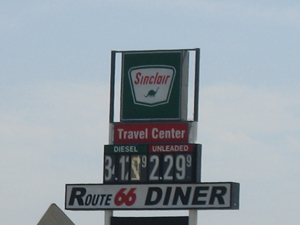
On the road somewhere in the USA.

In the 1960s, Chicago was very much a segregated city. Neighborhoods were categorized by race and/or ethnicity. When people moved to Chicago, they pretty much stuck to their own kind. This was in an era before anyone could foretell the coming of Political Correctness and everyone called every race and ethnic group by their corresponding slur.

Sometimes, people would be offended by such name calling, but oftentimes, most people merely accepted it as part of life in Chicago. Those neighborhood boundaries could only be crossed when going to work or when shopping, as long as no one over-stayed their time where they didn’t belong. No one ever commented on these inequities back then. That was Chicago.

When I lived in Back of the Yards, no blacks ventured there except to go shopping at the stores on Ashland Avenue between 45th Street and 51st Street. There was name calling and such, but basically there was never any trouble.

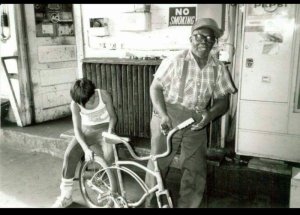
Al at the Sinclair gas station.

When I lived at 4546 S. Marshfield Avenue, there was a Sinclair gas station, whose logo was a green dinosaur, on the corner across the street. It had one gas pump that was directly in front of the building on the sidewalk. Whenever I needed air for my bicycle tires, I went across the street for it. As a ten year old, I often needed help fixing my bicycle when my father wasn’t home, so I would go to the gas station where Al would help me.

Al had the reputation for being the very best mechanic around, not just in our neighborhood, but anywhere. Everyone respected him for his mechanical skills and brought their cars to him if they needed repairs. Al also dispensed free mechanical advice to anyone who asked for it. After a while, no one even noticed that he was black. That’s right, a black man was working at our gas station beyond the allowable shopping district boundaries. But it was acceptable because he was at work. However, Al was accepted amicably by all the neighborhood residents. He was a hero to all my friends and me because he could fix our bikes no matter what was wrong with them. And he never charged us anything.

Al in action!

I used to like to hang out with him when I had nothing to do. He just seemed like the wisest man on earth because he could fix just about anything anyone brought in. I would ride my bike over and sit on his bench and watch him fix flat tires. He explained everything he did to me every step of the way. I was always fascinated by the machine that removed the tires from the rim. It was loud and menacing, but Al had tamed it to obey his every command. When business was slow, which was rarely, he would sit next to me on the bench and we would talk small talk. “How’s it going, buddy?” “Great! How are you, Max?” We were buddies. Then all Sinclair gas stations started giving out free passes to the Riverview amusement park with a gas fill-up. Since we were buddies, Al gave me enough passes for my entire family and my father took us to Riverview several times. Al was really popular with all the boys after that.

There was an older boy on the block that I often avoided. I always afraid of this boy because he was rotten to the core and he often scared me. He had that look that threatened physical violence to anyone who returned it. Then one day, he told me that Al was black. Looking back, I’m not even sure if I ever even noticed. He was just Al the mechanic at Sinclair to me. He was a very nice guy and he was always very helpful to me.

Anyway, this boy told me that Al was a “nigger.” I didn’t understand what he was talking about. He explained to me that Al was inferior to us because of his skin color. We rode our bikes to the corner and Al was standing in front of the gas station. The boy told me to call Al a “nigger.” I refused because Al was my friend. We stopped our bikes directly across the street from Al and the boy insisted that I shout “nigger” to Al. I just couldn’t. I knew that Al could hear our conversation, but he acted as if he were oblivious to us. Then the boy said he would beat me up if I didn’t call Al “nigger.” He punched me in the arm really hard, he gave me his patented menacing look, and said, “Then call him a Fudgecicle!” I refused at first, but then I was so afraid to get beat up. So I half-heartedly said, “Fudgecicle.” Al didn’t betray any form of acknowledgement that he had heard me. I felt so bad. I was sure my friendship with Al was over. But I didn’t get beat up.

The next day, I felt too guilty to visit Al as I usually did. After a few more days, I went back to the gas station and I tried to act as if nothing had happened. Al greeted me as he usually did. And we had our normal conversation of small talk. As if nothing had ever happened! Al was such a great friend!

DDR