Mexicanas


Ixtapa-Zihuatanejo, México

Mexicanas are incredibly unique women in this world. However, I don’t want to lump them all into one group as there are different kinds of Mexicanas. Sure, they all have the common denominator of Mexico somewhere in their background and that’s enough to differentiate them from women of other ethnicities. So in an effort to educate you, gentle reader, I will over-analyze Mexicanas for you. Yes, there are different kinds of Mexicanas that I like to divide into three groups: 1. Mexicanas, 2. Mexicanas, and 3. Mexicanas. As you can see, UIC didn’t give me my Ph.D. for nuthin’! I learned to categorize just about everything while studying for my graduate degrees. Anyway, if you examine my groups of Mexicanas, you will clearly see that there are three different kinds of Mexicanas: 1, 2, and 3. Is that clear?

First, there are Mexicanas like my abuelita, born and raised in Mexico, destined never to live anywhere else. And they don’t want to leave Mexico either. Their names are usually María or Guadalupe. Or even Guadalupe María or María Guadalupe. No exceptions. My abuelita María Guadalupe Valdivía came to Chicago only because my mother insisted. Abuelita didn’t like Chicago at all because it wasn’t Mexico. She hated the winters here and she hated the fact that she would have to learn English. She stayed just long enough to have her eye surgery and then she returned to Mexico. And she never came back. And she never missed Chicago at all. My mother would visit abuelita at least once a year in Mexico. And even though she was blind, abuelita lived by herself in Mexico. She was an extraordinarily strong Mexicana.

Second, there are Mexicanas like my strong-willed mother who were also born and raised in Mexico, but not firmly rooted there. They come to America for a while, then go back to Mexico. But return to America even though they always complained about America in Mexico. They just keep going back and forth, never entirely happy in either place. In general, nothing seems to please them. My mother always complained about everything, to everyone in America and Mexico. When her Mexicana friends would visit, they would all sit around complaining about America. And then, to change the subject just a little, they would complain about Mexico. Nothing ever seemed to please these Mexicanas as they sat around complaining and breast-feeding their babies.

Third, there are Mexicanas like my sister or ex-wives, born in America, but unmistakably Mexicana by their accent. I once had a Mexicana girlfriend who had the Mexicana accent but couldn’t speak a word of Spanish! She used to get so mad when people automatically spoke Spanish to her and she would have to admit that she only knew English, albeit the Mexicana kind of English. These Mexicanas love everything about Mexico, the music, the food, the culture, but they wouldn’t want to live there. It’s okay to visit once in a while to catch up with family events, but that’s about it. America is their home, even if they are Mexicanas, and they never hesitate to let the gringos know it.

I’ve known Mexicanas all my life, beginning with my mother, then my abuelita, and finally, my significant others. The more I get to know them, the less I seem to understand them. I do know they are sexual beings from observing them and from my very own personal hands-on experience. I don’t know much about my abuelita’s sex life, but let me say this. She never married my abuelito and they rarely lived together. Yet they managed to have six children together. My parents were always fighting, and I never ever heard them having a normal, civilized conversation. My father was always affectionate with my mother, but she would repel all his amorous overtures, at least that I could see. Occasionally, when my father didn’t work the midnight shift, I could hear him trying to seduce my mother in their bedroom, right next to mine. My father always saying something affectionate and my mother always telling him to leave her alone. Apparently, he didn’t give up and she didn’t resist enough because they had six children together. My youngest brother was born soon after my parents separated.

The Mexicanas that came into my life were certainly very affectionate, if you know what I mean. That’s the thing about Mexicanas: They immediately know if they like you or not, if they will love you or not. I met my first wife Linda when my friend invited me to go with him to a wedding in Merrill, Michigan. We barely spoke and I didn’t see her again for another month–and we spoke even less then. Next thing I knew she moved to Chicago just to be with me–not that I minded, of course.

My second wife Anna chased after me, too. She kept hinting for me to ask her out. I really wasn’t interested in her, but she was persistent. She gave me her phone number and I threw it away. Her friend gave me Anna’s phone number and I threw it away again. She was so persistent that I finally gave in. If a Mexicana is that interested in me, I know we will be happy together. If Mexicanas don’t love you, or at least like you, you better back off because you don’t have a chance and you’re just wasting your time.

From what I’ve seen, the odds are against you if you think you can win a Mexicana over. However, once she yours, you better show her that you need her, and she’ll be yours for as long as she wants you. But that may or may not be till death do you part. One of the fringe benefits of having a Mexicana is having an active sex life. I mean there’s no begging at all. In fact, I was dragged into the bedroom many times, although I must admit that I didn’t put up much of a fight. And the fun doesn’t stop just because it’s that time of month, either. In fact, a Mexicana wants you even more right then. This happened to me many times. And just because you have all these intense arguments during the day, doesn’t mean that you’ll be ignored at night. In fact, that’s usually some of the best lovemaking. And the next morning? She continues being mad at you from the day before. That is, until night falls again.

Well, that’s about all I’m willing to say for my over-analysis of Mexicanas for now. But someday, I’ll truly delve into Mexicanas to try to understand them! Maybe, I’ll discover that there are many more than just three groups of Mexicanas.

DDR

Matilde y el martillo


Mi tío Samuel y mi tía Matilde

My tía Matilde was quite a character. Once when we were visiting México, we stayed with my abuelita who was blind. All our relatives would always visit abuelita, especially when we came from Chicago. Matilde was still single at the time, so she lived with my abuelita.

While we were there, my mother decided to fix up my abuelita’s place a little. That meant everyone there had to work, vacation or not! We cleaned and painted, and when my mother saw the freshly painted walls, she decided to hang up some family pictures. Only one problem. My abuelita didn’t have a hammer. So, my mother sent tía Matilde to get a hammer from a friend’s house.

That sounds easy enough, no? Well, not to a Mexicana. Somehow the simplest errands became a complicated quest. Tía Matilde sets off on the simple errand of bringing back a hammer so my mother could hang up some pictures. My aunt should have returned in ten to fifteen minutes tops. Well, a half hour went by and tía Matilde didn’t return.

My mother looked down the street and saw no sign of her sister. An hour passed, then another, and still no sign of tía Matilde. My mother sent me to the friend’s house to see if Matilde ever went there. No, they hadn’t seen her all day. No one really worried about her because in México sometimes people get distracted and forget their original mission, in this case, the quest for the hammer.

Tía Matilde finally returned about three hours later! My abuelita and my mother started interrogating her. “Where did you go? What took you so long?”

Well, she met this certain Samuel. He was standing on the corner playing the guitar and he started serenading her. They went for a walk and before she knew it, three hours had passed. Then, she remembered about the hammer! She returned, finally, but without the hammer!

My abuelita and mother were mad at my tía Matilde, but they also couldn’t help laughing at the whole situation. Matilde and Samuel eventually married and had six children.

DDR

Abuelita


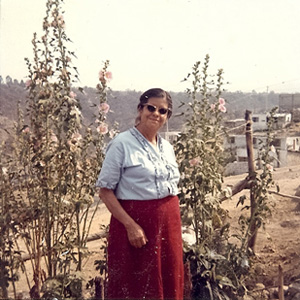
Mi abuelita en México.

I remember when my abuelita came to live with us in Chicago back in the 1960s. I liked having my grandmother living with us because she used to take care of me when both my parents went to work. She even protected me from my mother when she hit me a little too hard or a little too long.

I remember once for homework in the first grade I was supposed to read aloud from our reader to one of my parents. My father wasn’t home, so I went to my mother. She said she was too tired from work to help me do my homework. I told her that all she had to do was listen to me read. The reader was quite simple: “See David. See Ann.” And so on. I didn’t even know that much English at the time.

Anyway, my mother didn’t want to be bothered by me. I kept begging her to listen to me. Finally, my abuelita said that I should read to her. I wasn’t sure if she could help me to read this book. At first, I hesitated because not only did she not know English, but she was also blind. One of the reasons she came to Chicago was to get eye surgery.

DDR

Spanish textbooks


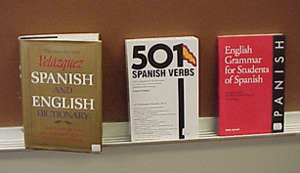
Spanish books

Sometimes Spanish textbooks inadvertently include words that invoke negative connotations or just plain poor choices.

For example, I’ve seen some books include “tonto” in the glossary as meaning, “silly” or “foolish.” Yes, it does mean that, but in general, no Spanish-speaker uses that word unless they really want to insult someone. “Tonto” is practically a swear word in almost every context.

I always warn students not to use this word, and if they do, they should be prepared to be punched. I saw one book explain the diminutive of words like “casa” changing to “casita,” and “hijo” changing to “hijito.” That’s all well and good, but then the textbook gave the example of “mamá” changing to “mamacita.” In real life, no Spanish speaker would call their mother “mamacita.” The only time you really hear “mamacita” is when the vato on the corner is flirting with a girl walking by and he says, “¡Oye, mamacita! ¡Qué chula estás!

Another book bothered me with its choice of negative examples. I prefer something that offers positive reinforcement, but, no, this textbook in explaining comparisons of inequality stated, “Estos estudiantes son más estúpidos que esos estudiantes.” What kind of thing is that to say in a classroom? “These students are stupider that than those students.”

I used one textbook with all these ambiguous illustrations that didn’t really clarify the lesson at all. In one of the drawings for the lesson on reflexive and reciprocal sentences, one cowboy is removing the boot off the foot of another cowboy! Every class of mine that looked at the drawing always laughed when we did the exercise. I would just tell them it was a scene taken from Brokeback Mountain.

DDR

Estudiantes


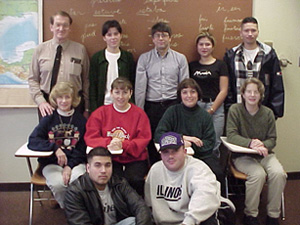
Morton College Spanish Class

The other day, one of my Spanish students asked me if he could be my friend on Facebook.com. Of course, I said yes. And we are now friends on Facebook. I’ve always gotten along with my Spanish students. That’s because I love my students. But not in the sexual harassment civil lawsuit kind of love. I’ve been teaching college Spanish for about twelve years now, so I remember a lot of students from over the years. Some students kept in touch with me for a while after taking my class and then eventually disappeared from my life. Other students occasionally run into me by chance. Some I will never forget.

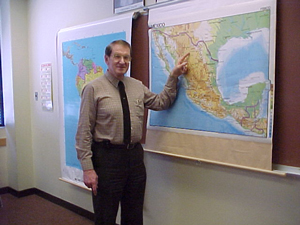
Elwood Chipchase, Morton College, Cicero, Illinois

I remember Elwood Chipchase and his wife Grace took Spanish 101 and 102 with me at Morton College. He was a minister in Cicero, Illinois, and his congregation was mostly Mexican. He was seriously studying Spanish so could better communicate with his parishioners. Both he and his wife were the students most dedicated to learning Spanish. At first, he didn’t tell me that he was a minister or why he was learning Spanish. One day, he asked me why when he asked Mexicans about their mother, they kind of paused before answering. Sometimes they gave him a pained look, as if they were offended. I asked Elwood how he asked them. He would greet them, ask them how they were, and how their spouse was in Spanish. Then he would ask about their mother, “¿Y tu madre?” I thought about it a while. Why would they hesitate to respond? Elwood’s Spanish was clear enough to understand. Then it dawned on me. But I felt uncomfortable explaining my theory to him since he was a minister. The problem is that all Mexicans refer to their mother as mamá or mami. The only time they use madre is when they swear at someone, as in, “Chinga tu madre.” Well, he was grateful for my explanation and said he would change his choice of words. The next week he reported that everyone responded more warmly to his inquiries.

DDR