Mexican hot chocolate


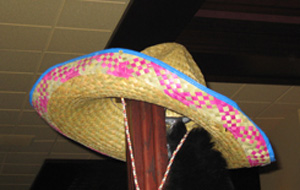
Mexican sombrero in a downtown restaurant

I have always loved Mexican hot chocolate. I mean real Mexican hot chocolate, made by real Mexicans. I generally drink it during the winter months, but I myself have never made Mexican hot chocolate in my life. In fact, I have never heard of a Mexican male making Mexican hot chocolate outside of a restaurant.

Usually, my mother or abuelita made it at home. They would bring the water in the pot to a rolling boil and then drop the brick of chocolate into the boiling water. Stir it with that wooden thing with the wooden rings–okay, I don’t know the Spanish name for it–that cosita until the chocolate brick melted. I loved the hot chocolate! Especially after all the TLC that went into it. You see, whenever my abuelita or mother made the hot chocolate, they would dip a spoon into it to taste it to see if it tasted good. They would dip the same spoon several times after removing it from their mouth. Not very hygienic, but full of TLC.

When I was married, my ex-wife would also like to make hot chocolate, too. Usually, unannounced. Using the same traditional Mexican recipe and Mexican TLC techniques. Well, our stove was next to the water heater and when my son was four years old, I would tell him the water heater was hot, hot, hot. “¡Ay! ¡Ay! ¡Ay!” And he would repeat “¡Ay! ¡Ay! ¡Ay!” and pull his hand back as if he had burned it.

Well, one day, I heard my ex tell my son, “Ask your father if he wants hot chocolate.” My son came into the living room and asked, “Dadá, you want ¡Ay! ¡Ay! ¡Ay! chocolate?” I had a tough time containing my laughter, but I could see the logic of his thought process and it made perfect sense! Now, I only drink ¡Ay! ¡Ay! ¡Ay! chocolate.
DDR

Deported


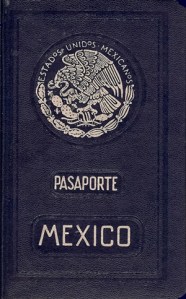
My Mexican Passport

In 1965 when I was a boy, my mother took us all the way from Chicago to Mexico City by train. We took one train to St. Louis where we spent the night sleeping on wooden benches until our next train departed for Laredo, Texas, in the morning. In Laredo, we boarded another train to Mexico City.

What I remember most about this visit to Mexico was my uncle’s fascination with American culture, particularly how important brushing one’s teeth was. He wanted to know what kind of toothpaste I used, what kind of toothbrush, how many times a day I brushed my teeth. He asked many other questions about our life in the U.S., but nothing mattered more to him than American dental hygiene!

Anyway, when we were packing to return to Chicago, my mother announced that my uncle was coming back with us. All he packed was a small handbag that was noticeably light. When the train arrived in Laredo, my uncle showed his documents to the authorities and slipped them some money. Everything was fine until we arrived in St. Louis. Some important-looking people boarded the train and questioned my uncle who presented them with his documents. The authorities then asked my uncle to go with them. I never saw my uncle in the U.S. again. I remember carrying his little handbag home and wondering what my uncle had packed since it was so light.

When we got home, my mother took the handbag for safekeeping. I was never to touch it or look in it. We would give it to my uncle when he would finally arrive in Chicago. Every now and then when I would snoop around in my mother’s bedroom closet, I would see my uncle’s handbag, but I would never open it. One day, I couldn’t resist the temptation anymore. So, I looked in the bag. All my uncle had packed for his trip to America was a toothbrush and toothpaste!

DDR

Language barrier


Back of the Yards, Chicago, Illinois.

When I was growing up, my parents always spoke Spanish at home. Once I began attending school, I was supposed to speak English at home. This way my parents would be forced to learn to speak English. This was a promising idea in theory, but the reality resulted in bilingual conversations in which I would speak English and my parents would speak Spanish. To this day, I still speak to my father in English; whenever I speak to him in Spanish, he doesn’t understand me.

When I was a boy, my mother sent me to the store to buy pork chops. She specifically told me to buy pork chops, but she told me in Spanish. As I’m walking to the store, I realize that I don’t remember how to say pork chops in English. I kept trying to remember as I walked to the store.

Luckily, there were two customers ahead of me. That gave me more time to think about what I had to buy. Unfortunately, I couldn’t remember the English name for pork chops. The best I could produce was “pig chops.” But I was too embarrassed to ask for “pig chops” because I knew that wasn’t the right term. So, I walked home empty-handed, and my mother asked me why I didn’t buy the pork chops. When I told her what happened, she said that I should have asked for “pig chops.” She didn’t know how to say pork chops in English, either.

That night, we ate chicken.

DDR

My father and I


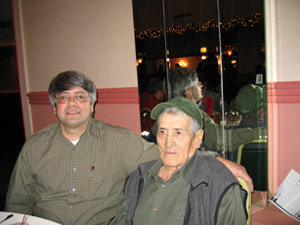
David Diego and José Diego Rodríguez

One day, I realized that I had become my father and had married my mother. Not literally, of course. Once, when I was at the show with my sons, I fell asleep during the movie. My oldest son woke me up, but I told him that I wasn’t sleeping. So, he asked, “Then what was the movie about?” And I didn’t know. So, he updated me on the movie.

But I had to ask myself, “What was this movie REALLY about?” Well, the truth is that I realized that I had become my father, who used to take us to the show and then fall asleep. The poor man worked the night shift, slept a few hours, and then would take us out to the movies on Saturdays without our mother. I have now become my father when I take my sons to the show and fall asleep at the show. But we all enjoy going to the show together! I was happy to go the show with my father even if he fell asleep. Otherwise, I would have missed a lot of good movies. My sons are happy going to the show, too, and they never complain if I fall asleep.

As a child, my father always took us to the circus every year. When I had children, I began taking my sons to the circus. The last few years, I have been going to the circus with my sons and my father, who is now 81 years old. On the last trip to the circus with my father, I told my sons, “See how I take my father to the circus? When I get that old, I want you to take me to the circus with your children!”

Well, it turns out that I did, indeed, become my father and marry my mother. But then I divorced her, just as my father did. Like father, like son. The candy doesn’t fall far from the piñata!

DDR

Lotería


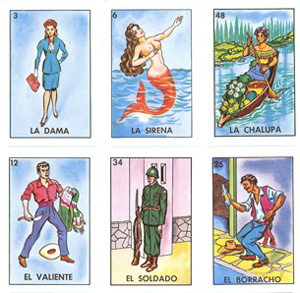
Lotería playing cards

Lotería.”

No, don’t say it like that. Say it louder.

“¡Lotería!

No, no, no! Scream it like you mean it! Yell it with passion! Now try it again.

“¡Lotería!

That’s much better. Now listen to me: “¡Lotería! ¡Lotería! ¡Lotería!” Did you hear the tone of my spine-tingling, blood-curdling, eardrum-shattering scream. You have to make your voice demand the attention of everyone in the room and the surrounding environs in order to brag to the world that you are the proud winner of ¡Lotería! Now get ready to be awarded your prize: a pack of Chiclets.

When we were little, we always played Lotería, whether we were in Chicago or Mexico. Lotería is a game very similar to Bingo–and sometimes people call it Mexican Bingo–where each player places markers on a card as the names of squares are called out. The first player to fill the entire card shouts, “¡Lotería!” and usually wins a small prize. Each card contains 25 pictures with the names listed below: La rosa, La dama, El valiente, El barril, etc. The names of the pictures are called out from a deck of cards that contains all the pictures. The cards are shuffled and called at random. The pictures on the card are marked by uncooked pinto beans. I always have fun playing Lotería. Especially when I win and I get to shout, “¡Lotería!” At our last family picnic, we played Lotería for 25 cents per card and the winner won the pot. It was certainly more exciting than playing for Chiclets.

When we were little, we once played Lotería with my cousins at their house. When we returned the next week, my mother noticed that my cousin Lulu had a strange odor emanating from her face. When my mother approached Lulu, she noticed that Lulu had extremely bad breath. My mother couldn’t understand how a five-year-old could have such foul-smelling breath. My mother looked in Lulu’s mouth, but saw nothing. However, while looking in Lulu’s mouth, my mother saw something suspicious in Lulu’s nose. My mother couldn’t tell what it was because it was so far up into her nasal passage. My mother and my aunt Marcela held Lulu down forcefully and used tweezers to pull the foreign object out of Lulu’s nose. Both my mother and my aunt shouted, “¡Ay, Díos mío!” They had extracted an uncooked pinto bean from Lulu’s nose. But the pinto bean had been in her nose so long that it had sprouted roots! Lulu must have put the pinto bean in her nose the week before when we played Lotería. So beware the dangers of playing Lotería, niños!

DDR