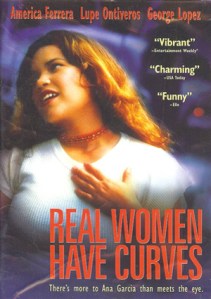
Real Women Have Curves


My Spanish students love this movie!

I really loved the movie Real Women Have Curves (2005, Directed by Patricia Cardoso) even though I’m not a woman and I’m not from Los Angeles. I laughed throughout the movie because I could identify with the Mexicans who were portrayed accurately in the movie. We could see the importance of family unity and how going to college could be perceived as a threat to this unity. Education is not viewed as a positive goal in a Mexican family that has relied on manual labor to survive. Carmen (Lupe Ontiveros) wants her daughter Ana (America Ferrera, as of late as Ugly Betty on TV) to work in her sister Estela’s dress shop instead of going away to college.

Ana finally gives in to her mother’s wishes, but you can see that Ana is not only unhappy there, but she really does not belong there because she has so much more potential than that of a laborer. But that’s how Mexicans think sometimes. Even though Carmen complains about how hard she has worked as seamstress throughout her life, she is willing to subject her daughter to the same punishment of manual labor.

Carmen also criticizes her daughter about her excessive weight, even though Carmen herself is overweight. However, beauty is in the eye of the beholder and Ana is beautiful in her own way. Her boyfriend Jimmy tells her that she’s beautiful and he seems genuinely sincere when he compliments Ana.

If she were in Mexico, many men would consider her beautiful simply because she has a nice smile, a nice personality, and is pleasingly plump. Once when I was in Mexico, my cousin saw a pleasingly plump woman and he flirted with her by saying, “Oye, esa gordita viene con atole?” Well, if you don’t know Spanish, I better explain that in this context gordita means both pleasingly plump with positive connotations and also refers to a food that is made of corn flour stuffed with chicken or beef; atole is a tasty, hot drink made from corn. I guess this sentence doesn’t translate well, so I’ll give you a similar example in English. Suppose an attractive woman, say dressed seductively in a short skirt, struts her stuff past you, jiggling all her assets, my cousin could say something like, “Does that shake come with fries?”

This difference in beauty standards reminds me of a story that Rosie O’Donnell once told on a talk show–I believe it was Johnny Carson’s–before she was really famous. She talked about how she went to Mexico with a thin, beautiful Hollywood actress, which at the time I wondered why she would go to Mexico with another actress. Well, now that she’s famous and I know a little more about her personal life, I know why she went to Mexico with a thin, beautiful Hollywood actress. Anyway, Rosie and her thin “friend” were at a bar where all the men were hovering around Rosie instead of her friend. Finally, Rosie asked one of the Mexican men why they found Rosie more attractive than the beautiful actress. One of the men said, and you must imagine Rosie saying this with a Mexican accent, “The bones are for the dogs. The meat is for the men!”

Well, this movie really got me to think about my mother again, whose name also happens to be Carmen. My mother never valued education and there was absolutely no possibility of college in my future. She always told me that I would work in a factory when I was old enough to work. But she would always complain about how factory work was wearing her down. She always came home sore and tired from working.

One day, she showed me her swollen hands and said, “Someday you’ll see what it’s like to work hard. One of these days you’ll be working in a factory just like me.” I didn’t plan to ever work in a factory, so I told her, “That’s why I’m going to college!” She said, “Why are you going to college if you’re only going to work in a factory?” She couldn’t imagine any other occupation for me.

She eventually found me a factory job–a job that would have been ideal for my mother, but not for me because I had such higher aspirations. However, since I lived under her roof, I had to live by her rules, so I began working the midnight shift in a peanut butter factory two days before my eighteenth birthday, while I was still a high school junior. I really hated this job! When I got out of work at 7:00 a.m., I immediately had to get ready to go to school even though I was ready to go to bed.

I was always tired in school and often fell asleep during my afternoon classes. I told my mother that I couldn’t work full-time and go to school full-time. She told me that if I didn’t work, I couldn’t live with her; I would have to move in with my father, which she had always described as being my worst possible destiny. So, I continued working at the factory, but when I couldn’t take the stress of working and going to school anymore, I dropped out of high school. My mother didn’t complain because I was still working, and I was contributing to the family financially.

In the movie, Ana gets accepted to Columbia University with a scholarship, but her parents are against Ana leaving the family in order to study in New York City. Her father finally gives his blessing to Ana, but Carmen doesn’t even say goodbye to Ana when she leaves for school. Carmen merely watches from her bedroom window. But you can see that not all Mexicans value education as much as most Americans who know the importance of going to college to get ahead in life.

When you consider this anti-education attitude of Mexicans in general, you can see why they have a high school drop-out rate of about 50%. At least the movie ends on a positive note with Ana going off to Columbia University and we get to see her walking the streets of NYC near Times Square.


DDR

Men don’t cry!


Evanston, Illinois

Even as a young boy, I was always taught that men don’t cry. I never really saw the men in our family cry, except at funerals. I only saw my father cry when his mother died, his father died, his younger brother died in Viet Nam, and when my mother died. No one criticized the men for crying then. And the men never cried tears of joy.   

But when I was little, I was always reminded not to cry whenever I fell, I didn’t get my way, or someone hit me–even when my mother hit me with the belt. Either my mother or my abuelita would constantly say, “Los hombres no lloran” [Men don’t cry!]

Sometimes when I cried, my mother would hit me and say, “¡Para que tengas algo para llorar!” [So you have something to cry about!] Once when I was about nine, I got beat up by one of the boys on the block and I came home crying. When my mother saw me, she asked me why I was crying. I told her what had happened, and she started hitting me. She made go back out to beat up the boy who had beat me up. Well, I went back to the boy’s house, and I beat him up–and I beat him up good! He felt all the pent-up anger that I had built up inside of me from the previous two beatings–the boy’s and my mother’s. But I finally understood that men don’t cry.   

So, I learned to control my emotions. I didn’t cry when my paternal grandmother died; I was too young to understand. I didn’t cry when my paternal grandfather died; he died when he was 68 and he had fathered 18 children, so it wasn’t exactly a tragic death.

However, I did cry when my uncle Joseph Rodríguez died in Viet Nam; I cried because he was only 22. And I thought that I, too, would die in Viet Nam.

When my mother died, we had a lot of unresolved issues between us. I think the main reason I didn’t cry when she died was because I constantly heard her saying, “¡Los hombres no lloran!”   

DDR

Enrico Mordini


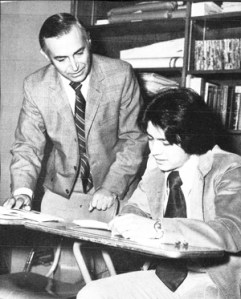
Enrico Mordini with Jerry Rodríguez at Divine Heart Seminary

Years ago, I attended Divine Heart Seminary in Donaldson, Indiana. I recently went to a DHS reunion where my classmates and I remembered our Spanish teacher Enrico Mordini. Señor Mordini was the Spanish teacher who taught me a lot about being Mexican even though he was an Italian born in Italy and raised in Spain. He taught me that there is more than one way to speak Spanish. I never realized there were so many dialects. I was originally in his Spanish I class, but he moved me up to Spanish II because I knew some Spanish. I had always wanted to learn Spanish formally so that I could read and write it. As an aside, when I attended Holy Cross Grade School, since the Lithuanian school didn’t offer Spanish classes, I asked if I could go to Saturday morning classes to study Lithuanian. I was told, “First, you have to learn English.”

Once I started classes with Señor Mordini, I questioned whether I even knew Spanish. He said some words so differently from my mother that it took me some time to recognize them. For example, “to drink” to my mother and me was “tomar” and to Señor Mordini it was “beber.” I had never even heard the word “beber” before! When my mother said “good” in Spanish, she would not say it the same way as Señor Mordini’s “bueno,” but rather, she would say, “güeno” instead. The Spanish word for needle was “aúja” to my mother and me, but to Señor Mordini, it was “aguja.” Our word wasn’t even in the dictionary without the letter g. When I informed my mother of these differences, she said that’s because Señor Mordini spoke “castellano” and not “español.” When I told Señor Mordini what my mother had said, he said that “castellano” and “español” were synonyms for the Spanish language. My mother never really believed him! After all, he wasn’t Mexican. In fact, he wasn’t even Spanish either. He was Italian!

Once while discussing Mexican culture in class, I said that I knew all Mexicans were a mixture of Spanish and Aztec blood. I was shocked when he said that was only partially true because not everyone, in fact, not many people were purely of Spanish and Aztec ancestry. I insisted that I was right. Even my father had told me so. Even after several convincing arguments by Señor Mordini that there were people in Mexico of pure, unmixed Spanish blood , I still didn’t believe him. When I reported this to my mother, she said that not all Mexicans were only of Spanish and Aztec ancestry. In fact, her grandfather had been Irish! “What?” I was so shocked. “Why didn’t you tell me before?” I asked my mother. She just nonchalantly said, “I didn’t think it was important.” Suddenly, I was sixteen and learning for the first time that I had more than just Spanish and Aztec blood coursing through my veins. In fact, I might not even have Spanish or Aztec blood coursing through my veins. I was in shock! It took me years to adjust to this new discovery about my ancestry. Was this a possible explanation for why my best friend in the Catholic Lithuanian grade school was Patrick McDonald from Ireland? But the fact remained that Señor Mordini was right again!

Years later, when I applied to teach Spanish at a community college, I was hoping against hope to get the position because I saw in the school catalogue that Señor Mordini was on the faculty! But such was not my luck. Señor Mordini died that year and I didn’t get the position! I suffered two severe blows at once. But I was lucky enough to have met Señor Mordini when I did. He certainly made more aware of myself and made me a much better person.

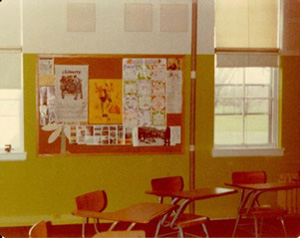
La clase del señor Mordini

Above: This was the Spanish classroom at Divine Heart Seminary in Donaldson, Indiana, in the 1970s. This is one of the many schools where Señor Enrico Mordini taught. As an aside, Señor Mordini had a good sense of humor and got along well with the students. Once my classmates talked me into hiding in the fire escape, which was a giant slide in a huge metal tube on the right in the picture but out of view, and Señor Mordini humored us by looking for me wherever my classmates suggested: under his desk, under the student desks, behind the bulletin board, etc. 🙂

DDR

Life in Mexico


Mexico D.F.

Once when I was I boy, I visited Mexico, and I realized that I wasn’t Mexican. I was American! All my Mexican cousins told me so. I didn’t speak Spanish as well as them. My Spanish vocabulary was lacking compared to them. I always had to stop to think in order put my thoughts into Spanish. Even though I spoke Spanish with my family and friends in Chicago, I had lost what little Spanish I had, and I never improved my Spanish vocabulary by constantly speaking Spanish with Mexicans from Mexico. Well, some of the children made fun of how I spoke Spanish and called me gringo.

Well, one day, I noticed that my aunt had various copies of Life Magazine in her house. I immediately recognized the Life logo, white letters in a red block. I was so excited because now I would be able to read something in English! But upon picking up the magazine and flipping through the pages, I realized that the magazine was published in Spanish. One of my cousins asked me what I was reading, and I told him, “Life,” but I pronounced “Life” in English. He asked me to repeat it, and when I did, he said that I didn’t know Spanish because I didn’t call the magazine, “Li-fe,” pronounced in Spanish as two syllables. I explained that “Life” is an English word and so I pronounced it in proper English as a one-syllable word, with a silent e. Of course, he didn’t believe me. I was still el gringo who couldn’t speak Spanish. Not only that! I also couldn’t speak English! He called my other cousins over and told them about how I had my own peculiar way of pronouncing “Li-fe.” Well, after that, they constantly quizzed me about the pronunciation of “Li-fe.” Remember, “Life” in Mexico is “LI-FE” with two syllables!!

DDR

Flor de Mayo


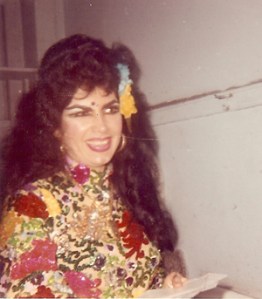
Irma Serrano, The Peoples Theater, Back of the Yards, Chicago, Illinois.

My mother always helped Mexicans who were new to Chicago. Whenever people threw away furniture, I would have to help her bring it from the alley to our basement until she could give it to someone who desperately needed furniture more than us. Many Mexicans came and went from my house because not only would my mother give them furniture, but she would also advise them on how to survive in Chicago.

My mother went to Mexico about once a year. She loved Mexico so much because the Mexicans in Mexico loved her and envied her because of her success in America. One year when she returned from her Mexican vacation, I overheard her calling the Spanish TV station and I asked her why. She had met a single Mexican mother with a one-year-old daughter. I don’t remember the woman’s name, but she also played guitar and sang songs she wrote herself. My mother had convinced this woman to come to Chicago because my mother knew people at the radio and TV stations. Important people!

So anyway, my mother told this woman she would have a promising musical career if she left Mexico and came to Chicago. Somehow, my mother convinced this woman to come to Chicago and she was scrambling to get her an appearance on the radio or TV. My mother was so sure that this woman was an extremely talented musician! I don’t know how she did it, but after a few days, my mother got her on the radio and on a TV show. I remember she rehearsed at our house a few times before her appearance. I was only about ten years old at the time, but I thought she performed very well, and she was so beautiful!

Sometime after her public appearances, she returned to our house to show us her new 45-rpm record. I don’t remember how well it sold, but she had a record! Her manager gave her the stage name of Flor de Mayo. We were all excited that Flor had made it, but none more excited than my mother who had exaggerated her connections to get Flor de Mayo to come to Chicago all the way from Mexico.

At my mother’s wake, many people, most of them Mexicans, came to pay their last respects to my mother. We had a three-day wake, which families no longer have. I saw a lot of people whom I hadn’t seen for years. The biggest surprise arrival was a woman who approached me, shook my hand, hugged me, and said in Spanish, “If it wasn’t for your mother, I wouldn’t be here in Chicago!” She was rather plump by then but still beautiful. I recognized her voice, but I couldn’t place her, so I asked her who she was. She said, “Flor de Mayo.”

DDR