I’ve had a few of my Spanish students ask me were the Spanish term, ese comes from.
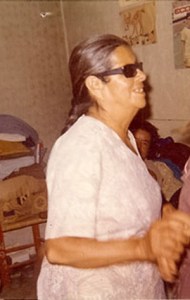
Well, now it can be told! I really believe my abuelita, my grandmother, started it. When we had our holiday parties, say for Thanksgiving Dinner or Christmas at my uncle’s house, more than one-hundred family members and friends would show up. We didn’t always know everyone’s name. This was before the invention of nametags. I remember asking people there, “And how are we related?” “I’m your cousin Agustín. You met me in Mexico when we were four.” “Oh, yeah, now I remember you,” I would lie. At every party, I would always meet a new family member whose name I would forget by the next party.
I have never been good at remembering names, but my abuelita had an even worse memory for names. I do believe I inherited this deficiency from my abuelita. At dinner, everyone would have to eat in shifts in the kitchen. She would make sure that everyone at the party ate in a smooth, systematic manner.
With my abuelita coordinating everyone and controlling the distribution of food, no one went hungry. Of course, that would involve everyone in close proximity of my abuelita to participate and obey her direct commands to the letter. The punishment for disobeying was a rap to the hand with a wooden spoon! Everyone entering the kitchen was on their toes.
So if you were standing by the stove and she didn’t remember your name, she would point at you and say, “Ese, dame el arroz.” [That one, give me the rice.] Since my abuelita couldn’t remember very many names, just about everyone in the house became ese. So now whenever I hear a Mexican say, “Oye, ese,” I think of my abuelita!
Last Sunday, I watched the Gold Cup soccer / fútbol match between the U.S. and Mexico. Okay, I have to admit that my allegiance was divided. Not only could I not decide which team to root for, Mexico or USA, but I was also switching channels so I could watch the White Sox play the Cubs. Talk about mental anguish! No matter which team won, USA or Mexico, I would feel some sort of disappointment. On the other hand, I wanted the White Sox to win since I am a southsider. The Cubs won. 😦 Sniff!
Well, team USA won, much to the disappointment of the Mexico fans who outnumbered the USA fans at Soldier Field. Almost three million households tuned in to watch the game. However, it was broadcast only on Univision, a Spanish-language station. Not enough Americans were interested in watching a soccer game. Ironically, a female announcer interviewed a flagged-draped American from the winning team and he spoke to the announcer in fluent Spanish! Doesn’t this send mixed signals to the general public about American culture? How do we deal with the English only issue when Americans are speaking languages other than English? At least we beat someone at their own game, that is, a non-American sport.
This reminds me of the immigration debate now before President Bush, the senate, and congress. No matter how many amendments are added to the bill, someone is disappointed, particularly the illegal immigrants who seek amnesty. There are too many issues to satisfy everyone. The immigration issue will not soon be resolved.
Have you seen the new movie Bandidas? Have you even heard of the movie Bandidas? You haven’t? But it premiered in France on January 18, 2006, and in Spain on August 4, 2006. This movie stars Salma Hayek and Penelope Cruz! What do you mean you haven’t heard of Bandidas?
Actually, I’d be surprised if you had heard of Bandidas. I almost didn’t hear of it myself. In the direct to DVD phenomenon of movie magic for profit, I read about the Bandidas DVD release couple of months back in Hoy, the Spanish newspaper I get delivered to my house for free. I looked to buy the movie at the usual places where I buy DVDs, but I couldn’t find it anywhere. And I also thought it would be in Spanish because I read about the movie in Spanish in a Spanish newspaper, but not in any of the newspapers printed in English! Well, I couldn’t find the movie in theaters or at the store, and once I did find it, I was disappointed because it was English! I found the movie when I bought a hard drive for my home network that was bundled with three free movies that I could download as part of a trial service for home movies. One of the free movies that I downloaded was Bandidas, since I wanted to see it after reading about it. I hate to say this, but I am sure glad I didn’t pay for it.
Hayek and Cruz are great actresses who wanted to make a movie together for the longest time, hence Bandidas. However, this certainly was not one of their best acting performances. Hayek was much better playing Frida Kahlo. And Cruz, well, I will never forget her incredible performance as a pregnant nun with AIDS!
Anyway, the movie is set in Mexico in the 1880s or thereabouts. Hayek plays Sara Sandoval, a spoiled, European-educated Mexican woman, and Cruz plays María Álvarez, a poor Mexican peasant. I was disappointed that the movie was in English, but relieved that Cruz spoke English with a Mexican accent, rather than her usual English with a Spanish accent that sounds as if she’s from Spain, which she is, by the way. An evil American railroad magnate decides to buy the land in the path of their new railroad line by whatever means possible, including killing landowners who refuse to sell. The attempted murder of Álvarez’s father and the murder of Sandoval’s father sets the contrived plot in motion, which reminded me of those made-for-TV movies from the 1970s. So Álvarez and Sandoval learn to rob banks and save the day by stopping the evil American. Were you expecting a better ending? So was I.
I loved the panoramic Mexican scenery as Sandoval and Álvarez traveled across Mexico. Those Mexican mountains are quite beautiful! However, they were no match for the mountainous cleavage of Hayek and Cruz. What mountain climber could resist scaling those peaks? Talk about gratuitous cleavage scenes! Of course, it’s a well-known fact that the quality of a movie is directly proportional to the amount of cleavage shown. But deep down inside, I know that their cleavage was necessary for plot development. Otherwise, they would have never gotten the help they needed by enticing their male partner Quentin Cooke to join their bank-robbing spree.
The movie does portray Mexicans in a realistic light, including the social and class distinctions. There are good politicians who care for the general welfare of their people and bad politicians who are greedy and assist the evil American railroad magnate. But as far as Mexican realism, I preferred Nacho Libre because it pulled no punches describing Mexican poverty. I’m not sure I can recommend Bandidas. If you happen to run across it–but don’t go out of your way to find it–go ahead and watch it. But don’t say I didn’t warn you!
My mother and I had a love / hate relationship, but what I remember the best about her was her sense of humor. She always knew how to make me laugh when I was little. She always told me jokes, by way of acting them out, and I would always laugh; when she repeated a joke, I would still laugh because she would always tell it slightly differently and the joke would be funny to me all over again.
Whenever I heard new jokes, I would tell them to her. She would always laugh even after I told them several times. And she wasn’t faking the laughter, either. Jokes, especially her own, always made her laugh. Everyone in my mother’s family enjoyed laughing–a lot! Whenever we went to Mexico, we always sat around after a meal telling jokes. Everyone always had a joke to tell. And someone would always request to hear their favorite joke. Some jokes made everyone laugh repeatedly. My mother usually told a lot of jokes and would be asked to repeat some of her jokes. I don’t remember all her jokes because it’s been a long time since I thought of them, but I will do my best to recall some of them. Here are a few of her jokes:
A woman is on an airplane with her baby. The man sitting next to her is continuously making fun of the baby and repeatedly telling the woman how ugly her baby is. The woman finally breaks down in tears. The flight attendant notices the commotion and approaches the woman. “What’s wrong?” asks the flight attendant. The woman says, “This man keeps bothering us.” The flight attendant finds another seat for the woman and her baby. The woman is satisfied with the new seat and thanks the flight attendant who tells the woman, “Everything will be okay now. Just let me get a banana for your monkey.”
A motorcyclist wore his jacket backwards to prevent the wind from hitting his chest. He crashes into a tree and a passerby tries to help him. When the ambulance arrives, the paramedics ask, “How’s he doing?” The Good Samaritan answers, “He was doing fine until I turned his head to face the right way.”
I can’t remember exactly how this joke went and I probably won’t tell it well, either, but it’s about a man who lives in the rural area of the state of Veracruz in Mexico. He must go to the big city of Veracruz, Veracruz, for the first time in his life and take the train to visit his dying grandmother. He has never seen a train before, so he asks what it looks like. They tell him that it’s big and black and puffs smoke. When he arrives in the city of Veracruz, he sees a well-dressed black man wearing a suit and smoking a big cigar. So, he jumps on the black man’s back thinking that he’s the train.
Of course, just reading the jokes now, they don’t seem as funny. You must imagine mother acting them out. Part of what made them funny was how my mother tried not to laugh as she anticipated the punchline. When she finally reached the end of the joke, she would laugh the loudest. Those jokes still make me laugh when I imagine my mother telling them. ¡Ja, ja!
Once when I was I boy, I visited Mexico, and I realized that I wasn’t Mexican. I was American! All my Mexican cousins told me so. I didn’t speak Spanish as well as them. My Spanish vocabulary was lacking compared to them. I always had to stop to think in order put my thoughts into Spanish. Even though I spoke Spanish with my family and friends in Chicago, I had lost what little Spanish I had, and I never improved my Spanish vocabulary by constantly speaking Spanish with Mexicans from Mexico. Well, some of the children made fun of how I spoke Spanish and called me gringo.
Well, one day, I noticed that my aunt had various copies of Life Magazine in her house. I immediately recognized the Life logo, white letters in a red block. I was so excited because now I would be able to read something in English! But upon picking up the magazine and flipping through the pages, I realized that the magazine was published in Spanish. One of my cousins asked me what I was reading, and I told him, “Life,” but I pronounced “Life” in English. He asked me to repeat it, and when I did, he said that I didn’t know Spanish because I didn’t call the magazine, “Li-fe,” pronounced in Spanish as two syllables. I explained that “Life” is an English word and so I pronounced it in proper English as a one-syllable word, with a silent e. Of course, he didn’t believe me. I was still el gringo who couldn’t speak Spanish. Not only that! I also couldn’t speak English! He called my other cousins over and told them about how I had my own peculiar way of pronouncing “Li-fe.” Well, after that, they constantly quizzed me about the pronunciation of “Li-fe.” Remember, “Life” in Mexico is “LI-FE” with two syllables!!





 Chicago USA