Why study Spanish?


I’ve been teaching college Spanish for twelve years now. Every student has his or her own reason for studying Spanish.  Most college students take Spanish because of the foreign language requirement. I remember one of these students who barely passed the course. When I corrected the first exam, I felt bad for her because she had only earned a D. When she saw her exam grade, she shouted, “Yes!” I was worried that perhaps I had given her the wrong grade. The entire class turned to look at her. She then shouted, “Yes, I got a D!” She was so proud of herself. She went through this ritual after every exam. I gave her a final grade of D for the course. The next semester, I saw her in the hallway, and I was hoping she wouldn’t see me because I thought she was unhappy about her grade. But alas, she saw me and approached. Suddenly, she smiled and said, “Thanks for the grade you gave me!” And she was genuinely happy about it. Then, she added, “I had a lot of fun in your class.” I was shocked by all this, but I must admit that it was all very rewarding.

So, I was thinking of other reasons that my students took Spanish. Here are some:

  1. I’ve always wanted to learn Spanish.
  2. My wife speaks Spanish.
  3. My husband speaks Spanish.
  4. It’s a beautiful language.
  5. I want to go to Mexico on vacation.
  6. Most of my customers speak Spanish.
  7. My parishioners speak Spanish.
  8. I want to move to Mexico.
  9. I want to go to a Mexican restaurant and order food in Spanish.
  10. I want to see Penelope Cruz movies in Spanish.
  11. There are so many Mexicans here, we’re all going to have to learn Spanish anyway.
  12. I want a sexy Mexican girlfriend.
  13. I’m Mexican and I can’t speak Spanish.
  14. I think the cooks in the kitchen are talking about me.

DDR

Matilde


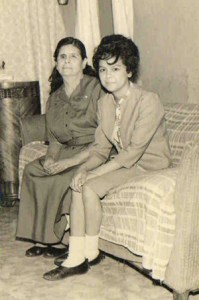
Mi abuelita y tía Matilde

My tía Matilde came to Chicago as part of the package deal when my abuelita came for eye surgery. Tía Matilde also needed surgery, so she came from México to have surgery on her ears. I’m not sure what exactly was wrong with her ears, but she was otherwise healthy.

My aunt was very young when she came, and she liked living in Chicago. She loved listening to pop music on the radio and she bought all the records by her favorite singer, Rick Nelson. She went wild when listening to his music.

What I remember most about my tía Matilde was how she did laundry. We, my parents, my three brothers, my abuelita, my tía Matilde, and me, all lived in a small four-room apartment. We had a washer and dryer in the kitchen next to the sink. When my parents were at work, tía Matilde would do all the laundry in the house, every handkerchief and sock. She would search everywhere in the apartment for dirty clothes. She found dirty clothes where I would never even think of looking. She just had to make sure that every last item of dirty clothing was clean when she was done doing the laundry. And so, when all the dirty clothes were in the washer, and there was a little room in the tub for more clothes, she would start taking off her clothes right at the washer and start putting them in the washer. She would be standing in the kitchen wearing nothing but her bra and panties, proud of the fact that all the dirty clothes in the house were now washed, obviously oblivious to my presence.

Back then, we always seemed to be either at home or at Cook County Hospital taking either my abuelita or tía Matilde to the doctors there. Anyway, my tía Matilde, who would undress at the washer, was very shy with the doctors when they asked her to disrobe. The day of her surgery, she refused to undress and refused to put on the hospital gown because it had no back to it.

I still remember her telling this story when she returned from her surgery. She absolutely refused to undress for the nurses and doctors. She thought she had won her battle, but after the surgery, she woke up in her hospital bed and immediately realized that she was completely naked! Whenever she told this story, she always sounded so shocked that this could have happened to her despite her precautions. She didn’t even remember when or why she lost consciousness. She always wondered who managed to see her naked. She would blush every time she told the story.  She was truly traumatized by this experience!

She eventually went back to México with my abuelita.

DDR

Olivia Maciel


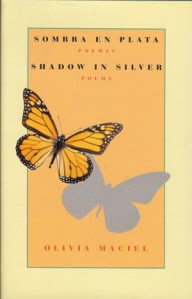
Sombra en plata por Olivia Maciel

Olivia Maciel is a poet who was born in Mexico City, but has lived in Chicago a long time. She has written several collections of poetry over the years. She writes poetry in Spanish, but her books include an English translation on the facing page. I recently read two of her collections: Sombra en plata [Shadow in Silver], Chicago, Swan Isle Press, 2005, and Luna de cal [Limestone Moon], Chicago, Black Swan Press, 2000. All her books are available for purchase on Amazon.com.

I first met Olivia in one of my graduate classes at UIC. We took several classes together while earning our master’s degrees. She graduated from the University of Chicago with a Ph.D. When Octavio Paz died, she published an article about her reactions to his death that appeared in the Chicago Tribune. We occasionally bump into each other at UIC because we are both Spanish lecturers there. I really enjoy talking to her because she’s so creative. Sometimes, she begins writing poems as we speak. She says that I inspire her when we talk. I asked her if she would hire me as her muse.

DDR

New Year’s Eve


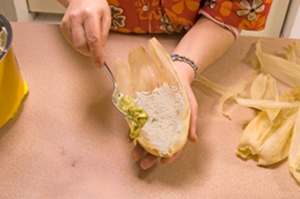
Making tamales with TLC

I have many fond memories of New Year’s Eve beginning in my childhood when our entire family would go to my Uncle Simon’s and Aunt Mari’s house. The party always involved eating a lot of  Mexican food and real hard play among cousins. At midnight, everyone, I mean children, too, toasted with a glass of champagne. That was the only time of the year I drank alcohol–until I became an altar boy and my friend once talked me into taking a sip of altar wine before mass.  But I only indulged that once because I felt so guilty and sinful afterwards.

Once, we were in Mexico for New Year’s Eve and we celebrated by making tamales and eating them. In Chicago, my mother made the masa during the day and then made buñuelos at midnight as a way of ringing in the new year. I think that New Year’s Eve wasn’t as exciting once we stopped going to my aunt’s and uncle’s house. I don’t really remember too many of those later celebrations now. When I was married, I was content to stay home with my wife and son and watch the festivities in Chicago on TV. When I lived in Bridgeport, I used to take my oldest son to the attic window at midnight where we could see the fireworks downtown. When the twins were born, we moved farther away from downtown, so we could no longer see the fireworks from the window. But we watched them on TV, although not quite as dramatic.

Later, after my divorce, my Mexicana girlfriend decided that we would make tamales for New Year’s Eve. She bought a giant pot for the tamales and lots and lots of masa. We would make tamales together, just the two of us. Actually, I enjoyed making the tamales. In Mexico, I only got to watch the women of the family make the tamales; males weren’t allowed to touch the masa. My girlfriend showed me how to mix the meat into the masa and stuff the masa into the corn husk. She had made tamales a few times and actually knew what she was doing. We even made some sweet tamales with raisins. We had about six different kinds of tamales. We literally did this for at least two hours and the giant pot was still only half-full. However, she insisted that we fill the pot all the way to the top. We filled the pot at about 3:00 a.m. And I was exhausted!

But wait! She put a penny at the bottom of the pot where there was boiling water to steam the tamales. The flame underneath had to be at just the right temperature and you could tell if the temperature was just right because the penny would keep making noise as the boiling water moved it. The only time I really saw tamales made was in Mexico as a boy, but my mother and aunts cooked the tamales over a bonfire.

Well, I went to bed about 6:00 a.m. because I couldn’t stay awake anymore. She stayed up to keep adding water and ensuring that the tamales cooked properly. I didn’t realize they would involve so much work. She woke me up a few hours later when they were done. She had stayed up the whole time! We then ate the tamales and they were so delicious! We ate them later that day. And the next day, too. There were so many tamales that she put some in her fridge and froze the some in her freezer. And there were still some tamales leftover! So I took some home and put them in my freezer. We ate tamales until the Fourth of July! And we never got tired of them. We loved them!

¡Happy New Year! ¡Próspero Año Nuevo!

DDR

My Mexican relatives


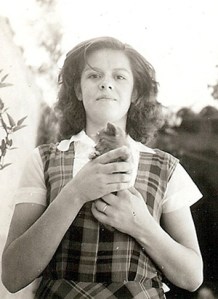
María del Carmen Martínez Valdivia

Well, I sure learned a lot about my family on this trip to México. For one, most of the stories that my mother told me about her family weren’t true! While talking to my cousin, I realized that none of the facts matched most of the stories my mother told me when I was a boy.

For example, my mother would often tell me how when she was a girl, she wanted a life-like doll for her birthday. One that cried like a real baby, drank a bottle, and wet her diapers, etc. And on my mother’s birthday, my tía Jovita was born. That was the birthday present my mother really wanted! Well, I told my cousin this story and she said that tía Jovita’s birthday is on December 24. So, this doesn’t match up to my mother’s birthday on April 27! Later, I discovered that my mother did get her birthday present, but it is my aunt Matilde, not Jovita. I had forgotten the birthday present’s name.

Also, everyone in México always knew my mother as Helen. When I was little that’s what my father called her. I always knew her as Helen, too, until she became a U.S. citizen, and she changed her legal name to Carmen M. Rodríguez. When my mother died, I was surprised to discover that her real name, based on her birth certificate was María del Carmen Martínez Valdivia.

When I was little, my mother always told me how she and her sisters didn’t like their given names, so they changed them to something that they really liked. Mariana Anita became Esthela, María del Carmen became Helen, María became Marusa, Rebeca became Jovita. Unfortunately, I can’t remember her sister Laura’s original name. Their brother Alfredo always remained Alfredo. Go figure!

My cousin also told me that her mother told her how my mother used to dress in boy’s clothes and insisted on being called Alejandro. Of course, I’m not sure how true this story is because it turns out my tía also liked to embellish her stories. But if it is true, what a coincidence that I also liked the name so much that I named one of my sons Alejandro!

DDR