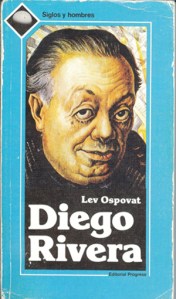
Translated into Spanish, published in Moscow, Russia
When I moved from Marquette Park to Bridgeport, I really missed having a bookstore a mere block away. Bridgeport had the reputation of being the center of city politics, rather than being an incubator of intelligence. So, needless to say, Bridgeport had no bookstores at all! Even their Salvation Army lacked a book section!
One day in the early 1990s, I was shocked when I saw an empty storefront on the 3100 block of South Halsted Street open as Modern Bookstore. For a neighborhood bookstore, it was very big. I was there the very first day it opened. The woman who greeted me let me browse for a while. I wasn’t sure what to expect from this bookstore, especially for one in the heart of Bridgeport. Imagine my surprise when I saw that most of the books were about socialism, communism, and labor unions. The woman asked me if she could help me find something. I asked to see the fiction section, but there was none. Then, even though I was sure that she would say no, I asked if they had a foreign language section. I told her I was interested in buying books in Spanish. Would you believe it? They did have a Spanish section that was actually bigger than most of the others in Chicago bookstores I had visited. And they actually had books by authors and biographies of political figures that I had actually heard of.
I bought a poetry anthology by Nicolás Guillén. Later, when I read the book, I discovered that the book was published in La Habana, Cuba, and probably shipped to the U.S. violating at least one embargo law. But wait, I also bought biographies about Diego Rivera, Benito Juarez, Benardo O’Higgins, and a few others that were written in Spanish. Much later, I realized that the books were written by Russian writers and later translated into Spanish. All these books were published in Moscow, Russia. I wondered if there would be any trouble if our local politicians had actually visited the Modern Bookstore and realized what kind of books the bookstore was selling there. But then I realized that’s why there wasn’t a bookstore in Bridgeport in the first place. No one in Bridgeport reads!
Bridgeport is a neighborhood unlike any other in Chicago. Actually, there are two Bridgeports: the mythical, political Bridgeport that every Chicagoan hears about since starting school and the earthy, gritty Bridgeport that contrasts sharply with the mythical, political version.
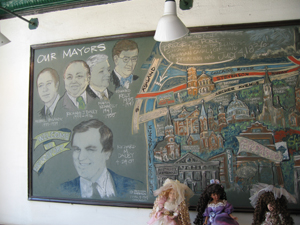
In grade school, we learned all about Bridgeport, which is the birthplace of five Chicago mayors, including the present Mayor Richard M. Daley (Richard da Second). Bridgeport didn’t invent machine politics; they merely perfected machine politics, reaching its apogee in Mayor Richard J. Daley (Richard da First). Bridgeport is also very near the geographical center of Chicago. Many south siders often went to the White Sox games at Comiskey Park in Bridgeport. When I was a student at Holy Cross School, no school field trip would be complete without first driving past Mayor Daley’s bungalow at 3536 S. Lowe Avenue. Bridgeport was the Mecca of the south side. Every Chicagoan made a pilgrimage to Bridgeport at some point in their life.
When I told my mother that I was planning to buy a house in Bridgeport, she cringed and told me that I would regret it. For some unknown reason, I was drawn to Bridgeport. Besides, this was the location of the only house I could afford using the GI Bill. But before I bought this house, I checked out the neighborhood first. I drove past the house several times, at different hours of the day and night. Every time I drove past my future home, the block was extremely quiet. I never saw any movement in this vicinity at any time. I was sure that I was moving into a good neighborhood. After all, this was Bridgeport. So, I bought the house, much to my mother’s disappointment, and I moved in.
This was when I saw the earthy, gritty side of Bridgeport for the very first time. You don’t really know a neighborhood until you move in, and you live there 24/7/365. It was only then that I saw the seedy side of Bridgeport. My house was situated next to an alley that ran alongside the length of my house, an alley that everyone in the neighborhood used as a shortcut. I always heard whoever walked through the alley talking, at all hours of the day. Then one day, I noticed that Bridgeport had a gang problem, and my house was right on the border between two gang turfs. My neighbor always tried to start a fight with me by pointing to my camouflage shirt, a remnant from my Marine Corps enlistment, and tell me, “Hey, man! The war’s over!” I would ignore him and walk past him quickly. It was about that time that I learned that there were two sides to Bridgeport. And I lived on the wrong side of Bridgeport! I lived on the side where the public housing projects were located, the only white projects in the whole city of Chicago!
While I lived in the Marquette Park neighborhood, I had developed certain habits and I thought I could continue them when I saw all the stores, shops, and restaurants that were available in Bridgeport. I really thought that I would enjoy all these places that were within walking distance of my house. I went to Lina’s Italian restaurant that was less than one block from my house because they served authentic Italian food. Or so I thought. When I entered the restaurant, I was greeted by Lina herself. I asked for the beef ravioli because I love authentic beef ravioli. Lina said, “It takes too long to make.” I said, “That’s fine. I’m not in a hurry tonight. I brought a book that I can read while I wait.” “Well, I’m not going to make ravioli just for you. Why don’t you order something else?” So, I did. But I went back a few times hoping to eat ravioli, but she always refused to make it.
I once needed a button sewn on my winter wool coat, so I went to a tailor on Halsted Street. The tailor said, “You want this button sewn on? Why don’t you buy yourself some needle and thread and sew it on yourself?” He didn’t understand that I didn’t want to sew it on myself and that I was willing to pay him to sew the button on for me. He continuously refused, so I left.
I went down the block to the barbershop that appeared to be in a continuous state of disrepair, since at least the 1960s, judging by the newspaper clippings on the wall. There were no customers in the store, so the barber was sitting in a chair. When I entered, he stood up and said, “How may I help you?” I told him that I wanted a haircut. Well, he wasn’t giving haircuts that day. So, I left.
Then, I went to the 11th Ward Office because I needed garbage cans for my house. They refused to give me garbage cans because I didn’t appear as a registered voter within their ward even though I had just moved there. I left without garbage cans. This was certainly a fine welcome to Bridgeport. I eventually adjusted to life in Bridgeport. You just had to learn not to have too high expectations.
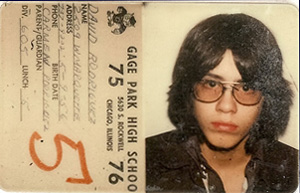
I can’t believe my mother let me grow my hair this long!
Everyone called him Hildago and he never corrected anyone. Years later, I discovered that his surname was actually Hidalgo, which is derived from the Spanish hijo de algo meaning someone with wealth.
I first met Hildago when I had my paper route. Later, when I was promoted to branch captain (Sounds impressive, doesn’t it?), I was his boss. He was Mexican, but he didn’t speak Spanish. Now that I think of it, he only kind of looked Mexican.
Hildago is one of those persons whom I often meet when I least expect to. I knew him as a paper boy. Then I didn’t seem him for years until I went to Tilden Technical High School. We were in an English class together where the teacher really didn’t teach anything and we talked the whole period or read comic books in class. That’s when I learned his real name. He was the one kid my mother told me to avoid. She just didn’t like him, for whatever reason I never found out. The more she tried to break up our friendship, the closer we got.
When we moved out of Back of the Yards to Marquette Park, I didn’t see Hildago for a couple of years. Once I started working and got a car, I started visiting him again. I guess he was a bad influence on me, but he made life much more fun. Because of him, I met my first wife Linda who was his cousin. When we were nineteen, Illinois lowered the drinking age to nineteen, so we used to drink wine and/or Southern Comfort together. I went to my first concert with him and two other friends. We used to go to discos together a lot. I can now see why mother was against our friendship. He really was a bad influence on me.
Hildago was quite unusual in that he made a lousy first impression, but he was very well liked by many people in the neighborhood. He was socially inept, but he always managed to impress people who needed to be impressed despite his various faux pas. When we were young men, he no longer looked Mexican. I mean, he had black hair, brown eyes, and perpetually tanned skinned, but he looked Filipino! Whenever we went out, a lot of Filipinas were attracted to him. He dated quite a few. I remember he dated one nurse whose husband was back in the Philippines. She was saving up enough money to go back to the Philippines, but she was lonely here in Chicago. So she dated my friend.
He eventually married a Filipina and when they had a daughter, they asked me to be the godfather. At first, I tried to turn down this great honor because I didn’t think I could fulfill the responsibilities of being a godfather. He told me that I would just have to show up for a few birthday parties and Christmas parties and then I could disappear. He insisted and then his wife insisted, so I agreed.
Then, they introduced me to the godmother with the hopes of starting a serious relationship between us. Well, the godmother was a Filipina named Lalin. We talked on the phone a few times before the baptism. Since she had just come from the Philippines, she didn’t speak English that well. We eventually spoke Spanish since she had studied it more than English. We seemed to get along fine. We never actually dated, though. After the baptism we never talked again. Hildago kept asking me what happened between us, but I told him that there wasn’t much chemistry between us. I was probably more interested in her than she was in me.
I lost track of Hildago again. Later, I invited him to my son’s birthday party and he came with his daughter, my god-daughter, whom I had not seen since she was very little. Then I didn’t see him again for years. But then I saw him at a K-Mart by my house. Just when I never expected to see him again. He told me it was my god-daughter’s eighteenth birthday, so he invited me to her party. I went and my god-daughter was happy to see me. Now that I think of it, I haven’t seen her since. But I warned Hildago in the first place that I wouldn’t be a good godfather.
Labas. That’s right. Labas. To all my Lithuanian friends: Labas! In fact, I’d like to greet everyone reading my blog: Labas! That’s hello in Lithuanian. My Lithuanian friend Vito taught me that word because he always insisted that we greet each other by saying Labas. Now, I always greet Lithuanians with Labas and they always smile. I especially love to greet them with Labas especially if they didn’t think I knew they were Lithuanians. I’m not sure why, but they’re always thrilled to hear me say Labas. So, to all my Lithuanian readers: Labas! I guess sometimes I go on and on, don’t I? Well, my friend Vito taught me another Lithuanian word: tylėk. Sometimes we would go to the show, I would just keep on talking even after the movie started. He would keep telling me tylėk until I finally shut up. That’s right, tylėk means shut up in Lithuanian. But I never did. And I never will.
For as long as I can remember, I have always lived near Lithuanians in Chicago. In Back of the Yards, Holy Cross was the Lithuanian church I attended. At Holy Cross School, the nuns always praised The Jungle by Upton Sinclair because the protagonist was Lithuanian, and the novel was set in Back of the Yards. When we moved to Marquette Park, 2509 W. Marquette Road, many Lithuanians lived there, and they even had a street named Lithuanian Plaza Court. In fact, that neighborhood was the unofficial capital of Lithuania during the Soviet era. Maria High School, run by Lithuanian nuns, was at Marquette Road and California Avenue. Right on the same campus was the retirement convent for the Sisters of Saint Casimir at 2601 W. Marquette Road. The Lithuanians also had their own Holy Cross Hospital at California Avenue and Lithuanian Plaza Court. I met my friend Vito when I lived in Marquette Park. Vito and I used to eat at the Lithuanian McDonald’s at 68th and Pulaski. I don’t know if it was actually Lithuanian, but Vito told me that the tiles on the wall were typical Lithuanian colors, so it became a Lithuanian McDonald’s in my mind. When I moved to Bridgeport, there weren’t that many Lithuanians there anymore, but they did have a street named Lituanica Avenue. My favorite restaurant in Bridgeport was a Lithuanian restaurant named Healthy Foods at 3236 S. Halsted Street. When I saw the movie Chariots of Fire, I was thrilled to learn that the family of Harold Abrams were Lithuanian Jews.
When I was a student at Holy Cross, my best friend was Patrick McDonald, but when he moved away, I became friends with Adrian Stanislovaitis and Anthony Kivenas, both Lithuanians. Whenever I was with them, we spoke English, but when they were with their parents, they spoke Lithuanian. I never understood what they said, and it didn’t bother me at all. However, I never even learned one Lithuanian word from them. And when they came to my house, I spoke Spanish with my parents and grandmother. I envied Adrian and Anthony because they got to go to Lithuanian classes on Saturday morning. I wanted to go with them. I wished Mexicans would have Spanish classes for Mexicans. Anyway, Adrian and I spent a lot of time together. For school holidays, we used to take the bus downtown and just wander around, but he showed me a few points of interest, such as the Prudential Building because it used to be Chicago’s tallest skyscraper.
When we moved to Marquette Park, we met more Lithuanians. Marquette Park has a monument for Lithuanian aviators Captain Steponas Darius and Lieutenant Stasys Girenas. This is where I met Vito and other Lithuanians. I went to Lithuanian restaurants and bars with Vito. At one bar on Lithuanian Plaza Court, it might have been Knight’s Inn, we met a Lithuanian improv group that was named Second Village, which is Antras Kaimas in Lithuanian. It was inspired by the name of Second City. We talked to them for a while, and Jim, Vito, and I told them that we performed standup comedy. We ended up making a little skit/song/dance for them sung to the tune of “Skip to My Lou.” I still remember it, but don’t know how to spell it because it was in Lithuanian. Vito wrote most of the song. My contribution to the song? Labas and tylėk! No surprise there!
We once went to a Lithuanian festival on Western Boulevard near the Lithuanian V.F.W. Hall, which if I remember correctly was named after Darius and Girenas. Anyway, there were all kinds of Lithuanian food. One vender was selling empanadas, which really surprised me because as far as I knew, empanadas were Mexican food. The Lithuanian cook tells me that empanadas were invented by Lithuanians. He could tell that I didn’t believe him. He pressed on with his explanation and tried to convince me that I really didn’t know Mexican food. He was so convincing that I almost believed him. Almost, but not quite. Finally, he told me that he learned to make empanadas in Argentina. During WWII, his family went to Argentina before they came to America.
That’s how I think of Lithuanians. They’re always ready to play a friendly practical joke on you. Vito was always the joker and had a great sense of humor that not everybody got. I could tell he got it from his father. Once I went to Vito’s house so we could go to the show. His father answered the door and I asked for Vito. He knew very well that I was asking for his son, Vito, my friend, but he said, “You’re talking to him.” I said, “No, Vito Junior.” He said, “I am Vito Junior!” This went on much longer than was comfortable for me, but Vito’s father was really enjoying this. Finally, he said, “Vito’s not home.” Why didn’t he just tell me that in the first place? Well, he wanted to play a joke on me. I laugh now that I think of it. But that day I learned that both Vito’s father and grandfather were named Vito. What really made me uncomfortable about them was how they greeted each other and how they said good-bye. Vito would always kiss his father on the lips. Talk about culture shock! For a while, Vito lived with his grandfather Vito. Before we would go out, Vito would kiss his grandfather on the lips before he went out. It wasn’t as shocking since I had finally gotten used to him kissing his father. But one day we were talking, and Vito told me that his father was adopted. Suddenly, it hit me. “Vito, you kiss your grandfather on the lips, and he’s not even related to you!” He thought nothing of it. I still can’t get over it!
El Gallo de Oro, 2952 W. 63rd Street, Chicago, Illinois
When I lived at 3006 W. 64th Street, I always used to eat at this great Mexican restaurant that was exactly one block away. El Gallo de Oro, 2952 W. 63rd Street, 773.737.8101, has been there since at least 1981 when I moved back to Marquette Park after being honorably discharged from the Marines.
This Mexican restaurant serves real Mexican food cooked by real Mexicans to other Mexicans who patronize the restaurant. That’s how you can tell if a Mexican restaurant is really good: by how many Mexicans eat there. I remember once going to Milwaukee and my girlfriend suggested that we eat at a Mexican restaurant, either La Perla or La Fuente, but she didn’t know which one was better. We ate at the one where all the Mexicans ate! And it was great Mexican food! So, are you wondering which restaurant was better? Well, I honestly can’t remember because I drank a few too many bottles of Negra Modelo. Anyway, El Gallo de Oro has great Mexican food, and I say this after having come back from having eaten Mexican food in many Mexican restaurants and Mexican homes in Mexico. Well, lately, I’ve been going to different Mexican restaurants in the Chicagoland area, or Chicagolandia as I like to call it since we have so many Spanish speakers here, and I’ve been ordering the enchiladas de pollo. Today, I tasted the enchiladas at El Gallo de Oro, and they were ¡sabrosísimas! This is a great Mexican restaurant.
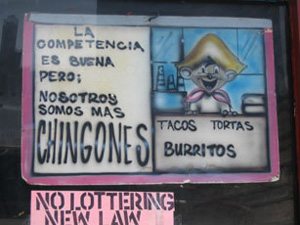
When I still lived in the neighborhood, I ate there several times a week. Of course, everything I needed in the neighborhood was within a two-block radius. The cleaners, the gas station, the locksmith, the used bookstore, my barber Aldo of Italy, and of course, El Gallo de Oro. I went to the locksmith exactly once, but it was nice to know that he was always available even though I dreaded the day that I would actually need him. Aldo of Italy cut my hair once a month before I ate at El Gallo de Oro. Aldo always loved speaking to me in Spanish while he cut my hair until I fell asleep. Anyway, again, I loved the attitude of the Mexican cooks at El Gallo de Oro. They were typical Mexicans who loved to brag about their food and service. I especially loved their sign in the window: “La competencia es buena, pero nosotros somos … ¡más chingones!” In English, “The competition is good, but we are … ” Okay, I’m not sure how to translate the last two words, but you could tell who was Mexican and who wasn’t by how they reacted to the sign. Of course, at that time the FCC let a lot of profanity get aired on all the Mexican radio stations. So the sign remained in the front window for many years until about two years ago. I rather miss that sign. That’s the thing about Mexicans. They have chutzpah!
One time, I told my father, brothers, and sister that I had a special surprise for them for our Thanksgiving dinner that year. They were so curious that I caved in to all their questions and told them my surprise beforehand. “We are eating Thanksgiving dinner at … ” and I paused for dramatic effect … “El Gallo de Oro!” “But we want turkey,” my sister shouted. “Yo quiero guajolote,” said my father. “Un momento,” I said. “El Gallo de Oro is serving turkey burritos on Thanksgiving Day!” After a little grumbling, they finally agreed to my Thanksgiving dinner plans! Everyone got to eat turkey, I got to eat at El Gallo de Oro, and my father got to eat so many jalapeño peppers that sweat poured from his forehead profusely and he had to keep asking for more and more water. Well, El Gallo de Oro managed to satisfy yet another finicky Mexican family–again!


 Chicago USA