You suck!


Chicago Tribune, January 24, 2010

I saw this advertisement in the real estate section of the Chicago Tribune last Sunday. I remember when the word “suck” was a swear word! Perhaps I’m just on the verge of becoming a grumpy old man, but maybe that’s the reason I still remember when “suck” was offensive. So, imagine my surprise when I saw this ad.

When I was growing up back in the 1960s, an age before political correctness had swept the land, people would purposefully insult each other. No holds barred. If someone had a physical deformity or a mental defect, that was exactly what the insulting party focused on. Racial slurs were not only permitted, but wholeheartedly encouraged.

But getting back to the word “suck,” most people who use the word today don’t even realize why they’re using it. Once, one of my students said, “Exams suck!” and many of the other students in the class agreed. She had a quizzical look on her face after she said it. Then, she said, “What does that even mean?” No one knows what “suck” even means nowadays. No wonder I hear it on the radio and TV all the time. That’s because no one knows the history of the word “suck.”

But getting back to the 1960s, if someone wanted to insult you, they would–in so many words–say that you performed fellatio, back in an era when oral sex was frowned upon. The main offense was to insult someone’s manhood by implying he was homosexual. If someone did something stupid–and about everything qualified as being “something stupid”–the person who didn’t like what you did would say, “You blow!” Sometimes people would hurl the insult to pedestrians as they drove by. Sometimes it was incorporated into everyday conversation: “Why aren’t you inviting Alloycius to your party?” “Because Alloyicius blows!”

Somewhere along the line, “blow” received fierce competition from “suck.” Both words referred to the same sexual act of fellatio. The only point of contention seemed to hinge on the direction of air flow. But both terms were equally insulting in a homophobic manner. No one argued that! If you did, people would not only say, “You blow!”, but also, “You suck!” It was the great philosophical debate of my generation. Is it better to blow or to suck?

Well, flash forward to the present, and the people using the word “suck” are unaware of the history of the word “suck” whenever they use it. Just think about it. Can exams really suck? Who wouldn’t like oral sex to relax during a grueling exam. If exams literally sucked, students would love taking exams. And, then afterwards, the students would smile and say, “Yeah, that exam really sucked!”

DDR

Hablar


Estamos charlando y divirtiéndonos.

“Hablar” is “to talk” or “to speak” in the general sense of emitting intelligible sounds from the aperture of the human brain housing group. “Charlar” is “to chat” or “to talk to someone.” “Platicar” is also a synonym of “charlar.”

“El idioma” refers to the language which we use to communicate. For example, “yo te expliqué la diferencia entre “charlar” y “hablar” en inglés. Pero, cuando dije “in the general sense of emitting intelligible sounds from the aperture of the human brain housing group”, un lenguaje particular porque podría haber dicho lo mismo con otras palabras. O, sea, el lenguaje es la selección del vocabulario. No importa si fuera en inglés o español.

DDR

Language jokes


Dr. D. laughing in Spanish.

As you may have noticed, I like jokes. Here’s a riddle. What do you call a person who speaks two languages? Bilingual. What do you call a person who speaks three languages? Trilingual. What do you call a person who speaks one language? American.

A Swiss man, looking for directions, pulls up at a bus stop where two American tourists are waiting.
Entschuldigung, koennen sie deutsch sprechen?” he asks. The two Americans just stare at him.
Excusez-moi, parlez vous francais?” he tries.
The two men continue to stare.
Parlare italiano?” No response.
Hablan ustedes español?” Still nothing.
The Swiss man drives off, extremely disgusted. The first American turns to the second and says, “Y’know, maybe we should learn a foreign language.”
“Why?” says the other. “That guy knew four languages, and it didn’t do him any good.”

A man tells his friend, “I’m going to learn German.” His friend says that German is a hard language to learn. The man replies, “How hard can it be? I’ve heard three-year-olds speaking it.

“I’m glad I wasn’t born in France.” “Why’s that?” “I don’t speak French!”

A man gave his wife a parrot. The next day, they’re eating dinner and the man notices that the parrot isn’t in its cage. He asks, “Where’s the parrot.” The wife says, “We’re having it for dinner.” “What? That parrot spoke three languages!” “Well, why didn’t it say something?”

A student fell asleep during an English professor’s lecture on pronouns. Upset, the professor wakes up the student by asking him to name two pronouns. The student replies, “Who? Me?” “Very good,” says the professor.

This linguistics professor was lecturing the class. “In English,” he explained, “a double negative forms a positive. In some languages, such as Spanish, a double negative is still a negative.” “However,” the professor continued, “there is no language wherein a double positive can form a negative.” Immediately, a voice from the back of the room piped up: “Yeah … right …”

DDR

Learning English


Holy Cross School

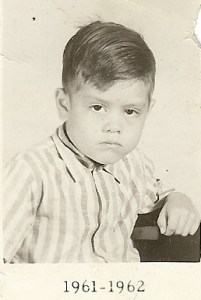
Since my parents came from Mexico, Spanish was my first language at home, and we never spoke English. When I started kindergarten at Holy Cross School, I didn’t know any English. So, when Sister Mary Joseph talked, I did what the other kids did. I sat next to Bridget, the smartest and prettiest girl in the kindergarten. I didn’t understand Sister Joseph’s instructions because she spoke English, so I watched Bridget’s every movement. When Bridget took out her crayons, I took out my crayons. When Bridget took a nap, I took a nap. Kindergarten was not that complicated. When Bridget got up and got in line, I got up and got in line. But I got in trouble. Sister Joseph walked me back to my desk. I noticed that the entire kindergarten class was laughing. I had followed Bridget to get in line to go the girls’ bathroom!

I always had a problem learning English. I didn’t quite understand everything correctly. I liked standing outside the corner bar on my block. You see, they had a sign that read, “3 IDs required. No minors allowed.” I was always waiting to see these miners wearing helmets with lights on top to come to the bar. And then they’d get really mad because they weren’t allowed in the bar and start a fight with the bouncer because he wouldn’t let them in. But I never saw any miners try to get in. I guess that sign really worked.

DDR

Make English official


Norton Anthology of English Literature

 Why didn’t someone think of this before? I guess it takes a politician! Pass an amendment that makes English the official language of the U.S. and then everyone–citizens, naturalized citizens, legal immigrants, and illegal aliens alike–will all speak English. Let’s begin by teaching President Bush to speak English. I love the beauty and simplicity of this amendment. As is well known, everyone who resides in the U.S. obeys and upholds all the laws of the land.

Of course, legislating any language into law will not force anyone to learn the language. Some people are destined to speak only one language, their first language, for the rest of their lives. Just think of Columbus and the Spaniards when they came to the New World under the aegis of Spain. Right from the beginning, the Spaniards attempted to get everyone to learn Spanish. The official language of New Spain, the name of the new Spanish colony, was Spanish. Spanish scholars wrote hundreds of books recording indigenous languages and customs. They even managed to get the Maya to write their Popol Vuh in Spanish. The goal was for everyone under the Spanish crown to speak one common language. Books published in languages other than Spanish were censored. In fact, the very first grammar book of a European vernacular language was published in 1492 by Antonio de Nebrija. He had the idea of using Spanish as the one common language that would unify the Spanish Empire. Under Ferdinand and Isabella, Spanish became the official language of Spain and the New World. Did everyone learn Spanish? Of course not! Even to this day, there are people in many Spanish-speaking countries of Hispanoamérica who do NOT speak Spanish. In Mexico alone, more than fifty different languages are spoken and not everyone speaks Spanish. Maybe Americans better stay close to the tourist resorts when visiting Puerto Vallarta and Cancún.

Well, if the U.S. makes English the official language of the land, will everyone learn English? Not necessarily. Just look at the president. One need only look at the immigrant groups that have come to our country throughout American history. The first generation learns just enough English to get by on. Only with the second generation does English become part of the immigrant family. If English becomes the official language, will bilingual government publications of all languages suddenly disappear? Will we still have interpreters of all languages in our courtrooms? Will people only speak English then? The answers are obvious. Legislating English as the official language would be a waste of time, resources, and tax dollars.

DDR