Kung Fu


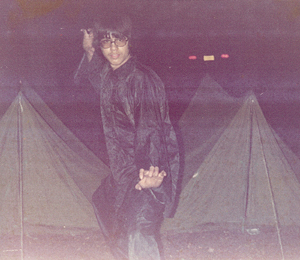
Dr. D in kung fu uniform

You’ve probably noticed the yin and yang symbol at the end of some of my blog posts. I’ve been meanig to explain why I use it, but I’ve always been hesitant to tell you. Well, now it can be told. Now that I’m feeling more comfortable with you, gentle reader, I’ll tell you. But you have to promise me that you won’t tell anyone. Okay? Well … Okay, I believe that you won’t tell anyone. So here goes.

I didn’t want to go to Divine Heart Seminary, but my mother made me go anyway. While I was there, I kept telling her that I wanted to leave. Finally, she gave in and she said I could leave the seminary. However, she didn’t make any effort to get me into the Catholic high school of my choice, or any private school for that matter. We lived in Back of the Yards, so I had to go to a public high school. I went to Tilden Technical H.S. I was extremely unhappy there.

As bad as things were, I never regretted leaving the seminary. At that time, I was only five feet tall and weighed about eighty-seven pounds. I was the perfect target for bullies. Ever since I was little, I always fought back no matter who picked on me, regardless of the consequences. When I transferred to Gage Park High School, I was suspended quite a few times for defending myself. My mother yelled at me for having to miss work in order to get me reinstated in school. I told her that if she would have sent me to a Catholic high school, I wouldn’t be having those problems.

Oh yeah, my bedroom was in the unfinished attic of our house at 4405 S. Wood Street. That added to my overall happiness of my adolescence. My bedroom was hot and humid in the summer, and extremely cold in the winter. I spent a lot of time by myself in that room. I had a black light and fluorescent posters. I had my own black and white TV. I had a radio that I wired to every speaker that I found. I had surround sound before anyone else even invented it.

Okay, get ready. Here comes the part about kung fu. Are you ready? Well, here goes anyway. I hated getting picked on at school. And, I loved to watch TV every waking moment, especially all the comedies like The Dick Van Dyke Show, Laugh In, The Bill Cosby Show, The Flip Wilson Show, the Johnny Carson Show, among many others. If the TV show wasn’t a comedy, I didn’t watch it. With one notable exception. Kung Fu. There was something about that show that attracted me. Something that really moved me. I felt lonely, scared, defenseless, and scared. After watching Kung Fu, I learned to apply some of that philosophy to my life. Oh yeah, and I observed those martial arts techniques and learned to use them to defend myself at school and in the neighborhood. I never backed down from anyone. And everyone learned not to start trouble with me. I’m not saying I won many fights since I was smaller than most of the bullies, but I would cause enough pain and anguish to my assailant the he often thought twice before picking on me again. Once, a bully approached me to exact revenge from our previous encounter. I gave him a look that could only be interpreted as, “Bring it on!” He shook his head in disbelief and walked away.

The TV show Kung Fu actually changed my life. I started practicing kung fu religiously. I wanted to be one with the universe. I wanted to be Chinese!

My favorite TV show when I was in high school.

Well, I never became Chinese. Or even learned to speak Chinese. But I have gotten older and wiser. That last time I practiced kung fu? Oh, about forty pounds ago. But I always fondly recall David Carradine as Kwai Chang Cane or Grasshopper when he was known when he was a young boy in the Shaolin Temple back in China. But I still feel that I benefited from watching Kung Fu. So whenever I get philosophical, in my own unique way, I categorize my blog entry under Life and end it with the yin and yang symbol. Peace, love, and eternal cosmic wisdom!

Real Women Have Curves


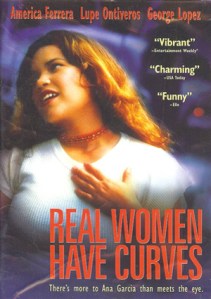
My Spanish students love this movie!

I really loved the movie Real Women Have Curves (2005, Directed by Patricia Cardoso) even though I’m not a woman and I’m not from Los Angeles. I laughed throughout the movie because I could identify with the Mexicans who were portrayed accurately in the movie. We could see the importance of family unity and how going to college could be perceived as a threat to this unity. Education is not viewed as a positive goal in a Mexican family that has relied on manual labor to survive. Carmen (Lupe Ontiveros) wants her daughter Ana (America Ferrera, as of late as Ugly Betty on TV) to work in her sister Estela’s dress shop instead of going away to college.

Ana finally gives in to her mother’s wishes, but you can see that Ana is not only unhappy there, but she really does not belong there because she has so much more potential than that of a laborer. But that’s how Mexicans think sometimes. Even though Carmen complains about how hard she has worked as seamstress throughout her life, she is willing to subject her daughter to the same punishment of manual labor.

Carmen also criticizes her daughter about her excessive weight, even though Carmen herself is overweight. However, beauty is in the eye of the beholder and Ana is beautiful in her own way. Her boyfriend Jimmy tells her that she’s beautiful and he seems genuinely sincere when he compliments Ana.

If she were in Mexico, many men would consider her beautiful simply because she has a nice smile, a nice personality, and is pleasingly plump. Once when I was in Mexico, my cousin saw a pleasingly plump woman and he flirted with her by saying, “Oye, esa gordita viene con atole?” Well, if you don’t know Spanish, I better explain that in this context gordita means both pleasingly plump with positive connotations and also refers to a food that is made of corn flour stuffed with chicken or beef; atole is a tasty, hot drink made from corn. I guess this sentence doesn’t translate well, so I’ll give you a similar example in English. Suppose an attractive woman, say dressed seductively in a short skirt, struts her stuff past you, jiggling all her assets, my cousin could say something like, “Does that shake come with fries?”

This difference in beauty standards reminds me of a story that Rosie O’Donnell once told on a talk show–I believe it was Johnny Carson’s–before she was really famous. She talked about how she went to Mexico with a thin, beautiful Hollywood actress, which at the time I wondered why she would go to Mexico with another actress. Well, now that she’s famous and I know a little more about her personal life, I know why she went to Mexico with a thin, beautiful Hollywood actress. Anyway, Rosie and her thin “friend” were at a bar where all the men were hovering around Rosie instead of her friend. Finally, Rosie asked one of the Mexican men why they found Rosie more attractive than the beautiful actress. One of the men said, and you must imagine Rosie saying this with a Mexican accent, “The bones are for the dogs. The meat is for the men!”

Well, this movie really got me to think about my mother again, whose name also happens to be Carmen. My mother never valued education and there was absolutely no possibility of college in my future. She always told me that I would work in a factory when I was old enough to work. But she would always complain about how factory work was wearing her down. She always came home sore and tired from working.

One day, she showed me her swollen hands and said, “Someday you’ll see what it’s like to work hard. One of these days you’ll be working in a factory just like me.” I didn’t plan to ever work in a factory, so I told her, “That’s why I’m going to college!” She said, “Why are you going to college if you’re only going to work in a factory?” She couldn’t imagine any other occupation for me.

She eventually found me a factory job–a job that would have been ideal for my mother, but not for me because I had such higher aspirations. However, since I lived under her roof, I had to live by her rules, so I began working the midnight shift in a peanut butter factory two days before my eighteenth birthday, while I was still a high school junior. I really hated this job! When I got out of work at 7:00 a.m., I immediately had to get ready to go to school even though I was ready to go to bed.

I was always tired in school and often fell asleep during my afternoon classes. I told my mother that I couldn’t work full-time and go to school full-time. She told me that if I didn’t work, I couldn’t live with her; I would have to move in with my father, which she had always described as being my worst possible destiny. So, I continued working at the factory, but when I couldn’t take the stress of working and going to school anymore, I dropped out of high school. My mother didn’t complain because I was still working, and I was contributing to the family financially.

In the movie, Ana gets accepted to Columbia University with a scholarship, but her parents are against Ana leaving the family in order to study in New York City. Her father finally gives his blessing to Ana, but Carmen doesn’t even say goodbye to Ana when she leaves for school. Carmen merely watches from her bedroom window. But you can see that not all Mexicans value education as much as most Americans who know the importance of going to college to get ahead in life.

When you consider this anti-education attitude of Mexicans in general, you can see why they have a high school drop-out rate of about 50%. At least the movie ends on a positive note with Ana going off to Columbia University and we get to see her walking the streets of NYC near Times Square.

DDR