Good Friday


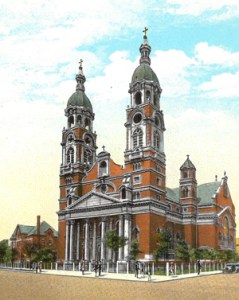
Holy Cross Church, Back of the Yards, Chicago, Illinois

Good Friday always reminds me of many things. I know, I know, it’s Saturday. I’m not late. I’m running on Mexican Time. I once saw that on a T-shirt.

If you ever have a party and invite some Mexicans, make accommodations for Mexican Time. If you want everyone to be at your house by four, tell them the party’s at three. Well, because 3:00 o’clock lasts until 3:59! 3:59 is still 3:00 in the mind of a Mexican. Say 3:59 out loud. Go ahead. Did you hear all three digits? If you did, you’re not Mexican. A Mexican will only hear the initial digit “3” and then block out the rest of the digits. That’s just how Mexicans process time.

Anyway, I forgot all about Good Friday until late last night when Jay Leno mentioned that it was Good Friday. And then I felt guilty. Because I’m a lapsed Catholic who suffers from constant guilt. It’s like being Mexican. You never stop being Catholic–or feeling guilty about something. Well, during the day yesterday, I remembered that it was Good Friday. I thought I should celebrate it in my own lapsed-Catholic fashion to ease some guilt for forgetting about not going to church on Good Friday. So, I had decided to write a blog entry about Good Friday. But then I forgot all about it. Or I blocked it out. And now I feel extremely guilty. That’s why I’m writing this while Good Friday is less than twenty-four hours over. I feel a little less guilty now.

Toluca, México

As Mexican Catholics, we attended a Lithuanian Catholic church in the Back of the Yards. Holy Cross Church was our parish. I also attended Holy Cross School from kindergarten through eighth grade. There was no separation between church and school. We were taught lessons in church, and we prayed in school. In church, we were taught by Lithuanian priests and in school Lithuanian nuns taught us, with the occasional visit by the pastor who would give us holy cards if we answered his catechism questions correctly. We never forgot about religious holidays because we were in school five days a week and in church six days a week. We would be reminded for weeks in advance of an upcoming holy day. Holy Week was one of the most important times of the year for us. It began on Palm Sunday and ended on Easter Sunday.

Mexicans in Chicago commemorate many of these events by reenacting them. I’ve been to reenactments of the Last Supper, Jesus Christ’s procession to Golgotha, and the Crucifixion of Jesus Christ. This always struck many people, who were of the non-Mexican persuasion, as sacrilegious.

To this day, the holy day that I remember the most is Good Friday. That was the day that Jesus Christ was crucified for our sins. And we should never forget that!

We attended school on Good Friday until it was time to go next door to church for the Good Friday service at 3:00 p.m. sharp. All the students sat with their classmates and nuns who were their teachers. We would get to church early so we could pray until the service began. We were supposed to recall all the events of Jesus Christ’s life and how he died for our sins.

I remember when I was about eight years old, the nun told us in school that Jesus Christ died at three p.m. and that every Good Friday it rains at that time for Jesus Christ. I was just a boy and I believed absolutely everything I was taught. During the Good Friday service, the bright sunny church interior suddenly dimmed and then darkened. Just as the priest told of how the Romans were nailing Jesus Christ to the cross, the church became as dark as night. Someone turned some lights on. Then, we saw lightning flashes and a moment later we heard deafening thunder. The church trembled and the lights flickered. The thunderstorm, lightning, and thunder continued for several minutes. The priest stopped to genuflect and bless himself. That was a defining moment in my development as a young Catholic. I became a true believer at that precise moment. From then on, I always believed everything that the priests and nuns told me.
DDR

Patrick McDonnell


Happy Birthday to me! Happy Birthday to me!
Patrick, Adam Méndez, Delia, David, and Rick at my twelfth birthday party.

Patrick McDonnell was my best friend in the second, third, and fourth grades at Holy Cross School. He was the smartest kid I ever knew. He had moved to Back of the Yards in Chicago from Ireland with his father, his brothers James, Leon, and Michael, and his sisters Cora and Margaret. His mother had died in Ireland before they came to Chicago. They lived next door to the firehouse on the corner of 45th Street and Marshfield.

I loved going to his house after school because we had fun visiting the firemen. Since he was a year behind in school because of his move from Ireland, he was older and wiser than me. Whenever I needed the mysteries of the universe explained to me, Patrick was there to explain them to me so that even I understood them.

Once, we were standing in the crosswalk on the corner of 46th Street and Paulina. I was about to cross the street when he stretched his arm across my chest to prevent me from crossing. Much to my surprise, a car drove right in front of our path. I was so amazed that he knew the car was coming our way. “How did you know the car was turning?” I asked him. “I saw his turn signal,” he said. “What’s a turn signal?” I asked. And he explained the Rules of the Road to me, edifying me about another one of the mysteries of the world, as only Patrick could. He performed a visual reenactment of our incident with him as the car and his eyes as the turn signals. He said he knew the car was turning left because he saw a left turn signal. He then winked his left eye repeatedly to represent the car’s left turn signal. For some reason, I always remember Patrick’s freckled face reenacting the left turn signal.

When his family finally moved to the suburbs—I don’t remember which one—he came to my house to say good-bye. In retrospect, I should have gotten his new address and phone number. On the other hand, he didn’t ask me for mine, either.

Labas


Holy Cross Church

Labas. That’s right. Labas. To all my Lithuanian friends: Labas! In fact, I’d like to greet everyone reading my blog: Labas! That’s hello in Lithuanian. My Lithuanian friend Vito taught me that word because he always insisted that we greet each other by saying Labas. Now, I always greet Lithuanians with Labas and they always smile. I especially love to greet them with Labas especially if they didn’t think I knew they were Lithuanians. I’m not sure why, but they’re always thrilled to hear me say Labas. So, to all my Lithuanian readers: Labas! I guess sometimes I go on and on, don’t I? Well, my friend Vito taught me another Lithuanian word: tylėk. Sometimes we would go to the show, I would just keep on talking even after the movie started. He would keep telling me tylėk until I finally shut up. That’s right, tylėk means shut up in Lithuanian. But I never did. And I never will.

For as long as I can remember, I have always lived near Lithuanians in Chicago. In Back of the Yards, Holy Cross was the Lithuanian church I attended. At Holy Cross School, the nuns always praised The Jungle by Upton Sinclair because the protagonist was Lithuanian, and the novel was set in Back of the Yards. When we moved to Marquette Park, 2509 W. Marquette Road, many Lithuanians lived there, and they even had a street named Lithuanian Plaza Court. In fact, that neighborhood was the unofficial capital of Lithuania during the Soviet era. Maria High School, run by Lithuanian nuns, was at Marquette Road and California Avenue. Right on the same campus was the retirement convent for the Sisters of Saint Casimir at 2601 W. Marquette Road. The Lithuanians also had their own Holy Cross Hospital at California Avenue and Lithuanian Plaza Court. I met my friend Vito when I lived in Marquette Park. Vito and I used to eat at the Lithuanian McDonald’s at 68th and Pulaski. I don’t know if it was actually Lithuanian, but Vito told me that the tiles on the wall were typical Lithuanian colors, so it became a Lithuanian McDonald’s in my mind. When I moved to Bridgeport, there weren’t that many Lithuanians there anymore, but they did have a street named Lituanica Avenue. My favorite restaurant in Bridgeport was a Lithuanian restaurant named Healthy Foods at 3236 S. Halsted Street. When I saw the movie Chariots of Fire, I was thrilled to learn that the family of Harold Abrams were Lithuanian Jews.

When I was a student at Holy Cross, my best friend was Patrick McDonald, but when he moved away, I became friends with Adrian Stanislovaitis and Anthony Kivenas, both Lithuanians. Whenever I was with them, we spoke English, but when they were with their parents, they spoke Lithuanian. I never understood what they said, and it didn’t bother me at all. However, I never even learned one Lithuanian word from them. And when they came to my house, I spoke Spanish with my parents and grandmother. I envied Adrian and Anthony because they got to go to Lithuanian classes on Saturday morning. I wanted to go with them. I wished Mexicans would have Spanish classes for Mexicans. Anyway, Adrian and I spent a lot of time together. For school holidays, we used to take the bus downtown and just wander around, but he showed me a few points of interest, such as the Prudential Building because it used to be Chicago’s tallest skyscraper.

When we moved to Marquette Park, we met more Lithuanians. Marquette Park has a monument for Lithuanian aviators Captain Steponas Darius and Lieutenant Stasys Girenas. This is where I met Vito and other Lithuanians. I went to Lithuanian restaurants and bars with Vito. At one bar on Lithuanian Plaza Court, it might have been Knight’s Inn, we met a Lithuanian improv group that was named Second Village, which is Antras Kaimas in Lithuanian. It was inspired by the name of Second City. We talked to them for a while, and Jim, Vito, and I told them that we performed standup comedy. We ended up making a little skit/song/dance for them sung to the tune of “Skip to My Lou.” I still remember it, but don’t know how to spell it because it was in Lithuanian. Vito wrote most of the song. My contribution to the song? Labas and tylėk! No surprise there!

We once went to a Lithuanian festival on Western Boulevard near the Lithuanian V.F.W. Hall, which if I remember correctly was named after Darius and Girenas. Anyway, there were all kinds of Lithuanian food. One vender was selling empanadas, which really surprised me because as far as I knew, empanadas were Mexican food. The Lithuanian cook tells me that empanadas were invented by Lithuanians. He could tell that I didn’t believe him. He pressed on with his explanation and tried to convince me that I really didn’t know Mexican food. He was so convincing that I almost believed him. Almost, but not quite. Finally, he told me that he learned to make empanadas in Argentina. During WWII, his family went to Argentina before they came to America.

That’s how I think of Lithuanians. They’re always ready to play a friendly practical joke on you. Vito was always the joker and had a great sense of humor that not everybody got. I could tell he got it from his father. Once I went to Vito’s house so we could go to the show. His father answered the door and I asked for Vito. He knew very well that I was asking for his son, Vito, my friend, but he said, “You’re talking to him.” I said, “No, Vito Junior.” He said, “I am Vito Junior!” This went on much longer than was comfortable for me, but Vito’s father was really enjoying this. Finally, he said, “Vito’s not home.” Why didn’t he just tell me that in the first place? Well, he wanted to play a joke on me. I laugh now that I think of it. But that day I learned that both Vito’s father and grandfather were named Vito. What really made me uncomfortable about them was how they greeted each other and how they said good-bye. Vito would always kiss his father on the lips. Talk about culture shock! For a while, Vito lived with his grandfather Vito. Before we would go out, Vito would kiss his grandfather on the lips before he went out. It was as shocking since I had finally gotten used to him kissing his father. But one day we were talking, and Vito told me that his father was adopted. Suddenly, it hit me. “Vito, you kiss your grandfather on the lips, and he’s not even related to you!” He thought nothing of it. I still can’t get over it!

DDR

Divine Heart Seminary


Divine Heart Seminary
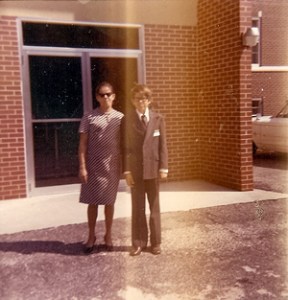
My mother Carmen and me. 1971

I attended Divine Heart Seminary in Donaldson, Indiana, despite my protests. It all started when I was in the seventh grade at Holy Cross School. Two seminaries, Divine Heart Seminary and Divine Word Seminary, sent priests to talk to the boys about vocations. When I was thirteen, I thought I might be interested in becoming a priest. After all, I attended mass almost everyday. My father and all his brothers attended a seminary in Montezuma, New Mexico. My aunt was a nun, and two of my uncles were priests. But I had my doubts about the priesthood because I would have to take vows of obedience, poverty, and celibacy. Celibacy? Now wait a minute. The vow of celibacy was my main stumbling block. I knew that someday I would like to have children. Anyway, I gave both priests my name because I said I might be interested in the priesthood. Then, I forgot all about their visit.

In the eighth grade, Divine Heart Seminary called me to see if I wanted to visit their campus. They would come to my house to pick me up and drive me all the way to Donaldson, Indiana. How could I say no? Before I went to visit DHS, I truly wondered if I wanted to become a priest. I was an altar boy then and a very devout Catholic, but I did have my mischievous side. Overall, I considered myself a good person.

At the Divine Heart, I saw how the seminarians lived. I spent one weekend there and got a taste of seminary life. I slept in the dorm where I would sleep as a freshman and I got a tour of the campus with the “big brother” that I was assigned. I got to see how real seminarians lived! Well, I was disillusioned by the seminary life. I didn’t think that potential future priests should behave like these seminarians.

At Holy Cross, I was taught that just about everything was a sin: swearing, smoking, playing pool, etc. Well, I was shocked to hear the boys swearing when their were no priests or brothers present! And they were going to be priests? Then, my big brother showed me the smoking lounge. These boys were allowed to smoke? I thought smoking was a sin. But my biggest shock of all was that they had pools tables! Not one or two pool tables, but many pool tables. In fact, there were several rooms that were exclusively reserved for playing pool. At that moment, I decided that future priests should not behave like these seminarians. I absolutely knew that I would not attend this seminary because they lived sinful lives.

Later, when I had forgotten all about my visit to Divine Heart Seminary, Sister Cecilia, the principal, called me outside of the classroom to talk to me. I thought I was in trouble for something I did. She told me that DHS called and wanted to know if I was still interested in attending their seminary. I immediately told her, “No.” She said, “You’re just too shy to admit it.” We went back into the classroom, I sat down, and she addressed the class, “Well, boys and girls, you are all very fortunate! David has received a vocation. He will become a priest someday! Next year, David will be attending Divine Heart Seminary in Indiana.”

Well, that little announcement truly changed my life forever. I sure didn’t want to attend any seminary, let alone Divine Heart Seminary. Soon, my classmates started calling me Father David. In the neighborhood, the kids would see me coming and mutter under their breath, “Watch what you say. Here comes the priest.” The girl I really liked in the class lost all interest in me. The next morning when I served mass as an altar boy, Father Gilbert congratulated me on my vocation. I told him that I didn’t want to become a priest, but he didn’t believe me and said that I was just being modest.

I told my father about what had happened to me with the seminary. That’s when I learned he, too, had attended a seminary for many years. He was actually proud of the fact that I would also attend a seminary. When my mother found out about my “vocation,” she told me that she was so proud of me. No one would listen to me! I didn’t want to attend Divine Heart Seminary. I had narrowed down my choices for high school to Leo High School or De La Salle High School. Try as I might not to attend DHS, I was forced to attend DHS. Before I even started school there, I had already made up my mind that I would never become a priest. Yet everyone was so proud of me and the fact that I would attend Divine Heart Seminary!

Newspaper routes


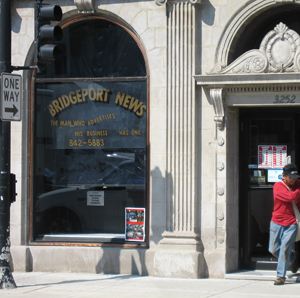
Bridgeport News, Chicago, Illinois

When I was in Holy Cross School, I had several paper routes and I really enjoyed delivering newspapers. My best friend in the fourth grade was Patrick McDonnell. One day he asked me to help him deliver newspapers on his paper route. One of his older brothers had the paper route, but when he got tired of delivering newspapers, he gave the paper route to his brother Patrick. In those days, it was almost impossible to get a paper route on your own. True to Chicago tradition, you even needed clout to get a paper route.

I helped Patrick deliver his newspaper, The Chicago American, for a few days. One day, he asked me if I knew who all the customers were. Of course, I did! “That’s good,” he said. “Because you can have the paper route!” He had gotten tired of delivering papers and couldn’t quit the paper route until he found a replacement.

Well, I was extremely happy to be his replacement because I loved delivering newspapers and I especially loved having some spending money. I’m not sure how long I had that paper route, but it was long enough to see the Chicago American become the Chicago Today. I loved reading the newspaper as I walked door to door delivering it. Then one day, the Chicago Today folded and I was out of a job. But it was fun while it lasted.

Months later, my friend Patrick asked me to help him with his paper route again. He had found another paper route and again he was tired of delivering newspapers on his bicycle. He immediately thought of me as his replacement. This route had many more customers than the other one and you needed to deliver the papers on a bicycle because this route covered our entire neighborhood. This paper route was the most memorable one for me. Paper route number 9! I really learned a lot about life while delivering newspapers on this route. And I also truly learned a lot about the Back of the Yards and its residents. On this route, I delivered the Chicago Daily News, the Chicago Zgoda, and the Chicagowski, the last two were newspapers published in Polish. I tried to read the Polish newspapers, but they seemed be written in a foreign language to me. And most of the Polish subscribers hardly knew English, but we always understood each other.

There were two facets to delivering newspapers. One was the actual delivery of the newspapers. Some subscribers wanted it delivered in a certain way. Folded without a rubber band, or with a rubber band. On the front porch, or on the back porch. Between the screen door and the door. There were considerate customers who didn’t mind if I just rode past on my bike and threw the paper on their front porch. And my aim was true, most of the time.

One day, as I was approaching a house next to the alley, I was about to throw the newspaper on the porch when suddenly a car sped out of the alley. I was shaken a little and when I released the newspaper, it broke the glass on the storm door. I was so scared that I kept riding and delivering papers. When I returned to the newspaper agency, the subscriber had already reported me to my boss, Ernest Pressman. I swear. That was his real name. She knew it was an accident and she only wanted me to pay for the broken window. I remember I had to pay about four dollars for a new window, roughly my weekly salary before tips.

Sometimes delivering the newspaper could be downright dangerous. One customer wanted the paper delivered in the rear hallway. What I didn’t know was that sometimes she kept her German Shepherd there. One day, I open the hallway door and saw the German Shepherd lounging at my hand that was attempting to drop the newspaper in the hallway. I quickly shoved the newspaper in his mouth and slammed the door shut. I was waiting for another reprimand from Mr. Pressman when I returned to the newspaper agency, but I was never reported for this.

The second facet was collecting the money for the subscriptions. Collecting money from some customers required an excellent memory, ruses, and stratagems. All this just to collect a measly fifty cents! I had to remember what day they got paid so I could go collect the money that day before they squandered it away on rent, food, utilities, and other such nonsense. And I also had to make sure I had enough change so they could pay, and I could give them change. They wouldn’t pay unless I gave them correct change.

One woman once asked me if I had change for a five. Of course, I did. So, then she upped it to ten dollars. I told her I had change for a ten, too. Then, she said for a twenty and I said yes. She then told me she had a fifty-dollar bill and I showed her that I had enough change. I was ready for her because she had tried this before. She then paid me in exact change and gave me a nickel for a tip.

I mean I got to know all of my customers very well. One woman told me to collect the money on Saturday morning at 8:00 a.m. and then wait for about ten to fifteen minutes until she opened the door. Not a problem, I told her. All I wanted to do was collect my money, and hopefully, a small tip. The reason she wanted me to knock on her door so early was that I was her Saturday-morning alarm clock. And she took so long to open the door because she went to the bathroom first. I always hoped she washed her hands.

I delivered the Daily News to a bar on the corner of 43rd Street and Wolcott. When the bartender paid for the subscription, he would tip me fifty cents and tell me to take a bag of Mrs. Vitner’s potato chips, any candy bar of my choice, and a pack of gum. One customer I never saw. She left me a note on her door in the rear hallway saying she would leave the money hidden in a crack in the wall. I was pleased by this arrangement because this mystery woman tipped well.

One little old Polish lady always wanted me to deliver both the Zgoda and Chicagowski directly into her hands. So, I had to get off my bike, go knock on her door, she would say something in Polish that I didn’t understand, I would say I was the paperboy, and then she would open the door. I did this every day! Actually, I didn’t mind doing it, either. Of course, she wasn’t a big tipper, either, even though she considered herself extremely generous. On the day I had to collect the money for the subscription, she would tell me to enter her apartment and lock the door behind me. She would give a crisp brand-new dollar bill to pay for her bill of ninety-nine cents. I would then give her her change of one cent, which she would give back to me immediately as my tip and insist that I put the penny in a different pocket because that penny was for me and not the newspaper agency. Most subscribers would tip a nickel or a dime and that was extremely generous in all reality. But I really loved going through this weekly ritual for my one-cent tip! Sometimes I had to run out of the apartment so she wouldn’t hear me when I couldn’t contain my laughter anymore. I really loved this little old Polish lady!

There was another little old Polish lady on paper route who received the Chicago Daily News, the Zgoda, and the Chicagowski. Her bill was about $1.50 per week. She wasn’t as demanding about her delivery, either. When I went to collect the money for her subscription, she would tip me 100%. I told her that $1.50 was way too much money for the tip, but she insisted. Well, being the polite Mexican boy that I was, I would pocket the money, in a different pocket, of course, so the Mr. Pressman wouldn’t get my tip. Sometimes, she would feel really guilty about the tip and slip me an extra nickel or dime before I walked out!

DDR