El Gallo de Oro


El Gallo de Oro, 2952 W. 63rd Street, Chicago, Illinois

When I lived at 3006 W. 64th Street, I always used to eat at this great Mexican restaurant that was exactly one block away. El Gallo de Oro, 2952 W. 63rd Street, 773.737.8101, has been there since at least 1981 when I moved back to Marquette Park after being honorably discharged from the Marines.

This Mexican restaurant serves real Mexican food cooked by real Mexicans to other Mexicans who patronize the restaurant. That’s how you can tell if a Mexican restaurant is really good: by how many Mexicans eat there. I remember once going to Milwaukee and my girlfriend suggested that we eat at a Mexican restaurant, either La Perla or La Fuente, but she didn’t know which one was better. We ate at the one where all the Mexicans ate! And it was great Mexican food! So, are you wondering which restaurant was better? Well, I honestly can’t remember because I drank a few too many bottles of Negra Modelo. Anyway, El Gallo de Oro has great Mexican food, and I say this after having come back from having eaten Mexican food in many Mexican restaurants and Mexican homes in Mexico. Well, lately, I’ve been going to different Mexican restaurants in the Chicagoland area, or Chicagolandia as I like to call it since we have so many Spanish speakers here, and I’ve been ordering the enchiladas de pollo. Today, I tasted the enchiladas at El Gallo de Oro, and they were ¡sabrosísimas! This is a great Mexican restaurant.

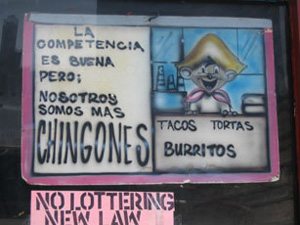
When I still lived in the neighborhood, I ate there several times a week. Of course, everything I needed in the neighborhood was within a two-block radius. The cleaners, the gas station, the locksmith, the used bookstore, my barber Aldo of Italy, and of course, El Gallo de Oro. I went to the locksmith exactly once, but it was nice to know that he was always available even though I dreaded the day that I would actually need him. Aldo of Italy cut my hair once a month before I ate at El Gallo de Oro. Aldo always loved speaking to me in Spanish while he cut my hair until I fell asleep. Anyway, again, I loved the attitude of the Mexican cooks at El Gallo de Oro. They were typical Mexicans who loved to brag about their food and service. I especially loved their sign in the window: “La competencia es buena, pero nosotros somos … ¡más chingones!” In English, “The competition is good, but we are … ” Okay, I’m not sure how to translate the last two words, but you could tell who was Mexican and who wasn’t by how they reacted to the sign. Of course, at that time the FCC let a lot of profanity get aired on all the Mexican radio stations. So the sign remained in the front window for many years until about two years ago. I rather miss that sign. That’s the thing about Mexicans. They have chutzpah!

One time, I told my father, brothers, and sister that I had a special surprise for them for our Thanksgiving dinner that year. They were so curious that I caved in to all their questions and told them my surprise beforehand. “We are eating Thanksgiving dinner at … ” and I paused for dramatic effect … “El Gallo de Oro!” “But we want turkey,” my sister shouted. “Yo quiero guajolote,” said my father. “Un momento,” I said. “El Gallo de Oro is serving turkey burritos on Thanksgiving Day!” After a little grumbling, they finally agreed to my Thanksgiving dinner plans! Everyone got to eat turkey, I got to eat at El Gallo de Oro, and my father got to eat so many jalapeño peppers that sweat poured from his forehead profusely and he had to keep asking for more and more water. Well, El Gallo de Oro managed to satisfy yet another finicky Mexican family–again!

DDR

Spanish in English


This not the Mexican telephone company!

Americans take English for granted. They also accept all foreign borrowings into the English language without any qualms, which is the reason that English has the largest vocabulary of any language on Earth. There are many  words of Spanish origin and actual Spanish words in our English vocabulary and everyone uses them without realizing it.

For example, on the news they’ll talk of military juntas. For years, people have been going to rodeos and watching cowboys lasso calves. Let’s not forget about the countless times we went to the plaza with gusto. Of course, many people eat tortilla chips with salsa. Let’s not forget about our famous politicians who use Spanish phrases to court the Hispanic vote. President Bush has said good-bye by saying, “¡Adiós, amigos!” and Arnold Schwarzenegger by saying, “¡Hasta la vista, baby!” In the office, we occasionally need something done ASAP! But sometimes, we need it “¡Pronto!

Those tasty avocados come from the Aztec word for testicles. I hope I didn’t cause you to drop your tortilla chip full of guacamole! That reminds me. When we’re hungry, we often eat tacos, tamales, quesadillas, bocadas, and eat flan for dessert. When someone asks you a stupid question, you may say, “Does chili come with con carne?” Sometimes we want to be moderate and not go all the way, but other times we want the whole enchilada! If we really love something, we become an aficionado of the thing we truly love. Occasionally, we stray from the path to eternal salvation and commit pecadillos. And if anyone disagrees with me about these words of Spanish origin, I will take you on mano a mano. Because I know how to take care of número uno!

¡Sayonara!

DDR

Despedida mexicana


Why are these tequila bottles so blurry?

There are good-byes. And then there are Mexican good-byes. By this, I mean that most people say good-bye and then they leave. Mexicans, on the other hand, say good-bye and think of many reasons for staying un poquito más. Such as telling the story they just remembered on the way out, upon touching the doorknob. Or, because they haven’t seen each other in such a long time, since like last week. I, too, of course am guilty of these long, extended good-byes. Perhaps, I didn’t say everything that I wanted because I couldn’t get a word in edgewise or the stories told were so good that I didn’t want to interrupt them.

While I was in Mexico, every good-bye was a despedida mexicana, but one long good-bye especially comes to mind. I was staying at my cousin’s house and we were going to visit her sister, also my cousin. My cousin, her husband, my aunt, and I went to my other cousin’s house. We would leave about three o’clock in the afternoon in order to avoid the afternoon rush hour traffic. I agreed because Mexico City’s normal traffic is horrendous and traumatic, even if you’re just a passenger, let alone driving during rush hour. So we visit my cousin, we eat at a restaurant called California, we go back to the house of the cousin we just visited, look at some old family pictures, and talk and talk and talk over old times since the last time I went to Mexico, which was twenty-nine years earlier. By the way, we started up the conversation right where we left off the last time I was there as if I had just left a few days before.

At 3:00 p.m. sharp, my cousin announces that we’re leaving immediately in order to avoid the rush-hour traffic. My cousin’s husband says that we can’t leave his house without first drinking some tequila together. That would reflect poorly on their hospitality. Besides, how could I go to Mexico and not drink tequila?

As the guest of honor, he served me tequila in his very own special tequila shot glass that was wrapped in specially treated tan leather with his name embossed on the leather. How could I say no to this shot of tequila? So we all had a shot of tequila as we were standing to leave. Sure enough, we all start talking about when my cousin came to visit Chicago in 1979. As luck would have it, I was in California in the Marines at the time. So we all sit down to hear about her trip to Chicago and how she almost saw snow because the weatherman predicted a snowstorm, but then there was only a light dusting of snow.

Of course, this called for another shot of tequila! Which no one refused, including me because I always try to be polite and eat and drink everything that is served to me. (You’d be surprised at how polite I can be when food or tequila is involved!) Then it occurs to our host that if you drink tequila you should drink it properly. So he serves us another shot of tequila, but this time he passes around a bowl of lime slices and a salt shaker. That’s how Mexicans really drink tequila! You squeeze some lime juice on the side of your fist, shake some salt on the lime juice, you drink the tequila shot in one gulp, and then lick the lime juice and salt afterwards. Well, we down a few more tequila shots the proper Mexican way and then our host said he had to go to work to take care of some business, but when he returned, he would bring back some food for supper.

The tequila had long ago been consumed and we were left to our own devices to entertain ourselves. Actually, for Mexicans like my aunt, my cousins, and I, we merely entertain ourselves by talking about what we did in the past since the last time we saw each other. In fact, I spent most of my trip just sitting around talking to my relatives bringing myself up to date on their lives. Well, it’s after six p.m. and our host still hasn’t returned. His wife calls him on his cell phone and it turns out that he’s stuck in rush-hour traffic. When he finally returns, he returns empty-handed. We’re all extremely famished by this time. So we all pile into two minivans and go to their favorite restaurant in town. We eat supper and spend a couple of hours talking over our food. By the way, we’re still saying good-bye since three p.m.! We eventually return to my cousin’s house about 9:30 p.m.! However, we did manage to avoid Mexico City’s infamous rush-hour traffic! I have to admit that it was my longest good-bye ever, even by Mexican standards. But it was also one of the most entertaining.

Okay, let me just blurt this out and be off. ¡Adiós!

DDR

Mexicanismos


El Paseo de la Reforma, México D.F.

Mexicanismos are words or phrases in Spanish that are unique to México, but may not be familiar to other Spanish speakers, also known as Hispanophones. French speakers are Francophones and English speakers are Anglo-Saxophones.

Anyway, in Mexico, people use words and phrases that are unique to that region and are commonly misunderstood by other Hispanophones. At UIC (University of Illinois at Chicago), we have graduate students who come from all over the Spanish-speaking world, most of whom specialize in linguistics. They can spot the dialect and region of most Spanish speakers almost immediately. Some have trouble identifying me because I have my American accent and I use words and phrases from almost every dialect that I’ve ever heard. I’m like a sponge in this regard. Sometimes, someone will throw their hands up in the air and just ask me where I’m from. They’re often surprised to hear that my parents were from México. My cousin’s husband thought I spoke with an Argentine accent. Once, a friend and I were speaking, and then I didn’t hear something she said. So, I said, “¿Mande?” and she said, “¡Ajá! You’re from Mexico!” That simple little mande gave me away as a Mexican.

Once, at the end of the semester, a professor from Argentina told us that she would bring us a torta for the last day of class. To most Mexicans and me, a torta is a type of sandwich that is served on a bun with meat and other condiments. I didn’t eat before class because I wanted to be polite and eat everything that was offered to me. Well, she came to class with a torta, but it was a cake, as in a pastry for dessert. I left the classroom hungry that day.

Another time, I brought some Thanksgiving leftovers to UIC for lunch. A graduate student from the Basque Country in Spain asked me what I was eating. I told her guajolote and camotes. She didn’t know what I was talking about. For her turkey was pavo not guajolote and yams or sweet potatoes were patatas not camotes because they didn’t differentiate between the various kinds of potatoes in Spain.

I have a friend who grew up in Seville, Spain, and we once had a minor misunderstanding. He told me that his car had broken down: “Se me estropeó el coche.” Being the nice guy that I am, I wanted to be helpful, so I offered him a ride: “¿Quieres un aventón?” I could tell by the tone of his voice that he was a little upset when he replied, “¿Y yo qué te hice?” You see, to a Mexican, un aventón is a ride, but to just about any other Spanish speaker un aventón implies some kind of physical violence. I explained to him that I only wanted to help him by giving him a ride to wherever he wanted to go, and I am happy to say that we are still friends to this day.

Another graduate student from Spain taught a class that had many Mexican American students. She frequently used the word coger, meaning “to get” or “to pick up” when she spoke not realizing that to Mexicans coger is a profanity that refers to the act of sexual intercourse that begins with the letter “f.” So, one day, she talked about picking up her dog: “Cogí mi perro.” She was surprised when the class began to laugh until someone explained to her what she had said.

While I was in México, I learned a few more mexicanismos. My cousin used the diminutive “-is” instead of “-ito, -ita.” For example, she went to see her “amiguis” instead of her “amiguitas.” Before we went to visit my cousin David Rodríguez in Celaya, everyone refered to him as Davis.

In the U.S. we have Spanglish, which is the mixture of English and Spanish, but I only thought it existed north of the Rio Grande (In Mexico, they call it El Río Bravo). For example, you take an English word like “to check” and make it Spanish: chequear, instead of comprobar or some other Spanish word that already exists. Anyway, they have a similar word in Mexico: checar. Several street venders approached me and called me jefe, showed some product they were selling, and said, “Checa esto.” Or “Check this out,” in English. So, this word is a little different than the Spanglish word chequear because it’s a mexicanismo. Or maybe it should be called inglañolismo.

I always thought of an aquarium as un acuario, but to my cousin in Celaya it was el pecero. I had never heard the word before, but I knew exactly what he meant. Then when I was in Mexico City, when people talked about taking the bus they still called it el camión, but now a lot of people also called it el pecero. That made perfect sense because if you look at the buses with their large windows, they do look like aquariums with people swimming inside instead of fish.

If you park your car in México City, you’re likely to meet el viene viene. He is a self-appointed parker of cars and is often found on public streets and grocery store parking lots. He doesn’t officially work for anyone. He’s just there–and everywhere else. You can’t miss him. He pops up out of nowhere waving his salmon-colored mechanic’s rag as you park your car. As you back up, he tells you how far you can back up by saying “Viene, viene.” When you get out of your car, he’s standing next to you with hand, and you’re supposed to give him a tip of two pesos or so.

Then, there’s also the aguinaldo that is a bonus that most employees receive before Christmas and before el Día de los Reyes to buy holiday gifts or pay off debts. At Christmas, children received candy bags. They were told, “Come get your aguinaldo!”

DDR

Azteca Tacos


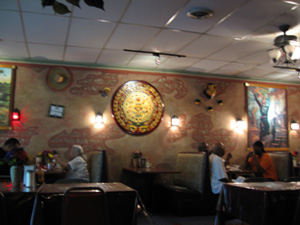
The ambience makes up for the sinking seats.

My favorite all-time Mexican restaurant is Azteca Tacos in Pilsen, 1836 S. Blue Island Avenue, Chicago, IL 60608, 312.733.0219

I’ve eaten there many times over many years. I was still in high school the very first time I ate there. My father and I went to the Fiesta del Sol when it was still on Blue Island Avenue. Rather than eating at one of the vendors from the fiesta, we went to Azteca Tacos and ordered our food through the window with wrought iron grating as we stood on the sidewalk.

It was kind of like eating at a restaurant in México. Authentic Mexican food is served by authentic Mexicans. The food is so delicious–¡Riquísima!–and they serve you large portions. It’s like being in México. Street merchants walk in to sell you everything from chiclets to blankets. Once an elderly man came in with a boom box and a book with a list of songs in Spanish. I picked two songs that I recognized and he sang them for us. I paid him $10 and he left the restaurant with a smile.

I like going there with my friends because it’s a nice place to hang out for a few drinks. Granted, it doesn’t look like a luxury restaurant, the seats in the booths are worn down a little, and the bathrooms remind me of México, but the food and the ambience make up for everything else. You have to go there at least once in your lifetime!

DDR