A little misunderstanding


On a wing and a prayer.

In the late 1950s, my parents and I lived in Perth Amboy, New Jersey, where I was born. My mother told my father that she would only marry him and come to America if she could visit her family in Mexico every year. My father agreed even though he would never return to Mexico ever again.

About 1957, my mother learned that her father was dying in Mexico. She bought plane tickets to visit her father on his deathbed. My mother took me with her even though I was still a baby. My father drove us to the airport. He always had trouble driving anywhere without getting lost. When he asked for directions, he would only confuse himself even more. Well, my mother and I were supposed to fly to Mexico from Newark. My mother told me this story several times. However, I remember the story became more exciting and compelling every time she told it.

Well, my father asked for directions to the airport in Newark. At that time, neither my father or mother understood English very well and they spoke English even more poorly. So, when my father asked for directions to the airport in Newark, the man misunderstood my father and gave directions to the airport in New York, . Well, my parents and I ended up going to the wrong airport. By the time we arrived at the right airport, they told my mother that our plane had already departed. She began crying because she would not be able to see her father before he died. Someone with a private plane heard her crying and when she told them why, he arranged for us to fly on a charter flight to Texas. From there, we flew to Mexico.

When we arrived at her father’s house in Mexico, my mother saw vigil candles lighted all over the house. When her family answered the door, they started crying even more when they saw us. My mother started crying thinking that she had arrived too late to talk to her father. “Did he die already,” my mother asked. “No,” my aunt answered. “He’s still alive?” my mother asked. “Yes,” my aunt said. “Then why is everyone crying?” my mother asked. “We thought you were dead. Your plane crashed!”
DDR

Maxwell Street


I’ll have a Polish sausage with mustard and onions, but hold the cholesterol!

Last night, I watched The Blues Brothers movie again, mainly to show my sons a classic movie about Chicago. I first saw it in 1980 when I was in the Marines. I saw the 25th anniversary edition DVD at my local library and I borrowed it since I always talk about classic movies with my sons.

This is an age of reproductions and sometimes my sons will quote something from a song, a TV show, or a movie they have seen without knowing the source of the imitation, parody, or spoof. So whenever possible, I try to educate my sons by pointing out the original source. Perhaps the most famous scene from The Blues Brothers movie is the one that I’ve seen in many contexts and that is the scene where Jake and Elwood Blues go to the Triple Rock Baptist Church and find God. You know the scene where Jake back flips up and down the aisle. I once saw this scene with my sons at a movie theater during the previews. My sons had seen the scene before, too, but they had never seen the whole movie.

I liked the scene at Maxwell Street because I still remember going to Maxwell Street as a boy with my father and uncles when we lived in Pilsen. When we went to St. Francis of Assisi Church on Roosevelt and Halsted, we were right around the corner from Maxwell Street. Sometimes we went to Maxwell Street after mass. My father always went to Preskill’s hardware store where my father could look at tools for hours. I always remember the little shacks that were built in the middle of the street to sell food such as red hots (hot dogs), Polish sausages, and other appetizing greasy foods, but we never ate there.

When I was old enough to drive, I often returned to Maxwell Street, against my mother’s wishes. This was a wonderful place to buy nice clothing cheap. And tailors would alter it for a perfect fit.

It was then that I was finally attracted to the fine cuisine that Maxwell Street had to offer. Yes, I’m talking about those Polish sausages and pork chop sandwiches, way before they started serving them with French fries. Jim’s Original Maxwell Street Polish Sausage was right on the corner of Maxwell and Halsted. That was my favorite eating establishment.

Sometimes I would stop there on the way home from the comedy clubs because they never closed. I mean never! Not even Christmas or New Year’s Eve. Where else could I buy a Polish sausage and pork chop sandwich at any hour of the day, any day of the year? Sometimes I would drive by just to smell the all the Polish sausages, pork chops, and onions piled high on the ever-grilling grill that was the equivalent of Maxwell Street’s eternal flame.

I would always meet interesting people there, too. I once saw a limo pull up and the passenger in the backseat got out to buy a Polish sausage and then got back into the backseat of the limo and then it drove off. I’ve often wondered about the true story of that purchase. How cool would it be to go to Maxwell Street in limo?

When I became a Chicago police officer, if I drove past Maxwell Street, I just had to stop for a Polish sausage and a pork chop sandwich. No matter what district I worked in, if I somehow found myself going by Maxwell Street on the way back from the Cook County Jail, the Cook County Hospital, or the Cook County Juvenile Detention Center. Of course, I would stop at Jim’s Original Maxwell Street Polish Sausage and partake of their fine cuisine.

DDR

My writer’s garret


La casa de Diego Rivera

Since my retirement, I’ve been trying to re-create a lot of things from my previous lives. That is, things I had prior to my marriage and children, things that I had to sacrifice for the sake of being a good husband and father.

Now, I can regress a little and so I am trying to recreate my writer’s garret. Back in 1981 BC (Before Children), I had a nice little apartment all to myself that served me well for all my writing purposes. I wrote a lot back then, but nothing incredibly significant like the Great American Novel or the Declaration of Independence. However, I did get published in some local publications. Even though these bylines impressed only me, I was proud of my writing and myself for achieving another one of my personal goals. Furthermore, I also earned enough money to say I was a paid, published writer, even if it wasn’t enough to earn a living. But I was in my glory as an aspiring writer!

So now, in my retirement, I’m trying to write again. To finish the play that I started 25 years ago and have been finishing for the last nine; to start the novel I’ve been meaning to write since I was in grade school but never actually started writing; and just to write everyday just to be able to say that I am a proficient writer. (Only real writers know how to use semicolons!)

To that end, I realized that I need my very own writer’s garret where I can feel comfortable expressing my most inner thoughts as a writer. I decided that I must create this writer’s space where I can agonize over the mot just and play the long-suffering writer who lives under squalid conditions that will induce great literature. I need a place where I may rendezvous with my muse, but she better bring some help because she’s really going to need a lot of reinforcements with me.

And so, I have been constructing my writer’s garret. Only, I’m not too much for playing up the suffering part. I’d rather focus on the creature comforts now, especially now during these warm summer months. Therefore, my “writer’s garret” is air-conditioned and has a ceiling fan. How am I supposed to author the Great American Novel if I’m hot and sweaty? Would you like to read a hot, sweaty novel? Plus, I need music to inspire me. Ergo, I have a high-fidelity sound system in my garret, along with a cordless phone, a fax machine, Internet radio, and a television.

Don’t laugh! So far, it’s working. What you just read is a product of my writer’s garret!

DDR

Okay, I’ve really become my father!


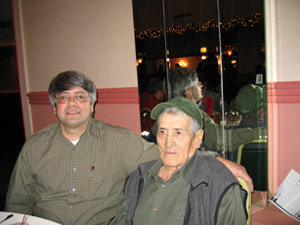
DDR with my Dad Diego

Well, I really did it this time! I was trying to fix my website so it would be even better than before. I saw that there was an update for WordPress software, so I tried to upgrade. Unsuccessfully! I’m not sure exactly what I did, but I seem to have deleted everything that I wrote before. I just couldn’t leave well enough alone! There was nothing wrong with my blog, but still, I tried to improve it. I really remind myself of my father now. Yes, luckily, I made a backup of everything. However, I can’t retrieve anything now. I know that I’ll eventually figure it out. In the meantime, I’ll just continue writing new entries in my blog. Hasta pronto.

DDR

Men don’t cry!


Evanston, Illinois

Even as a young boy, I was always taught that men don’t cry. I never really saw the men in our family cry, except at funerals. I only saw my father cry when his mother died, his father died, his younger brother died in Viet Nam, and when my mother died. No one criticized the men for crying then. And the men never cried tears of joy.   

But when I was little, I was always reminded not to cry whenever I fell, I didn’t get my way, or someone hit me–even when my mother hit me with the belt. Either my mother or my abuelita would constantly say, “Los hombres no lloran” [Men don’t cry!]

Sometimes when I cried, my mother would hit me and say, “¡Para que tengas algo para llorar!” [So you have something to cry about!] Once when I was about nine, I got beat up by one of the boys on the block and I came home crying. When my mother saw me, she asked me why I was crying. I told her what had happened, and she started hitting me. She made go back out to beat up the boy who had beat me up. Well, I went back to the boy’s house, and I beat him up–and I beat him up good! He felt all the pent-up anger that I had built up inside of me from the previous two beatings–the boy’s and my mother’s. But I finally understood that men don’t cry.   

So, I learned to control my emotions. I didn’t cry when my paternal grandmother died; I was too young to understand. I didn’t cry when my paternal grandfather died; he died when he was 68 and he had fathered 18 children, so it wasn’t exactly a tragic death.

However, I did cry when my uncle Joseph Rodríguez died in Viet Nam; I cried because he was only 22. And I thought that I, too, would die in Viet Nam.

When my mother died, we had a lot of unresolved issues between us. I think the main reason I didn’t cry when she died was because I constantly heard her saying, “¡Los hombres no lloran!”   

DDR