Again I traduce


On the southwest side of Chicago

I was curious as to who was actually reading my Blog. So, I did some snooping around, I mean some investigating. For some unknown reason, I keep getting hits from Russia. I can’t quite figure it out. My most viewed Blog entry is the one about Enrico Mordini, my Spanish teacher at Divine Heart Seminary. I guess I should go back and actually finish writing it and editing it since so many people are reading it. Now I feel embarrassed that I didn’t fix it up sooner. Another thing that really surprised me was the fact that people in Spanish-speaking countries are also finding my blog. I was wondering how they would read it since I mostly write in English. I went to the referring page and found that an automated translator could actually translate my blog into Spanish with a link on the search engine page. Wow! I mean, ¡Ay, ay, ay! The webpage is automatically translated into Spanish, but in very poorly-written Spanish at that. Upon reading the translation, I realized that people in Spanish-speaking countries will think that I don’t know Spanish!

Let me give you a sample of some of these translations. Well, it actually starts out quite well. The title at the top of my blog is David Diego Rodriguez, Ph.D. without an accent mark on the “i” of Rodriguez because otherwise all these strange characters appear and distort my last name thanks to the mysteries of computers and the Internet. However, the translator actually put the accent mark where it belongs! The rest of the translations are rather sad. For example, under my name I write, “¡Hola! ¡Yo hablo español e inglés!” For some strange reason that phrase is translated as, “¡Yo hablo español electrónico español!”, which somehow fails to convey my original message. I suppose if someone really wants to read my blog, they will gladly plod their way through this computer-generated translation.

When my Spanish students write compositions, I ask them to do the best they can. I ask them to write the composition in Spanish right from the start. I know that the student will make plenty of mistakes, but that’s part of the learning process. Sometimes the original text is upstaged by all my corrections in red ink. That’s fine by me if they make a valiant effort to write in Spanish. However, I do not want a student to write the composition in English and then translate it into Spanish. That’s double the work! And of course, I can always tell when they write it in English and then use an internet or computer translator. Well, the output hardly resembles proper Spanish. In fact, in many cases, I cannot even decode what the student wanted to say in the first place. All the words are in Spanish, but the composition is incomprehensible! I always ask the student to rewrite such a composition, “but in Spanish this time.” About the only word that doesn’t lose anything in translation is the English word “no” that also happens to translate to “no” in Spanish. Even an automated translator gets this translation right!

DDR

Enrico Mordini


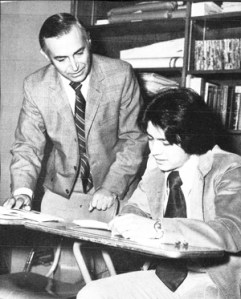
Enrico Mordini with Jerry Rodríguez at Divine Heart Seminary

Years ago, I attended Divine Heart Seminary in Donaldson, Indiana. I recently went to a DHS reunion where my classmates and I remembered our Spanish teacher Enrico Mordini. Señor Mordini was the Spanish teacher who taught me a lot about being Mexican even though he was an Italian born in Italy and raised in Spain. He taught me that there is more than one way to speak Spanish. I never realized there were so many dialects. I was originally in his Spanish I class, but he moved me up to Spanish II because I knew some Spanish. I had always wanted to learn Spanish formally so that I could read and write it. As an aside, when I attended Holy Cross Grade School, since the Lithuanian school didn’t offer Spanish classes, I asked if I could go to Saturday morning classes to study Lithuanian. I was told, “First, you have to learn English.”

Once I started classes with Señor Mordini, I questioned whether I even knew Spanish. He said some words so differently from my mother that it took me some time to recognize them. For example, “to drink” to my mother and me was “tomar” and to Señor Mordini it was “beber.” I had never even heard the word “beber” before! When my mother said “good” in Spanish, she would not say it the same way as Señor Mordini’s “bueno,” but rather, she would say, “güeno” instead. The Spanish word for needle was “aúja” to my mother and me, but to Señor Mordini, it was “aguja.” Our word wasn’t even in the dictionary without the letter g. When I informed my mother of these differences, she said that’s because Señor Mordini spoke “castellano” and not “español.” When I told Señor Mordini what my mother had said, he said that “castellano” and “español” were synonyms for the Spanish language. My mother never really believed him! After all, he wasn’t Mexican. In fact, he wasn’t even Spanish either. He was Italian!

Once while discussing Mexican culture in class, I said that I knew all Mexicans were a mixture of Spanish and Aztec blood. I was shocked when he said that was only partially true because not everyone, in fact, not many people were purely of Spanish and Aztec ancestry. I insisted that I was right. Even my father had told me so. Even after several convincing arguments by Señor Mordini that there were people in Mexico of pure, unmixed Spanish blood , I still didn’t believe him. When I reported this to my mother, she said that not all Mexicans were only of Spanish and Aztec ancestry. In fact, her grandfather had been Irish! “What?” I was so shocked. “Why didn’t you tell me before?” I asked my mother. She just nonchalantly said, “I didn’t think it was important.” Suddenly, I was sixteen and learning for the first time that I had more than just Spanish and Aztec blood coursing through my veins. In fact, I might not even have Spanish or Aztec blood coursing through my veins. I was in shock! It took me years to adjust to this new discovery about my ancestry. Was this a possible explanation for why my best friend in the Catholic Lithuanian grade school was Patrick McDonald from Ireland? But the fact remained that Señor Mordini was right again!

Years later, when I applied to teach Spanish at a community college, I was hoping against hope to get the position because I saw in the school catalogue that Señor Mordini was on the faculty! But such was not my luck. Señor Mordini died that year and I didn’t get the position! I suffered two severe blows at once. But I was lucky enough to have met Señor Mordini when I did. He certainly made more aware of myself and made me a much better person.

La clase del señor Mordini

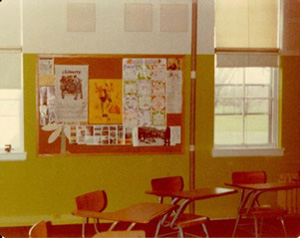
Above: This was the Spanish classroom at Divine Heart Seminary in Donaldson, Indiana, in the 1970s. This is one of the many schools where Señor Enrico Mordini taught. As an aside, Señor Mordini had a good sense of humor and got along well with the students. Once my classmates talked me into hiding in the fire escape, which was a giant slide in a huge metal tube on the right in the picture but out of view, and Señor Mordini humored us by looking for me wherever my classmates suggested: under his desk, under the student desks, behind the bulletin board, etc. 🙂

DDR