I am bilingual. I know Spanish and English. I like to think that I speak, read, and write two languages very, very fluently. However, I always have the vague feeling that I don’t communicate like a native speaker in either language. Sometimes people tell me that I speak English with an accent, which I don’t doubt at all.
As I was driving through to Mexico to visit my family, I had no trouble communicating with anyone. Except at the border where I applied for an auto permit to drive in Mexico. The clerk asked me something that I didn’t understand. She repeated it three times, but I understood everything else she said, except for one word. She asked if I drove a Pontiac. But she pronounced Pontiac in Spanish, and I didn’t recognize the word immediately. Finally, her colleague pronounced Pontiac in English and I understood. This taught me that I had to adjust my way of listening since I would be listening to different dialects.
Once I reached Celaya, I had no trouble communicating with anyone. I met my family, and we understood each other perfectly. Ditto for my relatives in Mexico City. They mentioned other family members who had come from the U.S. who spoke no Spanish at all. However, a few relatives discreetly mentioned my accent, of which I have always been painfully aware. I wanted to buy some Mexican T-shirts for my sons at the mercado and my cousin told me to be quiet and she would do the haggling. If they heard me speak, they would think I was tourist, and we wouldn’t get a fair price. On the one hand, I had an American accent, but on the other, several people mentioned that I spoke Spanish extremely well. Well, that’s me to a tee. I abound in paradoxes. I speak Spanish with an accent, but very well. A few people mentioned that I stuttered through plenty of conversations while speaking Spanish. I pointed out that I stutter in English, too. But I was incredibly happy that I could communicate in Spanish in Mexico!
Okay, the one thing that worried me even more than the drive to Mexico was the fear of getting sick there. You know, Montezuma’s Revenge. When I went to Mexico in 1978, my mother advised me as to what to eat and what to avoid eating in order not to get sick. Since she went to Mexico every year, I honestly believed she knew what she was talking about. She told me, and I still remember to this day, to avoid drinking the water and eating fruits, chicken, and eggs. But most important of all: “Don’t drink the water!” I was there for a month, and I really enjoyed myself despite depriving myself of some foods in the beginning.
When I took the bus to Celaya with my aunt and cousin, all my relatives were eating chicarrón and I couldn’t resist indulging myself. Besides, chicharrón was NOT on my mother’s list of foods to avoid. So, I really, really indulged on chicharrón! Well, the next day, I felt nauseous, me who rarely gets sick. Soon, I was vomiting and had the runs. Simultaneously! My aunt attributed my illness to the chicharrón I had eaten. I felt so deathly ill that the only thing that kept me living was the hope that I would die. But blessings sometimes come disguised. After I recovered a few days later, I was able to eat anything I wanted. I even drank the water without getting sick again.
So, when I went to Mexico this time, I dreaded the risk of getting sick again. I remembered my mother’s list. But then I thought that if I got sick immediately I could then enjoy the rest of my trip with my newly acquired immunity. I drank agua de horchata, which is rice water that is very tasty. I assume that it’s made primarily of water, unpurified water, that is. It even had ice cubes! Presumably, also made from unpurified water.
When I went to my aunt’s house, I ate some fruit (I don’t remember what it was called) from a tree in her back yard and she scolded me for eating the peel since I didn’t wash it. Well, I kept waiting for my impending onset of “discomfort” with Montezuma’s Revenge. I remained healthy the entire trip! I felt like a real Mexican!
Driving in México has been my greatest, and perhaps most dangerous, accomplishment ever. I almost didn’t drive there after my cousin warned me that no driver obeys the rules of the road. However, I was due for an adventure since I do live a very boring life. As soon as I entered México, I noticed the driving difference immediately. In Nuevo Laredo, the streets were narrower and street venders were at every major intersection peddling their wares. Most lane markings were nonexistent. All the drivers accelerated quickly and stopped even faster when necessary. In Monterrey, I was fascinated by the different configuration of traffic signals. The green light flashes three times before it turns yellow. Then, there are two, count them, two red lights side by side. I honestly thought this meant that I should stop at the red light. Boy, was I wrong! All the cars behind me beeped at me until I drove through the red light.
As I was driving on the highway, I was fascinated by the road signs so much that I began to write them down as I drove. Of course, this made me swerve several times and once I almost drove off the edge of a cliff. I liked the fact that these white rectangular signs appeared on both sides of the road. In the U.S., whenever I need to read an important road sign, I usually can’t read it because it’s obstructed by a passing semi. Here are some of the signs that I saw while driving in México.
PONGASE VIVO USE EL CINTURON DE SEGURIDAD In México, it’s the law for front-seat passengers to wear seatbelts. I always wear my seatbelt anyway since I believe it has previously saved me from serious injury in my previous accidents.
GUARDE SU DISTANCIA Don’t tailgate. However, if you’re in the fast lane and you’re not driving way over the speed limit, drivers will rapidly approach your rear bumper flashing their left turn signal (that means they want to pass you) and you better move into the right lane!
DISMINUYA SU VELOCIDAD Reduce speed. This sign appears whenever approaching a town or tollbooth. However, no one actually slows down.
RESPETE LIMITE DE VELOCIDAD Obey the speed limit. I’m not sure why someone posted this sign along all the highways. No one obeys the speed limit and traffic enforcement is virtually nonexistent.
RESPETE EL SEÑALAMIENTO Obey road signs. Once again, I’m not sure why these signs are posted. I see these signs more as suggestions than anything else.
CUANDO TOME NO MANAJE If you drink, don’t drive. In general, everone was afraid to drink and drive because of the consequences if arrested for drinking and driving. Besides, no driver can survive the driving habits of other Mexican drivers even if they’re only slightly impaired.
MANEJE CON PRECAUCION Drive cautiously. That’s just a given for every driver. No one gets behind the wheel in México without dreading pulling into traffic. In fact, there are many Mexicans who don’t have a driver’s license simply because they’re afraid of the Mexican traffic.
OBEDEZCA LAS SEÑALES Obey signals. I think this another one of those signs that is more of a recommendation than anything else.
NO DEJE PIEDRAS SOBRE EL PAVIMIENTO Do not leave rocks on pavement. I really didn’t understand this sign at all. As I drove, I attempted to decode this mysterious sign to no avail. I finally asked one of my cousins who told me that sometimes drivers use rocks to prevent the car from rolling when changing a flat tire and then leave the rocks on the shoulder.
TRANSITO LENTO CARRIL DERECHO Slower traffic, keep right. But be careful because the right lane sometimes contains traffic that is inexplicably at a complete standstill.
CARRIL IZQUIERDO SOLO PARA REBAZAR Left lane for passing only. Even if you’re passing another vehicle and a faster vehicle comes along, you better get out of the way!
LO MEJOR DE TUS VACACIONES REGRESAR A TU CASA The best thing about your vacation, returning home. Of course, they don’t mention what condition your mental state will be in after driving among countless reckless drivers, in the Mexican mountains, on roads with little or no road markings, no median protection, or the complete lack of guardrails on the edges of cliffs with precipitous drops.
PISO MOJADO Wet pavement. Luckily, the streets were dry the whole time I was in México. Driving was challenging enough without complicating things with wet pavement.
UTILICE EL CINTURON DE SEGURIDAD Use your seatbelt. Most people put on their seatbelt willingly due to the driving conditions and risks involved rather than fear of the law.
CON NIEBLA DISMINUYA SU VELOCIDAD Slow down in fog. I didn’t actually see any fog, but I’m sure drivers will slow down with zero visibility. At least, I hope so.
CON NIEBLA ENCIENDA SUS LUCES Turn on lights in fog. I’ve driven in fog in California and I know that if you turn on your headlights you still can’t see what lies ahead. And if you turn on your high beams, you will be blinded. However, other drivers may see your taillights and avoid rear-ending you. At least, I always hoped so.
CONCEDA CAMBIO DE LUCES Dim your lights if someone flashes their brights at you. Okay, their was enough traffic on both sides of the highway after dark that it was impossible to use your brights. Oh, yes, those drivers who want to pass you will flash their brights at you at night if you’re in the left lane and not going at least 40 KPH over the speed limit.
NO MALTRATE LAS SEÑALES Do not damage the signs. All the road signs I saw were in good condition, unlike in America where some signs have shotgun pellet markings caused by some good ol’ boy.
NO DAÑE LAS SEÑALES Do not damage the signs. Again, but with different wording. These signs must work because all the road signs I saw were intact.
NO PRENDA FUEGO SOBRE EL PAVIMIENTO Do not light fires on pavement. I’m not sure what this sign means, since I didn’t actually see any fires on the road, I did, however, see people living on the side of the highway in makeshift shelters with fires in front and people tirelessly waving down drivers for money. Some drivers actually stopped and contributed.
NO CIRCULAR POR EL ACOTAMIENTO Do not drive on the shoulder. I find this sign incredibly amazing because on many sections of the highway there is no shoulder at all!
NO TIRE BASURA Do not litter. In general, drivers didn’t litter. There are plenty of garbage cans along the highway that are well-marked in advance for you to stop in time and dispose of your garbage. I only wished that the gas stations were also marked as well. I missed one gas station because no signs announced its location and I didn’t see it because it was behind the side of a mountain.
NO MANEJE CANSADO Do not drive tired. This sign is totally useless. If you drive for more than an hour in México, you will be tired. Most drivers were always alert.
TRAMO SINUOSO Winding road. This stretch of road was actually fun to drive if you didn’t look over the edge of the cliff for too long and imagine your horrific death.
CURVAS PELIGROSAS Dangerous curves. Take this sign seriously. They really do mean dangerous curves, especially since chances there won’t be any shoulder or guardrails to save you if you veer off the road.
FRENE CON MOTOR Brake with motor. In the U.S., the roads signs prohibit engine braking, but in México if you don’t, you’ll probably wear out your brakes before you get to your final destination.
VEHICULO SIN FRENOS SIGA LA LINEA ROJA Vehicles without brakes, follow the red line. So I’m driving in the lane with the red line go down a very steep incline and I’m constantly looking in the rearview mirror for runaway vehicles with no brakes. I felt safer when I drove in the other lane. The red line eventually leads the vehicle off the main highway to an adjacent road that rises sharply, presumably to slow the vehicle down, and ends with a steep cliff at the end. Pretty scary!
VIAJE CON SEGURIDAD Drive safely. You must multi-task while driving. The only way to drive safely in México is to drive defensively AND offensively simultaneously.
CEDA EL PASO Yield. You must always be prepared to yield–at any moment, on any stretch of the road. I thought I was about to run over a bicyclist who made a u-turn in front of me as I was driving 120 KPH. This only happened to me once since bicycles are prohibited on the highway.
NO CIRCULAR POR FAJA SEPARADORA CENTRAL Do not drive on the median strip. This sign is totally unnecessary. If anyone is foolish enough to drive on the median strip, they will total their car and/or kill themselves.
TUNEL PROXIMO ENCIENDA LUCES Approaching tunnel, turn on lights. And you better turn on your lights because the tunnel is very, very long if they actually post this sign. And, there are no lights in the tunnel other than your own!
To me the scariest part of driving through México was this godforsaken stretch of highway in the state of San Luis Potosí where not one single AM or FM radio station was broadcast. The horror, the horror! In summary, you will never forget driving in México, even if just as a passenger. On the one hand, Mexican drivers are reckless and don’t respect the driving laws. On the other hand, I didn’t witness even one accident the whole time I was in México.
Click here if you would like to see more driving vocabulary in Spanish:
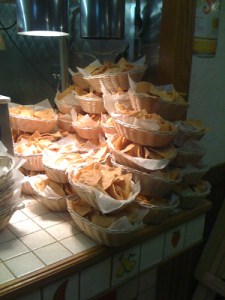
There are Doritos. You’ve eaten them before. Nacho flavored tortilla chips, which some people complain are too tangy or too hot.
And then, there are Mexican Doritos. In Spanish, they are totopos de maíz con queso y chile. They even have their own website: http://www.sabritas.com.mx/. These Mexican Doritos are more potent than American Doritos. You do not need to dip these tortilla chips into any kind of salsa. Mexicans added jalapeño peppers and other spices to the recipe, so these chips are very, very hot! Of course, a true Mexican would still add salsa and / or a whole jalapeño pepper.
As I was driving home from Mexico, I had to buy gas. So as long as I was in the gas station, I decided to buy some snacks. I naturally grabbed the familiar name brand of Doritos since they are based on the Mexican food of tortillas. But I was surprised to discover that Mexicans would sell an Americanized version of a Mexican food. So, I’m driving in Mexico enjoying the scenery, looking at the cacti, watching for drivers who speed up to my rear bumper, so I move out of there way, etcetera. I decide to eat some of these Mexican Doritos. Wow! What a surprise! They were spicy. However, since I had been eating so much hot stuff anyway, they tasted just right. But I have a feeling that I once I eat American Doritos, they will taste rather bland.
When we went to Mexico when I was little, I remember that Mexicans didn’t really celebrate Christmas. The day for giving gifts to children was January 6, el Día de los Reyes. Occasionally, small gifts were given for Christmas, but the big gifts were given on January 6.
So, I was surprised to see that many Mexicans were Christmas shopping when I was in Mexico before Christmas. I asked my cousin about all the Mexicans Christmas shopping, and she told me that more and more people were giving the big gifts on Christmas and the smaller ones on January 6.
I attribute this to American cultural imperialism and capitalism. Mexico as a country that is adapting to better function in a global economy. And of course, when Mexicans watch television, they get to see all of the American Christmas movies that stress gift-giving on Christmas Day, especially by Santa Claus.
While in Mexico City, I noticed the traditional Christmas decorations featuring a Nacimiento (Nativity Scene), but I also saw other Christmas decorations like Santa Claus, Rudolph the Red-Nosed Reindeer, and Frosty the Snowman, which was ironic since it hardly ever snows in México City. The street vendors even sold reindeer antlers and noses to attach to your car. I was surprised to see that people drove around in these “reindeer” cars.
Meanwhile, my family in Celaya celebrated Christmas in the traditional way by gathering on Noche Buena (Christmas Eve), going to mass at the catedral, and then eating a big dinner. We went to mass and my cousin took a baby Jesus surrounded by candy on a tray that she placed near the altar for the priest to bless during the mass.
After mass, we walked back home with baby Jesus and then ate dinner. Then we took baby Jesus to the Nativity Scene, and everyone prayed and sang songs to him. Everyone then kissed baby Jesus and took a piece of candy from the tray. After this, I placed baby Jesus in the Nacimiento. My cousin later started a bonfire that the children enjoyed because they placed inflated balloons over the flames and watched the balloons fly away. No one received gifts on Christmas morning because in Celaya the children still receive their gifts el Día de los Reyes.



 Chicago USA