I want to wish everyone a belated Happy New Year! ¡Próspero Año Nuevo! I was too busy to write this post on New Year’s Day because I celebrated in Mexico City. This was the only the second time I celebrated New Year’s Eve in Mexico. The first time was way back in 1965, but all I really remember is breaking a piñata with my cousins. I do remember this New Year’s Eve, however.
We started with a few drinks on an empty stomach because dinner wasn’t served until after midnight! We watched celebrations from other cities on TV. When the countdown to the New Year started, we were all ready with a glass of apple cider, a glass of water, and twelve grapes. The tradition of eating twelve grapes began in 1909 in Spain and is now also followed in Mexico, Chile, and Argentina–Chile and Argentina eat raisins instead. No one is sure why we eat twelve grapes, but speculation is that it’s one for each month of the year or one for each toll of the bell at midnight. At the stroke of midnight, we ate the grapes to bring us good luck throughout the year. (I learned these interesting tidbits of information while watching TV before our New Year’s Eve celebration!) We had a toast with the glass of cider. Then we threw out the glass of water in the yard. The water represents the tears we will avoid throughout the rest of the year. Everyone danced in yard–including me, but not very well. Everyone took turns walking around the yard rolling a suitcase behind them. This was done with the hopes that they get to travel somewhere exotic on vacation during the next year.
I make no New Year’s resolutions this year since I never manage to keep them for very long anyway.
I’ve reached a juncture in my life where I am very happy and content. I go to bed whenever I want. I get up whenever I want. If I feel like, I do a little writing, a little reading, or nothing at all. I really don’t have to be anywhere until the middle of August when the semester begins.
I’m looking forward to my road trip to Mexico City with my sons who are now twelve and actually a lot of fun to have around. They stay up late and get up late, so I actually have some time to myself in the morning. Today, when they woke up, I announced, “We’re going to Starved Rock!” I was waiting for a resounding, “Hooray!” But I was greeted by silence. However, whenever I suggest outings they go willingly because we always have fun on these trips. And today’s trip was no exception. I like just getting in the car and driving somewhere–anywhere–with my sons.
I have to admit that this is where I wanted to be in my life for the longest time. I really don’t have too many obligations to complicate my life. I get up in the morning, drink my coffee, read my paper, and then go running. After that, the rest of my day is a blank daily planner. I can do whatever I want. Literally. And I often do.
My only personal goal at the moment is to write a blog entry everyday until I go to Mexico. Then, I’ll have to take a little break. I’d like to finish editing my play that I’ve been writing for more than twenty years, but I always manage to put it aside for yet another day. And I don’t feel at all guilty about it. I’m happy to have gotten to this point in my life because not many people get to theirs. I’ve been very fortunate and I’m grateful for it.
Mexicanismos are words or phrases in Spanish that are unique to México, but may not be familiar to other Spanish speakers, also known as Hispanophones. French speakers are Francophones and English speakers are Anglo-Saxophones.
Anyway, in Mexico, people use words and phrases that are unique to that region and are commonly misunderstood by other Hispanophones. At UIC (University of Illinois at Chicago), we have graduate students who come from all over the Spanish-speaking world, most of whom specialize in linguistics. They can spot the dialect and region of most Spanish speakers almost immediately. Some have trouble identifying me because I have my American accent and I use words and phrases from almost every dialect that I’ve ever heard. I’m like a sponge in this regard. Sometimes, someone will throw their hands up in the air and just ask me where I’m from. They’re often surprised to hear that my parents were from México. My cousin’s husband thought I spoke with an Argentine accent. Once, a friend and I were speaking, and then I didn’t hear something she said. So, I said, “¿Mande?” and she said, “¡Ajá! You’re from Mexico!” That simple little mande gave me away as a Mexican.
Once, at the end of the semester, a professor from Argentina told us that she would bring us a torta for the last day of class. To most Mexicans and me, a torta is a type of sandwich that is served on a bun with meat and other condiments. I didn’t eat before class because I wanted to be polite and eat everything that was offered to me. Well, she came to class with a torta, but it was a cake, as in a pastry for dessert. I left the classroom hungry that day.
Another time, I brought some Thanksgiving leftovers to UIC for lunch. A graduate student from the Basque Country in Spain asked me what I was eating. I told her guajolote and camotes. She didn’t know what I was talking about. For her turkey was pavo not guajolote and yams or sweet potatoes were patatas not camotes because they didn’t differentiate between the various kinds of potatoes in Spain.
I have a friend who grew up in Seville, Spain, and we once had a minor misunderstanding. He told me that his car had broken down: “Se me estropeó el coche.” Being the nice guy that I am, I wanted to be helpful, so I offered him a ride: “¿Quieres un aventón?” I could tell by the tone of his voice that he was a little upset when he replied, “¿Y yo qué te hice?” You see, to a Mexican, un aventón is a ride, but to just about any other Spanish speaker un aventón implies some kind of physical violence. I explained to him that I only wanted to help him by giving him a ride to wherever he wanted to go, and I am happy to say that we are still friends to this day.
Another graduate student from Spain taught a class that had many Mexican American students. She frequently used the word coger, meaning “to get” or “to pick up” when she spoke not realizing that to Mexicans coger is a profanity that refers to the act of sexual intercourse that begins with the letter “f.” So, one day, she talked about picking up her dog: “Cogí mi perro.” She was surprised when the class began to laugh until someone explained to her what she had said.
While I was in México, I learned a few more mexicanismos. My cousin used the diminutive “-is” instead of “-ito, -ita.” For example, she went to see her “amiguis” instead of her “amiguitas.” Before we went to visit my cousin David Rodríguez in Celaya, everyone refered to him as Davis.
In the U.S. we have Spanglish, which is the mixture of English and Spanish, but I only thought it existed north of the Rio Grande (In Mexico, they call it El Río Bravo). For example, you take an English word like “to check” and make it Spanish: chequear, instead of comprobar or some other Spanish word that already exists. Anyway, they have a similar word in Mexico: checar. Several street venders approached me and called me jefe, showed some product they were selling, and said, “Checa esto.” Or “Check this out,” in English. So, this word is a little different than the Spanglish word chequear because it’s a mexicanismo. Or maybe it should be called inglañolismo.
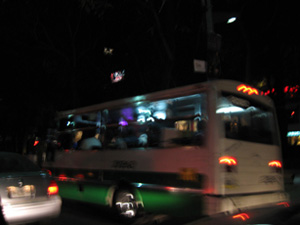
I always thought of an aquarium as un acuario, but to my cousin in Celaya it was el pecero. I had never heard the word before, but I knew exactly what he meant. Then when I was in Mexico City, when people talked about taking the bus they still called it el camión, but now a lot of people also called it el pecero. That made perfect sense because if you look at the buses with their large windows, they do look like aquariums with people swimming inside instead of fish.
If you park your car in México City, you’re likely to meet el viene viene. He is a self-appointed parker of cars and is often found on public streets and grocery store parking lots. He doesn’t officially work for anyone. He’s just there–and everywhere else. You can’t miss him. He pops up out of nowhere waving his salmon-colored mechanic’s rag as you park your car. As you back up, he tells you how far you can back up by saying “Viene, viene.” When you get out of your car, he’s standing next to you with hand, and you’re supposed to give him a tip of two pesos or so.
Then, there’s also the aguinaldo that is a bonus that most employees receive before Christmas and before el Día de los Reyes to buy holiday gifts or pay off debts. At Christmas, children received candy bags. They were told, “Come get your aguinaldo!”
When we went to Mexico when I was little, I remember that Mexicans didn’t really celebrate Christmas. The day for giving gifts to children was January 6, el Día de los Reyes. Occasionally, small gifts were given for Christmas, but the big gifts were given on January 6.
So, I was surprised to see that many Mexicans were Christmas shopping when I was in Mexico before Christmas. I asked my cousin about all the Mexicans Christmas shopping, and she told me that more and more people were giving the big gifts on Christmas and the smaller ones on January 6.
I attribute this to American cultural imperialism and capitalism. Mexico as a country that is adapting to better function in a global economy. And of course, when Mexicans watch television, they get to see all of the American Christmas movies that stress gift-giving on Christmas Day, especially by Santa Claus.
While in Mexico City, I noticed the traditional Christmas decorations featuring a Nacimiento (Nativity Scene), but I also saw other Christmas decorations like Santa Claus, Rudolph the Red-Nosed Reindeer, and Frosty the Snowman, which was ironic since it hardly ever snows in México City. The street vendors even sold reindeer antlers and noses to attach to your car. I was surprised to see that people drove around in these “reindeer” cars.
Meanwhile, my family in Celaya celebrated Christmas in the traditional way by gathering on Noche Buena (Christmas Eve), going to mass at the catedral, and then eating a big dinner. We went to mass and my cousin took a baby Jesus surrounded by candy on a tray that she placed near the altar for the priest to bless during the mass.
After mass, we walked back home with baby Jesus and then ate dinner. Then we took baby Jesus to the Nativity Scene, and everyone prayed and sang songs to him. Everyone then kissed baby Jesus and took a piece of candy from the tray. After this, I placed baby Jesus in the Nacimiento. My cousin later started a bonfire that the children enjoyed because they placed inflated balloons over the flames and watched the balloons fly away. No one received gifts on Christmas morning because in Celaya the children still receive their gifts el Día de los Reyes.
After Carlos Mojaro moved back to Mexico, we just didn’t have as much fun as before. Most of the time we just played baseball in the prairie or just sat on somebody’s porch talking about the good old days. Then we saw the Mexico City Olympics on TV, mainly because our parents were so proud of the fact that an international event could take place in Mexico City. So all my friends and I watched the Olympics religiously.
I especially liked the track and field events, but I also liked women’s gymnastics. Whenever we talked about the Olympic events we watched, we couldn’t help but act them out. Soon we started up our own Olympics. For the shotput, we through a brick in my backyard. Luckily, we weren’t strong enough to throw it out of the yard. We had competitions in many events. We even made charts with the athlete and team standings and the “world records” that we had achieved. After watching the Olympic marathon, we were amazed that anyone could run 26 miles. However, as we discussed this amazing feat, we realized that when we were very active on those long summer days, we ran quite a lot distance without realizing it. I even suggested that we could probably run a marathon if we tried. There was some dissension amongst us at first. But then we decided to put ourselves to the test.
There were about fifteen of us and we decided that we would run the Mexico City Olympic Marathon. I felt as if Carlos Mojaro was still with us. Well, we didn’t exactly know how a long marathon was, and since our mothers wouldn’t let us cross the street, we decided to run around the block until we competed the marathon or dropped dead like Phidippides. I didn’t know much about running back then, but I did know that we had to pace ourselves to go the distance.
After the opening ceremony, we toed the line and ran at sound of the exploding firecracker. Douglass sprinted from the start and only made it around the block once. The rest of us ran as a pack as we had observed the Olympic marathoners do. I’m not sure how long our Chicago city blocks are, but I believe our block at 4405 South Wood Street was about one-third of a mile when we ran completely around. As we ran around the block we would shout out the lap number as we passed my house. It was getting dark fast. We were actually having fun running around the block in the Mexico City Olympic Marathon.
My mother came out to see what was going on because a crowd had gathered in front of my house. We didn’t actually expect to have any spectators. This was just like the Olympics! By lap ten, a few runners had dropped out of the race. The spectators shouted out the lap numbers with us. About lap twenty, my mother said it was time to go in the house. My friends’ mothers were also waiting for their sons to go home. My mother insisted that I go inside so my brothers would go home, too.
I knew if I went in, then the marathon would stop and everyone would go home. I begged my mother, without breaking my stride, to let us keep running a little longer. We ran a few more laps and we were still having fun, but we were also getting tired and starting to feel pain in our legs. When we reached lap 27, my mother said that if I didn’t go in right now, she would beat me: ¡Te voy a dar una paliza! That was just the excuse we needed to save face. There were only six of us left running and we all complained to our mothers about interrupting our marathon. But we all went home, secretly thankful to our mothers for saving us from embarrassment.
However, we always felt great about our running accomplishments. We always talked about how much farther we could have run if weren’t for our mothers stopping us. Of course, we never attempted to run another marathon either.




 Chicago USA