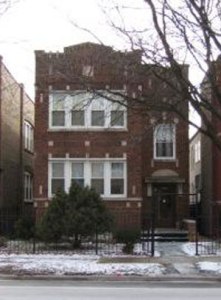
When I lived near Marquette Park, there was a lot of racial tension. The neighborhood suffered from panic as the blacks moved closer and closer due to white flight. When my mother bought our house at 2509 W. Marquette Road, the neighbors said, with a sigh of relief, “At least you’re not black.” But we weren’t completely accepted by many in the neighborhood.
No matter where you lived in Chicago back in the 1970s, there would be someone who resented you, regardless of your race. In 1966, Dr. Martin Luther King Jr. had marched in Marquette Park was greeted by whites who threw bricks, rocks, and bottles at the marchers. We moved to Marquette Park in 1973 and people still talked about the Doctor King march. I was a typical teenager in that I wasn’t fully aware about the political events in Chicago or our neighborhood.
So, one Saturday in 1975, I was driving home from work at Derby Foods. When I got close to my house, all the streets were blocked off by the police and I couldn’t drive home. Helicopters flew overhead. I drove around until I found a side street that wasn’t closed. I managed to park my Firebird about four blocks from my house. I had no idea why there were so many police officers in our neighborhood, nor why all the streets were closed.
As I walked home, I could hear people chanting in the direction of my house. When I reached Marquette Road, there were hundreds, if not thousands, of people lining both sides of the street. Reverend Jesse Jackson had led a protest march, but I had just missed it. The street was littered with rocks and bottles. A black man and a boy drove up Marquette Road and people threw rocks and bottles at his car shouting racial epithets. The car sped off westbound where he was greeted by more projectiles.
I had a tough time crossing Marquette Road to get home. When I finally got to my house, there were hundreds of people standing in front of my house. I couldn’t reach my front door, so I watched until the march was over and most of the people left. My younger brother told me how he saw police officers on horses near California Avenue. Someone blew up a cherry bomb near the horse and scared it so that it stood on its hind legs. Someone kicked one of horse’s hind legs and the horse and police officer both fell. The police immediately arrested the offender.
One of my friends told me he was standing on the curb watching all the action when a little old white lady gave him a brick and said, “You throw it! I’m too old!”
When I finally got home, my mother asked me where I was. I told her that I was at work and that I had a hard time getting home. When my mother asked my brother if he was at the march he swore he was at his friend’s house. My mother didn’t believe him. She didn’t want the neighbors to think we were causing trouble. Little did she realize that all our neighbors were out there throwing things. The next day, my mother punished my brother for being at the march and for lying to her. She had seen my brother on the news near where the horse was kicked down. They had more protest marches after that, but that was the only one I saw up close.
I met Tony Jr.–his full name was Anthony Borkowski Jr.–when I worked at Derby Foods, 3327 W. 47th Place, home of Peter Pan Peanut Butter and Derby Tamales. His father, Anthony Borkowski Sr.–also called Tony–wanted his son to work while he attended school at DeVry. Tony Sr. thought his son was getting too lazy by just going to school and not working. Tony Jr. was already twenty-two, but still had not graduated from college. He was a student at the University of Illinois Circle Campus–before it became the University of Illinois at Chicago (UIC)–and belonged to a fraternity, so he partied a little too much for his father’s liking. So Tony Jr. transferred to DeVry and started working at Derby Foods.
Tony Jr. towered over me whenever we talked. He had dark blond hair and wore round wire-rimmed glasses. He looked flabby, but was actually rather muscular. He could do any job at Derby Foods, including unloading the 135-pound bags of raw peanuts from the railroad boxcars (something I could only do for more than a few days at a time because that job exhausted me). He was always on time for work because his father always woke him and they went to work together, even if Tony Jr. had been out partying all night. Tony Sr. would pull off the blankets and announce, “Time to go to work!” with his heavy Polish accent. If Tony Jr. still didn’t get up, his father would push him out of bed and shout, “If I have to go to work, you have to go to work!” Some mornings, Tony Jr. was a walking zombie.
Tony Sr. was a miniaturizad version of his son who never missed a day of work because he loved his job. He was quite a character in his own right, a man who was quite liked by everyone because he was friendly, had a good sense of humor, and could take a joke. Of course, people often tired of his standard greeting that always made him laugh, but no one else. In the morning, he would greet the women by saying, “Hey, good looking! What you got cooking?” No one ever responded to his question, so he would answer it himself with either, “Chicken! You wanna neck?” or “Bacon! You wanna strip?” The first time someone heard Tony Sr. say that, they laughed. Then after about the third time, they were just tired old jokes. After about the hundredth time, those lines became funny again when he used them on new employees. But everyone humored him because he was such a friendly guy.
On the other hand, he was disliked because he was a foreman and always wanted to earn his annual bonus by increasing productivity on the peanut butter production line. Number one on his agenda at work was that his peanut butter production line produce at least 100%. Sometimes, he would work harder than his workers rather than just stand there idly and merely supervise. He also was concerned about job security–so much so that he never told anyone how to start up the peanut butter processing machinery. He was so afraid that he would be replaced if someone else learned his trade secrets, so he would come in early Monday morning before anyone was at the factory to start everything up. He even did this while he was on vacation.
But back to Tony Jr. who was promoted from laborer to mechanic because he was intelligent, a DeVry student, and had great clout because his father was a foreman. He would have preferred to remain a laborer while he was in school, but his father insisted he get ahead at Derby Foods in case he wanted to make a career of it. Because of his father’s encouragement, Tony Jr. spent less time drinking and more time studying. It was about this time that Tony Jr. and I became fairly good friends at work. Sometimes we would go out to lunch together. The very first time we went, I had to laugh for two reasons. First, he said we should drive to the hot dog stand that was a block away, but he pointed out that we only had thirty minutes for lunch, so it was actually a very practical suggestion. Second, I laughed when I saw his car. He drove this tiny little Honda Accord. When I explained to him why I laughed, he told me that since he was so tall and husky, he had to shop around for car in which he would fit comfortably. The Accord offered him the most room. He was always very practical like that.
Once he was so deathly ill that he didn’t come in at 3:30 a.m. as he usually did. The shift started at 7:00 a.m. and there was no sign of Tony Sr. who had not called in sick. Since he had never missed a day of work, not even due to illness, everyone thought he had died. Even Tony Jr. was MIA. The assistant foreman drove to the Borkowski home and Tony Jr. answered the door. His father was so sick that he had overslept. Tony Sr. immediately got dressed and went to Derby Foods rather than reveal how to start up the machinery to his assistant foreman. The plant was then up and running, albeit a little later than usual.
And no one learned how to start up the machinery until about two months before Tony Sr. retired. Tony Sr. insisted that it would take a lifetime to learn what he would attempt to teach in a mere two months. In order to avoid another plant startup fiasco due to illness, the plant superintendent decided that Tony Sr. would train three people to learn the startup procedure. Tony Sr. then started bragging, “See how important I am at Derby Foods. It takes three people to replace me! Maybe I shouldn’t retire.” But everyone insisted that he retire.
One day, Tony Jr. asked me for help with a composition he was writing for his composition class. I was surprised he asked me because I was not known for my intelligence at Derby Foods. In fact, everyone thought of me as the kid who dropped out of high school in order to work in a factory. Anyway, I told Tony Jr., “Why do you want my help? I only have a GED! You’re a college student!” I really thought I had him there! But no! He said, “You’re a published writer!” Okay, he had me there. I had some local publications. Whenever I was at Derby Foods, I often forgot about my accomplishments. But the main reason he wanted my help was because he had once seen me reading a grammar book. I can read grammar books the way most kids read comic books. This really impressed him, so he asked me for help. Needless to say, he got an A on his composition!
When I was growing up, in an age before everyone tried to be politically correct, everyone told ethnic jokes. They were always insulting and mean-spirited to whatever group was targeted. Sure, some people were offended by these jokes, which only led to them being the target of more ethnic jokes. However, these jokes also brought a lot of joy and laughter among friends. For example, I worked in a peanut butter factory, named Derby Foods, with various ethnic groups who lived in the Back of the Yards neighborhood. In general, we all got along very well. Shirley, one of my Polish coworkers, loved to hear any kind of joke because she loved to laugh. Her real name was Ursula, but she preferred to be called Shirley. Anyway, she especially loved to hear Polish jokes. She always insisted that I tell her any new Polish joke that I heard. And when I didn’t learn any new jokes, she insisted that I retell her the old ones. Whenever I told her Mexican jokes, she told me she liked the Polish ones better. In this age of political correctness, I will not tell any Polish jokes lest I offend anyone. But I suppose it would be okay if I told some of the Mexican jokes that I still remember. I’m not doing this to propagate any negative stereotypes about Mexicans, but merely as a scientific exercise to preserve our humorous past. Now, I’m not saying that these jokes are funny anymore, but once upon a time, people laughed at these jokes. Some of them are quite dated. Okay, you have been forewarned!
Why can’t Mexicans be fireman? They don’t know the difference between José and Hose B.
Mexican weather report: Chili today. Hot tamale.
Why do Mexicans wear pointy shoes? To kill cockroaches in the corner.
What is the name of the Mexican telephone company? Taco Bell.
Why don’t Mexicans have barbecues? The beans keep falling through the grille.
How can you tell if you’re at a Mexican birthday party? There are more adults than children.
What do you call a Mexican basketball game? Juan on Juan.
What do you get when you cross a Mexican with an octopus? I don’t know, but boy can it pick lettuce!
Why doesn’t Mexico have an Olympic team? Because every Mexican who can run, jump, or swim is already in the U.S.
What do you call a Mexican in a BMW? A valet.
Upon further reflection, I retract the above listed jokes because they are in extremely bad taste. With apologies to Ursula, I mean, Shirley!




 Chicago USA