Spatiality


Wrigley Field

When you learn a foreign language, you can’t help but learn about another culture and its customs. I often remember Vito’s friend Jean-Claude von Bostal who came to visit Vito in Chicago from Belgium. Everything was so different for him. Vito asked me what we could do with Jean-Claude that would be very American. I suggested going to a baseball game. That’s about as American as you can get, if you overlook the fact that most of the players are from Latin America. So we went to Wrigley Field to see the Cubs play. It was a warm day, so everyone dressed in summer clothes.

A woman seated near us wore a tank top. When one of the Cubs hit a home run, she clapped with her hands over her head, revealing her shaved armpits. We couldn’t help but notice her because she was also whooping it up. Jean-Claude immediately noticed her shaved armpits and said, “That’s stupid!” Vito corrected him, “You mean that’s different.” Well, I know for a fact that women don’t shave their armpits in Europe. So I said, “Vito, I think he really means that it’s stupid.” Jean-Claude nodded and said, “Why do they shave their armpits?” Well, you see, there are always cultural differences even when you don’t think of them. They abound everywhere.

Physical distance between people is a common cultural topic of many Spanish textbooks. When you learn a foreign language, you also learn about the culture. The two are inseparable. When associating with someone from a Spanish-speaking country,  they usually get very close to you when they speak. They are more likely to greet you by shaking your hand and/or giving you a hug and a kiss. This is something that you’ll have to learn to accept. This happens if you’re in the U.S. or in Mexico.

In the U.S. we’re accustomed to having plenty of distance between us when we speak to someone. And we hardly ever hug someone unless they’re a family member. For me, you have to be a family member on speaking terms. When I was in Mexico, I was hugging and kissing total strangers just because they were close friends to my cousin.

I’ll be perfectly honest. With certain persons of the female persuasion,  I squeezed them a little harder with the hug and held the kiss a little longer than necessary. This is something I would never do here in America. I generally don’t like people touching me! Period.

In Mexico, a hug between two male friends is quite common, but in America I never even think about hugging another man. Once, I hadn’t seen a friend for about five years. When I saw him, he immediately ran to me and gave me this big overly friendly bear hug. I said, “Whoa! I wasn’t ready for that.” I needed some distance between us.

Since I grew up on the south side of Chicago, I’m uncomfortable if someone gets too close to me when speaking. I like to have ample distance between my interlocutor and me. I like to be beyond striking distance. At UIC parties, I noticed that the Spaniards used to like to talk to me by putting their face about two inches away from mine and I felt extremely uncomfortable! I usually keep backing up until I bump into the wall and have to stop back pedaling. But then I discovered that if I held my plate of food about six inches in front of me, that offered me a buffer zone that kept me well beyond the striking distance of fists and/or food ejected during conversation. Spaniards like to speak to you face to face, but they respect food and will maintain a safe distance from it in order not to knock it over.

DDR

Enrico Mordini


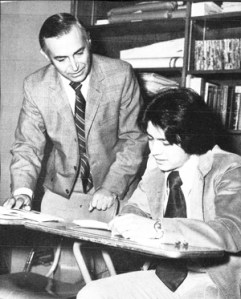
Enrico Mordini with Jerry Rodríguez at Divine Heart Seminary

Years ago, I attended Divine Heart Seminary in Donaldson, Indiana. I recently went to a DHS reunion where my classmates and I remembered our Spanish teacher Enrico Mordini. Señor Mordini was the Spanish teacher who taught me a lot about being Mexican even though he was an Italian born in Italy and raised in Spain. He taught me that there is more than one way to speak Spanish. I never realized there were so many dialects. I was originally in his Spanish I class, but he moved me up to Spanish II because I knew some Spanish. I had always wanted to learn Spanish formally so that I could read and write it. As an aside, when I attended Holy Cross Grade School, since the Lithuanian school didn’t offer Spanish classes, I asked if I could go to Saturday morning classes to study Lithuanian. I was told, “First, you have to learn English.”

Once I started classes with Señor Mordini, I questioned whether I even knew Spanish. He said some words so differently from my mother that it took me some time to recognize them. For example, “to drink” to my mother and me was “tomar” and to Señor Mordini it was “beber.” I had never even heard the word “beber” before! When my mother said “good” in Spanish, she would not say it the same way as Señor Mordini’s “bueno,” but rather, she would say, “güeno” instead. The Spanish word for needle was “aúja” to my mother and me, but to Señor Mordini, it was “aguja.” Our word wasn’t even in the dictionary without the letter g. When I informed my mother of these differences, she said that’s because Señor Mordini spoke “castellano” and not “español.” When I told Señor Mordini what my mother had said, he said that “castellano” and “español” were synonyms for the Spanish language. My mother never really believed him! After all, he wasn’t Mexican. In fact, he wasn’t even Spanish either. He was Italian!

Once while discussing Mexican culture in class, I said that I knew all Mexicans were a mixture of Spanish and Aztec blood. I was shocked when he said that was only partially true because not everyone, in fact, not many people were purely of Spanish and Aztec ancestry. I insisted that I was right. Even my father had told me so. Even after several convincing arguments by Señor Mordini that there were people in Mexico of pure, unmixed Spanish blood , I still didn’t believe him. When I reported this to my mother, she said that not all Mexicans were only of Spanish and Aztec ancestry. In fact, her grandfather had been Irish! “What?” I was so shocked. “Why didn’t you tell me before?” I asked my mother. She just nonchalantly said, “I didn’t think it was important.” Suddenly, I was sixteen and learning for the first time that I had more than just Spanish and Aztec blood coursing through my veins. In fact, I might not even have Spanish or Aztec blood coursing through my veins. I was in shock! It took me years to adjust to this new discovery about my ancestry. Was this a possible explanation for why my best friend in the Catholic Lithuanian grade school was Patrick McDonald from Ireland? But the fact remained that Señor Mordini was right again!

Years later, when I applied to teach Spanish at a community college, I was hoping against hope to get the position because I saw in the school catalogue that Señor Mordini was on the faculty! But such was not my luck. Señor Mordini died that year and I didn’t get the position! I suffered two severe blows at once. But I was lucky enough to have met Señor Mordini when I did. He certainly made more aware of myself and made me a much better person.

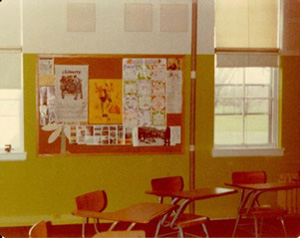
La clase del señor Mordini

Above: This was the Spanish classroom at Divine Heart Seminary in Donaldson, Indiana, in the 1970s. This is one of the many schools where Señor Enrico Mordini taught. As an aside, Señor Mordini had a good sense of humor and got along well with the students. Once my classmates talked me into hiding in the fire escape, which was a giant slide in a huge metal tube on the right in the picture but out of view, and Señor Mordini humored us by looking for me wherever my classmates suggested: under his desk, under the student desks, behind the bulletin board, etc. 🙂

DDR