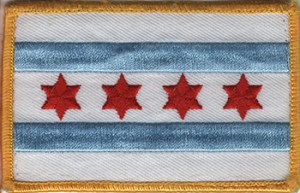
Chicago flag


My uniform patch of the Chicago flag

Everyone recognizes the Chicago flag, but not all Chicagoans know what our beautiful Chicago flag represents. Once I was eating lunch with my friend Mike when some tourists from France saw the patch of the Chicago flag on our uniforms. They wanted to know what the symbols on the flag meant. I’m embarrassed to admit that I didn’t know what the three white stripes represented back then. Mike explained all the symbols to the French tourists, much to their satisfaction. They were genuinely impressed that they had finally met a Chicagoan who knew what the Chicago flag represented. The French tourists left the restaurant, and Mike and I continued eating lunch. When we asked for the check, the waitress told us that the French tourists had paid for our meal. Talk about the value of a little knowledge!

So, the three white stripes represent the three sides of Chicago: south side, north side, and west side. Notably, there is no east side of Chicago. That’s Lake Michigan! The two blue stripes represent the two bodies that help define Chicago: the Chicago River and Lake Michigan. However, I have also heard that the two blue stripes represent the two branches of the Chicago River. Don’t you just hate it when there are two competing explanations? Each red star represents an important historical event in Chicago history: the 1812 Fort Dearborn Massacre, the 1871 Chicago Fire, the 1893 World’s Fair, and the 1933 World’s Fair.

In our era of politically correctness, the Fort Dearborn Massacre has been renamed The Battle of Fort Dearborn. It’s only a matter of time before this “encounter” gets softened even more. What’s next? The Fort Dearborn Cultural Exchange?

Now that you know the meaning of the Chicago flag, help share your knowledge of the city of Chicago and the Chicago flag to any tourist–whether from a foreign country or another state of the USA–who visits.

DDR

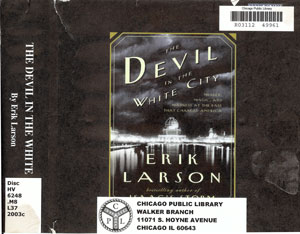
Devil in the White City


The audio book I borrowed from the Chicago Public Library.

I just finished reading this terrific book about Chicago and the 1893 Columbian Exposition. And when I say reading, I mean “reading” as in I didn’t actually read the book. Rather, I listened to the audio version of it on CDs while I drove. So, I’ve been doing a lot more “reading” lately because I’ve been doing a lot more driving (No quotes! I was physically driving.) lately. And that’s all thanks to these audio books on CD. For some reason, I didn’t like listening to audio books on cassette and I only listened to a few. Cassettes just seemed like too much work. For a while, I wasn’t reading as much because I was always on the go. But now I can do both at the same time! I love audio books on CD!

I had heard about this book years ago and I had always meant to get around to reading it, but somehow, I never had time. A few weeks ago, I was in my local library, and I saw this book prominently displayed on the shelf. I love reading books about Chicago! This book focuses on the Chicago World’s Fair of 1893, which is represented by one of the red stars of the Chicago flag below. (Note to self: Write a blog entry about the symbols of the Chicago flag.) I learned so much about Chicago history through this one book alone. First modern serial killer was H.H. Holmes who got his start during the World’s Fair.

By being awarded the World Fair, Chicago felt compelled to top the previous World Fair that was hosted by Paris, France, which had set attendance records for a peaceful event. And they also introduced the world to the tallest man-made structure ever built: The Eiffel Tower! Chicago was undaunted in trying to top Paris. From the ashes of the 1871 Chicago Fire, not only did Chicago rebuild itself, but it also topped the Paris World’s Fair. The engineering marvel that topped the Eiffel Tower was the Ferris Wheel that was then the tallest man-made structure. And people could ride it to the top and witness breath-taking views. To this day, most carnivals still have a Ferris Wheel. (In Spanish, it’s call la rueda de fortuna.)

The Chicago World’s Fair, or the World’s Columbian Exposition as it was also known, helped shape Chicago as a modern city and introduced the world to many modern inventions, including electricity on a wide scale at the White City. The main feature of the fair was the White City that was constructed by Daniel H. Burnham and company. This provided the creative spark for the Emerald City of Frank L. Baum when he wrote The Wizard of Oz. And the White City also influenced Disneyland and other amusement parks. The White City is also mentioned in “America, the Beautiful,” as “alabaster cities.”

DDR