Mexicanismos


El Paseo de la Reforma, México D.F.

Mexicanismos are words or phrases in Spanish that are unique to México, but may not be familiar to other Spanish speakers, also known as Hispanophones. French speakers are Francophones and English speakers are Anglo-Saxophones.

Anyway, in Mexico, people use words and phrases that are unique to that region and are commonly misunderstood by other Hispanophones. At UIC (University of Illinois at Chicago), we have graduate students who come from all over the Spanish-speaking world, most of whom specialize in linguistics. They can spot the dialect and region of most Spanish speakers almost immediately. Some have trouble identifying me because I have my American accent and I use words and phrases from almost every dialect that I’ve ever heard. I’m like a sponge in this regard. Sometimes, someone will throw their hands up in the air and just ask me where I’m from. They’re often surprised to hear that my parents were from México. My cousin’s husband thought I spoke with an Argentine accent. Once, a friend and I were speaking, and then I didn’t hear something she said. So, I said, “¿Mande?” and she said, “¡Ajá! You’re from Mexico!” That simple little mande gave me away as a Mexican.

Once, at the end of the semester, a professor from Argentina told us that she would bring us a torta for the last day of class. To most Mexicans and me, a torta is a type of sandwich that is served on a bun with meat and other condiments. I didn’t eat before class because I wanted to be polite and eat everything that was offered to me. Well, she came to class with a torta, but it was a cake, as in a pastry for dessert. I left the classroom hungry that day.

Another time, I brought some Thanksgiving leftovers to UIC for lunch. A graduate student from the Basque Country in Spain asked me what I was eating. I told her guajolote and camotes. She didn’t know what I was talking about. For her turkey was pavo not guajolote and yams or sweet potatoes were patatas not camotes because they didn’t differentiate between the various kinds of potatoes in Spain.

I have a friend who grew up in Seville, Spain, and we once had a minor misunderstanding. He told me that his car had broken down: “Se me estropeó el coche.” Being the nice guy that I am, I wanted to be helpful, so I offered him a ride: “¿Quieres un aventón?” I could tell by the tone of his voice that he was a little upset when he replied, “¿Y yo qué te hice?” You see, to a Mexican, un aventón is a ride, but to just about any other Spanish speaker un aventón implies some kind of physical violence. I explained to him that I only wanted to help him by giving him a ride to wherever he wanted to go, and I am happy to say that we are still friends to this day.

Another graduate student from Spain taught a class that had many Mexican American students. She frequently used the word coger, meaning “to get” or “to pick up” when she spoke not realizing that to Mexicans coger is a profanity that refers to the act of sexual intercourse that begins with the letter “f.” So, one day, she talked about picking up her dog: “Cogí mi perro.” She was surprised when the class began to laugh until someone explained to her what she had said.

While I was in México, I learned a few more mexicanismos. My cousin used the diminutive “-is” instead of “-ito, -ita.” For example, she went to see her “amiguis” instead of her “amiguitas.” Before we went to visit my cousin David Rodríguez in Celaya, everyone refered to him as Davis.

In the U.S. we have Spanglish, which is the mixture of English and Spanish, but I only thought it existed north of the Rio Grande (In Mexico, they call it El Río Bravo). For example, you take an English word like “to check” and make it Spanish: chequear, instead of comprobar or some other Spanish word that already exists. Anyway, they have a similar word in Mexico: checar. Several street venders approached me and called me jefe, showed some product they were selling, and said, “Checa esto.” Or “Check this out,” in English. So, this word is a little different than the Spanglish word chequear because it’s a mexicanismo. Or maybe it should be called inglañolismo.

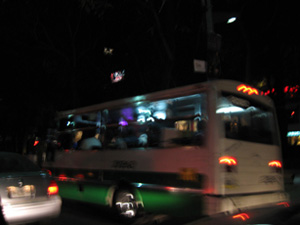
I always thought of an aquarium as un acuario, but to my cousin in Celaya it was el pecero. I had never heard the word before, but I knew exactly what he meant. Then when I was in Mexico City, when people talked about taking the bus they still called it el camión, but now a lot of people also called it el pecero. That made perfect sense because if you look at the buses with their large windows, they do look like aquariums with people swimming inside instead of fish.

If you park your car in México City, you’re likely to meet el viene viene. He is a self-appointed parker of cars and is often found on public streets and grocery store parking lots. He doesn’t officially work for anyone. He’s just there–and everywhere else. You can’t miss him. He pops up out of nowhere waving his salmon-colored mechanic’s rag as you park your car. As you back up, he tells you how far you can back up by saying “Viene, viene.” When you get out of your car, he’s standing next to you with hand, and you’re supposed to give him a tip of two pesos or so.

Then, there’s also the aguinaldo that is a bonus that most employees receive before Christmas and before el Día de los Reyes to buy holiday gifts or pay off debts. At Christmas, children received candy bags. They were told, “Come get your aguinaldo!”
DDR

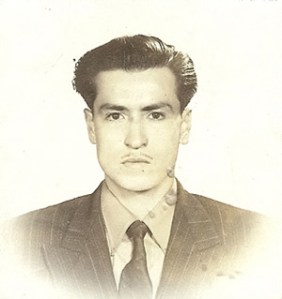
My father’s vocation


José Diego Rodríguez Rosiles

When I was in Celaya, my tío Timio told me about how all his brothers studied at the Montezuma Seminary in New Mexico. Tío Timio was the only brother not to attend the seminary. My father was at the Montezuma Seminary in New Mexico for eleven years. My father wanted to become a priest, but they advised him to go back home to Celaya for a while. They told him to get to know the world before he made a final decision. So, he returned to Celaya and while there he met my mother. Needless to say, my father never became a priest. Pues, como quien dice, en Celaya, se la halla.

DDR

Abuelito paterno


Eutimio Rodriguez
El Carmen Mueblería

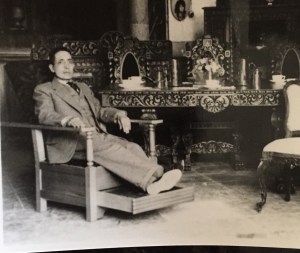
I actually met my paternal grandfather when I was little and went to his funeral when he died in 1965. I didn’t know him very well, but I heard some stories about him that were not very flattering. My mother told me that he was very mean to me when I was little, but I don’t really remember how he treated me. When my Uncle Plácido became a bishop, I remember reading in his biography that my grandfather had to escape political persecution. I’m not sure where the truth lies. When I was in Celaya, Guanajuato, on my trip to México, my tío Eutimio told me that his father Eutimio Rodríguez Cárdenas, a distant cousin to President Lázaro Cárdenas, met one of the president’s cousins and they didn’t like each other. But other than that, there really was no trouble between them. My tío Timio was the only one from my grandfather’s family to stay in México when all the other family members eventually moved to America.

My grandfather had owned a furniture shop that made furniture to order. The shop was called Mueblería del Carmen because it was located near la Catedral El Carmen in downtown Celaya. He gave the furniture shop to my tío Timio and my grandfather went to America for about a year. While there, he met a priest named Father Thomas Matin, CMF. My parents met Father Thomas in Perth Amboy, New Jersey, and he would eventually become my godfather.

My grandfather promised Father Thomas some furniture if he could arrange U.S. citizenship papers for my grandfather. So, my tío Timio ran the mueblería while his father lived and worked in America. When my grandfather returned to Celaya, he locked himself in his room for days at a time. My tío Timio ran the shop and business was booming. All the profits belonged to my tío Timio since he was now the proprietor. Soon, the shop received a government order for chairs with a round backrest, but they wanted high-quality chairs and in a very short time. My uncle took the order even though he wasn’t sure he could complete it in such a brief time. My grandfather came out of his room and worked in the shop. In order to complete the chairs on time, my uncle devised a mold so that he could cut the rounded backrests four at a time. My grandfather didn’t think the mold would work and told his son that. Well, they had to finish the chairs on time in order to gain more business. My grandfather couldn’t work with the mold and his chairs kept breaking. So, he locked himself in his room again. My uncle finished the order with plenty of time to spare and the government agent was extremely surprised. He said that he should have given him the rest of the order that they gave to another shop. However, they weren’t even half-done with the order yet.

My uncle was paid handsomely for his work, and he gained a lot more furniture orders as his reputation increased. My grandfather took the profits from this enterprise and used the money to go to America. He also took the furniture that his son Timio had made and took it to Father Thomas. If it weren’t for tío Timio, my grandfather and his sons wouldn’t have had enough money to go the U.S. I wouldn’t have been born in the U.S.

DDR

My American accent


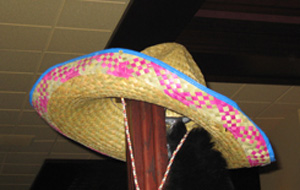
Sombrero in a Chicago restaurant.

I am bilingual. I know Spanish and English. I like to think that I speak, read, and write two languages very, very fluently. However, I always have the vague feeling that I don’t communicate like a native speaker in either language. Sometimes people tell me that I speak English with an accent, which I don’t doubt at all.

As I was driving through to Mexico to visit my family, I had no trouble communicating with anyone. Except at the border where I applied for an auto permit to drive in Mexico. The clerk asked me something that I didn’t understand. She repeated it three times, but I understood everything else she said, except for one word. She asked if I drove a Pontiac. But she pronounced Pontiac in Spanish, and I didn’t recognize the word immediately. Finally, her colleague pronounced Pontiac in English and I understood. This taught me that I had to adjust my way of listening since I would be listening to different dialects.

Once I reached Celaya, I had no trouble communicating with anyone. I met my family, and we understood each other perfectly. Ditto for my relatives in Mexico City. They mentioned other family members who had come from the U.S. who spoke no Spanish at all. However, a few relatives discreetly mentioned my accent, of which I have always been painfully aware. I wanted to buy some Mexican T-shirts for my sons at the mercado and my cousin told me to be quiet and she would do the haggling. If they heard me speak, they would think I was tourist, and we wouldn’t get a fair price. On the one hand, I had an American accent, but on the other, several people mentioned that I spoke Spanish extremely well. Well, that’s me to a tee. I abound in paradoxes. I speak Spanish with an accent, but very well. A few people mentioned that I stuttered through plenty of conversations while speaking Spanish. I pointed out that I stutter in English, too. But I was incredibly happy that I could communicate in Spanish in Mexico!

DDR

¡Feliz Navidad!


¡Feliz Navidad!

When we went to Mexico when I was little, I remember that Mexicans didn’t really celebrate Christmas. The day for giving gifts to children was January 6, el Día de los Reyes. Occasionally, small gifts were given for Christmas, but the big gifts were given on January 6.

So, I was surprised to see that many Mexicans were Christmas shopping when I was in Mexico before Christmas. I asked my cousin about all the Mexicans Christmas shopping, and she told me that more and more people were giving the big gifts on Christmas and the smaller ones on January 6.

I attribute this to American cultural imperialism and capitalism. Mexico as a country that is adapting to better function in a global economy. And of course, when Mexicans watch television, they get to see all of the American Christmas movies that stress gift-giving on Christmas Day, especially by Santa Claus.

While in Mexico City, I noticed the traditional Christmas decorations featuring a Nacimiento (Nativity Scene), but I also saw other Christmas decorations like Santa Claus, Rudolph the Red-Nosed Reindeer, and Frosty the Snowman, which was ironic since it hardly ever snows in México City. The street vendors even sold reindeer antlers and noses to attach to your car. I was surprised to see that people drove around in these “reindeer” cars.

Meanwhile, my family in Celaya celebrated Christmas in the traditional way by gathering on Noche Buena (Christmas Eve), going to mass at the catedral, and then eating a big dinner. We went to mass and my cousin took a baby Jesus surrounded by candy on a tray that she placed near the altar for the priest to bless during the mass.

After mass, we walked back home with baby Jesus and then ate dinner. Then we took baby Jesus to the Nativity Scene, and everyone prayed and sang songs to him. Everyone then kissed baby Jesus and took a piece of candy from the tray. After this, I placed baby Jesus in the Nacimiento. My cousin later started a bonfire that the children enjoyed because they placed inflated balloons over the flames and watched the balloons fly away. No one received gifts on Christmas morning because in Celaya the children still receive their gifts el Día de los Reyes.

DDR