Holy Cross


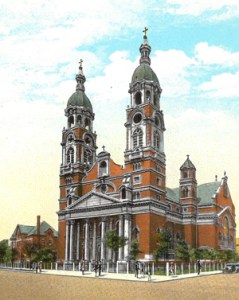
Holy Cross Church, Back of the Yards, Chicago, Illinois

I spent a significant number of years during my coming of age at Holy Cross Church and Holy Cross School. This parish was founded in the 1890s by Lithuanian immigrants. In the 1930s, there was a large influx of Mexican immigrants to Back of the Yards, which is one of the main reasons our family moved to the neighborhood in the 1960s after having lived in Pilsen.

I attended Holy Cross School from kindergarten through eighth grade and I graduated on June 6, 1971. The study habits I developed during this time served me well the rest of my years in school, especially college. Of course, it helped that all the teachers were strict Lithuanian Catholic nuns, with exception of Mr. Hovanec the history teacher. Nothing instills healthy study habits better than the fear of being disciplined with corporal punishment by a nun wielding a yardstick and a man’s name such as Sister Joseph or Sister Bartholomew.

Of course, during the 1960s there was a movement to convert U.S. to the metric system and move away from the English system of measurement that even the English didn’t use anymore. Our nuns participated in the metric system conversion by trading in their yardsticks for meter sticks when they hit us. That meant 3.37 more inches of pain. These nuns really wanted us to learn so we would go on to excel in high school and college. The school was very strict and if the corporal punishment didn’t straighten out a student quickly, expulsion was imminent. Once the principal, Sister Cecilia, lectured us on the importance of behaving well because our school record now could affect us later as adults. Recently, she told us, a former Holy Cross student applied to become an FBI agent and the FBI came to Holy Cross to see what kind of student he was. Well, that was enough to scare me into being a good student.

At school most of my friends were either Lithuanian or Mexican. Everyone had to learn English. Everyone had to become a good American citizen. In fact, the nuns constantly reminded us that any one of us could one day grow up to become the President of the United States. We always had to study hard and be on our best behavior. But somehow someone always got in trouble. I used to get in trouble for laughing at the class clown. When the nun would ask me what was so funny, I would tell her and she didn’t understand why I would laugh at such a thing. Looking back, I see her point.

Above all, they taught us to be good Catholics. We went to church everyday before going to school. If we were late for morning mass, we were considered late for school. Back then I thought the whole world was Catholic. Everyone I knew was Catholic. My parents, my brothers, my aunts, my uncles, my cousins, the nuns, our pastor, I mean everybody. Even famous people were Catholic. Mayor Richard J. Daley was Catholic and he was well-known for stopping at St. Peter’s on Madison Street to hear mass before going to City Hall. President John F. Kennedy was Catholic. The nuns would proudly remind us at every opportunity. To me, the whole world was Catholic. Even the Pope was Catholic! So why did he wear a yarmulke?

Of course, attending a private school meant paying tuition and having fundraisers. As I recall, we had one fundraiser after another all year, culminating in the parish carnival in June. We had raffles for everything. One year, the raffle prize was a brand new station wagon, and miraculously, one of the nuns had the winning ticket. There were bake sales, rummage sales, Christmas card sales, movie showings, and sometimes just outright petitions for donations for certain goals either at school or church.

I remember that I liked selling the Christmas cards door to door. My brother Tato and I teamed up one year on a cold, snowy day. We carried our boxes of Christmas cards with us and didn’t have much luck selling them at first. Then, we were at one house on the icy porch of a woman who had just refused to buy a box of Christmas cards from us. As my brother started walking down the stairs, he accidentally slipped on the ice and rolled down about eight stairs all the way to the bottom. Well, the woman asked if he was okay–he was because we always bundled up in multiple layers on cold days like this. Then she bought a box of Christmas cards from us. I think she was afraid of a civil lawsuit. At the next house, the woman didn’t want any Christmas cards either, until my brother “accidentally” fell down the stairs again. This was my brother’s brilliant idea and he kept falling until we had sold all our Christmas cards!
DDR

La migra


Back of the Yards, Chicago, Illinois

Nothing scares an undocumented Mexican more than the words “la migra.” Immigration agents seem to pop up out of nowhere and roundup illegal aliens at their place of employment. As a warning, someone will shout, “¡la migra!” But sometimes, they mistakenly pickup legal aliens and citizens by mistake. This happens all the time.

When I was about ten, I was in charge of making sure that my brothers and I walked home safely after school while my mother was at work. Most days this was an easy task. However, other days, we would walk our separate ways and meet up at home within a half-hour. We were always home together before my mother returned from work. Usually, we did this when we wanted to walk home with friends from our class, or occasionally, when we were mad at each other and didn’t want to talk to each other.

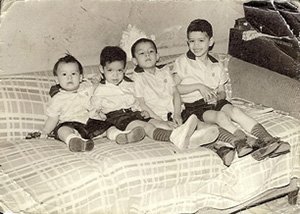
My three brothers and I would form different alliances depending on who was mad at whom. One of the most bitter was the one that pitted the Americans against the Mexicans. There were four of us: David Diego, Daniel, Diego Gerardo, and Dick Martin, in order of birth. Guess which brother was born in Mexico! That’s right, Diego Gerardo was born in Mexico. All because my mother insisted on going to Mexico while she was nine months pregnant even though everyone warned her not to do it. And my father Diego finally had a son named after him.

Anyway, when brother Diego would get mad at us, he would exclude himself from us because we were American and he was Mexican. He would proudly remind us that he was born in Mexico during these arguments. It was after one of these arguments after school that he walked off alone away from us. Well, I started to get worried when he didn’t return home within a half-hour. I went out looking for him, but I couldn’t find him at his usual hangouts.  I knew my mother would be furious when she came home.  Well, she came home and Diego still wasn’t home. She didn’t explode like I had expected, but she made me go with her and look for Diego everywhere. We looked for about an hour and still didn’t find him. We returned home to take a little break. While there, we heard a knock on the door. Two immigration agents were at the door with my brother. They had mistakenly picked him up after school. My mother explained to them that he was a legal resident and showed them the documentation to prove it.

Well, it turns out that the agents drove up alongside Diego and asked him where he was born. Of course, he said, “Mexico!” proudly. They scooped him up into their car and took him into their office for further questioning. Of course, Diego was only about six at the time and he didn’t know his address. When no one called for him at immigration, the agents asked my brother to show them where he lived. That’s when we saw him at home again. Would you believe we never fought the Mexican-American wars again? In fact, he never again bragged about being born in Mexico.

DDR

Día de Acción de Gracias


Back of the Yards, Chicago, Illinois

Happy Thanksgiving! I’m about to go out to a Thanksgiving dinner. While others are busy preparing for this cornucopious feast by shopping for groceries, cleaning the house, or cooking dinner, I’m, I’m–well, I’m busy writing my blog entry for today. However, I will buy an alcoholic beverage so I don’t arrive empty-handed at the Thanksgiving dinner today. I will also participate in the festivities by attempting to drink most of it. I love Thanksgiving because, well, because of all the food. Oh, yes, and the people with whom I eat and talk.

I always fondly remember my childhood Thanksgiving dinners at my tío Simón and tía Mari’s house. My father had a very large family, so the house was always packed with people, most of whom were related to my aunt and uncle somehow. Some of the others included friends of the family and neighbors past and present. My aunt did most of the cooking herself. She was an excellent cook! And there were never any leftovers!

As soon as people starting coming in, my aunt would start serving the food because there no possible way for everyone to sit down at the same table, at the same time to eat dinner. We had to eat in shifts and you didn’t want miss your turn because all the food would be devoured if you devoted too much time to your Margaritas. My parents in particular loved going to this dinner because this was the time to catch up on all the latest family news. My brothers and I loved going because we got to play with cousins we rarely saw. To this day, I love going to family parties because I always meet someone new who turns out to be related to me in some remote way.

Thanksgiving dinner was a special family occasion, so we had to dress up in our best clothes, something I hated to do because we’d get in trouble if we dirtied or ripped our clothes while playing. One year, my brothers and I actually wore suits and fedoras to the Rodríguez family Thanksgiving dinner. My grandfather had died the previous August and my mother said we had to wear suits to his funeral. So my three brothers and I went to Meyer Brothers on 48th and Ashland Avenue in Back of the Yards where she bought us all matching suits on credit. Since my mother had spent so much money on those suits, she would make us wear them for every special occasion, which eventually included going to Sunday mass.

DDR

Junk


South Side, Chicago, Illinois.

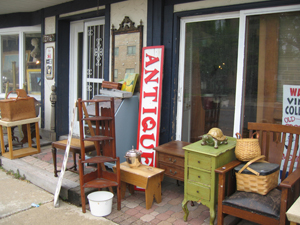
Once, while traveling in the country, Mark Twain saw a sign that read, “Junk bought, antiques sold.”

To my mother, junk wasn’t merely just junk. To this day, I realize that there’s junk, and then there’s Mexican junk–there is no Spanish word for junk, although I did see a sign that read “Yonke” in my travels through Mexico).

My mother managed to salvage just about everything she found in the alley. No chair was so splintered, no dresser was missing too many handles or drawers, no bed frame was so rusty or bent that they could not be repaired, refurbished, or rehabilitated with a little paint, elbow grease, and TLC. If my mother found something that was too heavy or bulky for her to bring home, she would come home to get me and between the two of us we would put it into the back of her red Volkswagen Squareback station wagon.

My mother always knew some Mexican or an entire Mexican family who had just come from Mexico and needed furniture. She would help them set up a home by giving them whatever furniture she had found. She genuinely loved to help people and she would never ask for any money in return. Occasionally, someone would offer money, but she would refuse it saying that they could repay her when they were settled down. People would come from Mexico and look for my mother because they knew that she would help them.

When I bought my four-flat house in Bridgeport, I attempted to help Mexicans on a smaller scale than my mother. I only helped my Mexican tenants and a few of their friends. When my brother lived in one of my apartments, he wanted to get rid of his living room set, but didn’t know what to do with it. I didn’t know anyone who needed furniture at the moment, so I told him to put it out in the alley only he didn’t want to throw it away. I explained to him that if we put it in the alley early Sunday morning, the Mexicans going to church would see it and take it home with them. Sure enough, all his furniture was gone within an hour.

When I got divorced and I needed to refurnish my new house, I got most of my furniture from my brother and sister. Sometimes I feel so Mexican!

DDR

Life in Mexico


Mexico D.F.

Once when I was I boy, I visited Mexico, and I realized that I wasn’t Mexican. I was American! All my Mexican cousins told me so. I didn’t speak Spanish as well as them. My Spanish vocabulary was lacking compared to them. I always had to stop to think in order put my thoughts into Spanish. Even though I spoke Spanish with my family and friends in Chicago, I had lost what little Spanish I had, and I never improved my Spanish vocabulary by constantly speaking Spanish with Mexicans from Mexico. Well, some of the children made fun of how I spoke Spanish and called me gringo.

Well, one day, I noticed that my aunt had various copies of Life Magazine in her house. I immediately recognized the Life logo, white letters in a red block. I was so excited because now I would be able to read something in English! But upon picking up the magazine and flipping through the pages, I realized that the magazine was published in Spanish. One of my cousins asked me what I was reading, and I told him, “Life,” but I pronounced “Life” in English. He asked me to repeat it, and when I did, he said that I didn’t know Spanish because I didn’t call the magazine, “Li-fe,” pronounced in Spanish as two syllables. I explained that “Life” is an English word and so I pronounced it in proper English as a one-syllable word, with a silent e. Of course, he didn’t believe me. I was still el gringo who couldn’t speak Spanish. Not only that! I also couldn’t speak English! He called my other cousins over and told them about how I had my own peculiar way of pronouncing “Li-fe.” Well, after that, they constantly quizzed me about the pronunciation of “Li-fe.” Remember, “Life” in Mexico is “LI-FE” with two syllables!!

DDR