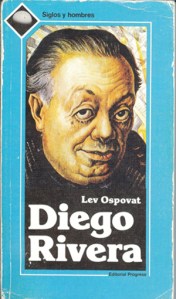
Translated into Spanish, published in Moscow, Russia
When I moved from Marquette Park to Bridgeport, I really missed having a bookstore a mere block away. Bridgeport had the reputation of being the center of city politics, rather than being an incubator of intelligence. So, needless to say, Bridgeport had no bookstores at all! Even their Salvation Army lacked a book section!
One day in the early 1990s, I was shocked when I saw an empty storefront on the 3100 block of South Halsted Street open as Modern Bookstore. For a neighborhood bookstore, it was very big. I was there the very first day it opened. The woman who greeted me let me browse for a while. I wasn’t sure what to expect from this bookstore, especially for one in the heart of Bridgeport. Imagine my surprise when I saw that most of the books were about socialism, communism, and labor unions. The woman asked me if she could help me find something. I asked to see the fiction section, but there was none. Then, even though I was sure that she would say no, I asked if they had a foreign language section. I told her I was interested in buying books in Spanish. Would you believe it? They did have a Spanish section that was actually bigger than most of the others in Chicago bookstores I had visited. And they actually had books by authors and biographies of political figures that I had actually heard of.
I bought a poetry anthology by Nicolás Guillén. Later, when I read the book, I discovered that the book was published in La Habana, Cuba, and probably shipped to the U.S. violating at least one embargo law. But wait, I also bought biographies about Diego Rivera, Benito Juarez, Benardo O’Higgins, and a few others that were written in Spanish. Much later, I realized that the books were written by Russian writers and later translated into Spanish. All these books were published in Moscow, Russia. I wondered if there would be any trouble if our local politicians had actually visited the Modern Bookstore and realized what kind of books the bookstore was selling there. But then I realized that’s why there wasn’t a bookstore in Bridgeport in the first place. No one in Bridgeport reads!
Bridgeport is a neighborhood unlike any other in Chicago. Actually, there are two Bridgeports: the mythical, political Bridgeport that every Chicagoan hears about since starting school and the earthy, gritty Bridgeport that contrasts sharply with the mythical, political version.
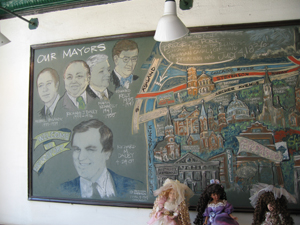
In grade school, we learned all about Bridgeport, which is the birthplace of five Chicago mayors, including the present Mayor Richard M. Daley (Richard da Second). Bridgeport didn’t invent machine politics; they merely perfected machine politics, reaching its apogee in Mayor Richard J. Daley (Richard da First). Bridgeport is also very near the geographical center of Chicago. Many south siders often went to the White Sox games at Comiskey Park in Bridgeport. When I was a student at Holy Cross School, no school field trip would be complete without first driving past Mayor Daley’s bungalow at 3536 S. Lowe Avenue. Bridgeport was the Mecca of the south side. Every Chicagoan made a pilgrimage to Bridgeport at some point in their life.
When I told my mother that I was planning to buy a house in Bridgeport, she cringed and told me that I would regret it. For some unknown reason, I was drawn to Bridgeport. Besides, this was the location of the only house I could afford using the GI Bill. But before I bought this house, I checked out the neighborhood first. I drove past the house several times, at different hours of the day and night. Every time I drove past my future home, the block was extremely quiet. I never saw any movement in this vicinity at any time. I was sure that I was moving into a good neighborhood. After all, this was Bridgeport. So, I bought the house, much to my mother’s disappointment, and I moved in.
This was when I saw the earthy, gritty side of Bridgeport for the very first time. You don’t really know a neighborhood until you move in, and you live there 24/7/365. It was only then that I saw the seedy side of Bridgeport. My house was situated next to an alley that ran alongside the length of my house, an alley that everyone in the neighborhood used as a shortcut. I always heard whoever walked through the alley talking, at all hours of the day. Then one day, I noticed that Bridgeport had a gang problem, and my house was right on the border between two gang turfs. My neighbor always tried to start a fight with me by pointing to my camouflage shirt, a remnant from my Marine Corps enlistment, and tell me, “Hey, man! The war’s over!” I would ignore him and walk past him quickly. It was about that time that I learned that there were two sides to Bridgeport. And I lived on the wrong side of Bridgeport! I lived on the side where the public housing projects were located, the only white projects in the whole city of Chicago!
While I lived in the Marquette Park neighborhood, I had developed certain habits and I thought I could continue them when I saw all the stores, shops, and restaurants that were available in Bridgeport. I really thought that I would enjoy all these places that were within walking distance of my house. I went to Lina’s Italian restaurant that was less than one block from my house because they served authentic Italian food. Or so I thought. When I entered the restaurant, I was greeted by Lina herself. I asked for the beef ravioli because I love authentic beef ravioli. Lina said, “It takes too long to make.” I said, “That’s fine. I’m not in a hurry tonight. I brought a book that I can read while I wait.” “Well, I’m not going to make ravioli just for you. Why don’t you order something else?” So, I did. But I went back a few times hoping to eat ravioli, but she always refused to make it.
I once needed a button sewn on my winter wool coat, so I went to a tailor on Halsted Street. The tailor said, “You want this button sewn on? Why don’t you buy yourself some needle and thread and sew it on yourself?” He didn’t understand that I didn’t want to sew it on myself and that I was willing to pay him to sew the button on for me. He continuously refused, so I left.
I went down the block to the barbershop that appeared to be in a continuous state of disrepair, since at least the 1960s, judging by the newspaper clippings on the wall. There were no customers in the store, so the barber was sitting in a chair. When I entered, he stood up and said, “How may I help you?” I told him that I wanted a haircut. Well, he wasn’t giving haircuts that day. So, I left.
Then, I went to the 11th Ward Office because I needed garbage cans for my house. They refused to give me garbage cans because I didn’t appear as a registered voter within their ward even though I had just moved there. I left without garbage cans. This was certainly a fine welcome to Bridgeport. I eventually adjusted to life in Bridgeport. You just had to learn not to have too high expectations.
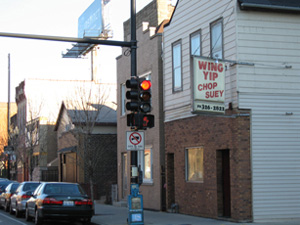
For the finest Chinese Food, you must go to Bridgeport on Chicago’s south side. Wing Yip Chop Suey, 537 W. 26th Street, 312.326.2822, is a cozy, family-owned Chinese carry-out restaurant. If you dine in, don’t expect a fancy ambiance. In fact, don’t even ask to use their public restroom. They don’t have one!
I have eaten at this Bridgeport establishment since the early 1980s, but I’m not sure what it was called back then because I don’t remember the restaurant ever having a sign outside with its name on it. This place doesn’t look like much from the outside–or the inside, now that I think of it–but the food is delicious and they serve generous portions for a more than reasonable price.
As you wait for your food, you may read the Chicago Tribune or Sun-Times that someone left behind after reading it. The carry-out customers are Bridgeport residents and people who work in the neighborhood. Everyone in Wing Yip is very friendly. People often meet other acquaintances, friends, or family members by surprise when they go there. But strangers greet each other, too. The loyal customers love this place so much that anyone who patronizes Wing Yip has something in common with all other customers who walk in. So it’s not that unusual for total strangers to greet each other and start up a conversation.
As a police officer, I used to like to eat lunch there because everyone respected the police there and I would meet other police officers whom I hadn’t seen in years. This is also a great police restaurant because the service is fast and cheap. I sometimes go out of my way just to eat there now that I’m a retired police officer. I like the fact that they know me by name because I’ve spent so much time in there over the years. If you go there, you just may see me sitting in the corner doing the crossword puzzle.
I have many fond memories of New Year’s Eve beginning in my childhood when our entire family would go to my Uncle Simon’s and Aunt Mari’s house. The party always involved eating a lot of Mexican food and real hard play among cousins. At midnight, everyone, I mean children, too, toasted with a glass of champagne. That was the only time of the year I drank alcohol–until I became an altar boy and my friend once talked me into taking a sip of altar wine before mass. But I only indulged that once because I felt so guilty and sinful afterwards.
Once, we were in Mexico for New Year’s Eve and we celebrated by making tamales and eating them. In Chicago, my mother made the masa during the day and then made buñuelos at midnight as a way of ringing in the new year. I think that New Year’s Eve wasn’t as exciting once we stopped going to my aunt’s and uncle’s house. I don’t really remember too many of those later celebrations now. When I was married, I was content to stay home with my wife and son and watch the festivities in Chicago on TV. When I lived in Bridgeport, I used to take my oldest son to the attic window at midnight where we could see the fireworks downtown. When the twins were born, we moved farther away from downtown, so we could no longer see the fireworks from the window. But we watched them on TV, although not quite as dramatic.
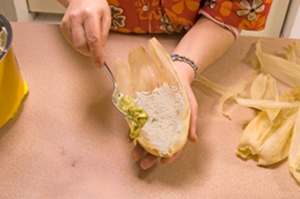
Later, after my divorce, my Mexicana girlfriend decided that we would make tamales for New Year’s Eve. She bought a giant pot for the tamales and lots and lots of masa. We would make tamales together, just the two of us. Actually, I enjoyed making the tamales. In Mexico, I only got to watch the women of the family make the tamales; males weren’t allowed to touch the masa. My girlfriend showed me how to mix the meat into the masa and stuff the masa into the corn husk. She had made tamales a few times and actually knew what she was doing. We even made some sweet tamales with raisins. We had about six different kinds of tamales. We literally did this for at least two hours and the giant pot was still only half-full. However, she insisted that we fill the pot all the way to the top. We filled the pot at about 3:00 a.m. And I was exhausted!
But wait! She put a penny at the bottom of the pot where there was boiling water to steam the tamales. The flame underneath had to be at just the right temperature and you could tell if the temperature was just right because the penny would keep making noise as the boiling water moved it. The only time I really saw tamales made was in Mexico as a boy, but my mother and aunts cooked the tamales over a bonfire.
Well, I went to bed about 6:00 a.m. because I couldn’t stay awake anymore. She stayed up to keep adding water and ensuring that the tamales cooked properly. I didn’t realize they would involve so much work. She woke me up a few hours later when they were done. She had stayed up the whole time! We then ate the tamales and they were so delicious! We ate them later that day. And the next day, too. There were so many tamales that she put some in her fridge and froze the some in her freezer. And there were still some tamales leftover! So I took some home and put them in my freezer. We ate tamales until the Fourth of July! And we never got tired of them. We loved them!
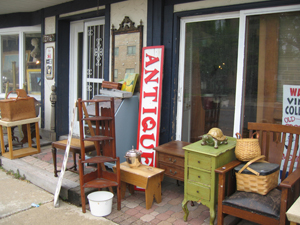
Once, while traveling in the country, Mark Twain saw a sign that read, “Junk bought, antiques sold.”
To my mother, junk wasn’t merely just junk. To this day, I realize that there’s junk, and then there’s Mexican junk–there is no Spanish word for junk, although I did see a sign that read “Yonke” in my travels through Mexico).
My mother managed to salvage just about everything she found in the alley. No chair was so splintered, no dresser was missing too many handles or drawers, no bed frame was so rusty or bent that they could not be repaired, refurbished, or rehabilitated with a little paint, elbow grease, and TLC. If my mother found something that was too heavy or bulky for her to bring home, she would come home to get me and between the two of us we would put it into the back of her red Volkswagen Squareback station wagon.
My mother always knew some Mexican or an entire Mexican family who had just come from Mexico and needed furniture. She would help them set up a home by giving them whatever furniture she had found. She genuinely loved to help people and she would never ask for any money in return. Occasionally, someone would offer money, but she would refuse it saying that they could repay her when they were settled down. People would come from Mexico and look for my mother because they knew that she would help them.
When I bought my four-flat house in Bridgeport, I attempted to help Mexicans on a smaller scale than my mother. I only helped my Mexican tenants and a few of their friends. When my brother lived in one of my apartments, he wanted to get rid of his living room set, but didn’t know what to do with it. I didn’t know anyone who needed furniture at the moment, so I told him to put it out in the alley only he didn’t want to throw it away. I explained to him that if we put it in the alley early Sunday morning, the Mexicans going to church would see it and take it home with them. Sure enough, all his furniture was gone within an hour.
When I got divorced and I needed to refurnish my new house, I got most of my furniture from my brother and sister. Sometimes I feel so Mexican!


 Chicago USA