

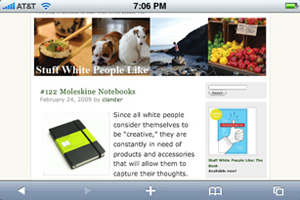
I started reading the blog Stuff White People Like about two months after it started up. I think I read about it on the Internet somewhere and I checked it out. I really enjoyed reading it and found myself laughing out loud many times.
Then, one day, I thought, “I could write for this blog.” So, I contacted Christian Lander and asked him if he accepted freelance submissions. He said that he would, but that he had just signed a book deal and they didn’t want a lot of other new writers now. I understood perfectly. But for some strange reason, I had really, really wanted to write one post for the Stuff White People Like. I tossed around several ideas in my head during my idle moments–of which I seem to have more and more with each passing day. But I never actually wrote anything down, as I am wont to do.
Soon the blog announced the forthcoming publication of the Stuff White People Like book and there was much excitement in the blog’s comments. I commented that I wouldn’t buy the book since I had already read all the posts and comments on the Internet for free. As it turned out, the book version had several new never-before-read entries. However, I still refused to buy the book and ended up reading it for free at the Borders bookstore in two visits!
Before the book’s release, Lander announced that there would be a contest for the best post written for Stuff White People Like. The prize? A free copy of the book. I immediately sprang at the opportunity to write for this blog. There were hundreds of entries. Since there were so many good entries, the first prize was expanded to the top five best entries. In addition to the free book, the winners would also receive a subscription to The Onion. Well, the first winner was announced and there were scores of complaints about the quality of the entry. Commentators complained that it wasn’t written in the same style, that it wasn’t funny, etc. With each winning entry announced, the complaints grew more vocal. Soon, readers started posting their own submissions in the comments. Okay, so did I! And since I wrote it, I’m posting it here for the sake of posterity! 🙂

English Major
When choosing a college major, white people often choose the tried and true English major rather than the last resort of Undeclared. When asked why, they will give the convincingly believable reason that an English major will help them get accepted into law or med school. Worst case scenario is that they can always go to grad school for that arts degree and work at the local coffee shop and be the most intelligent, misunderstood barista there. Being misunderstood adds to the mystique of the English major.
Whenever a college student announces that he or she is an English major, be sure to state, “But you already know English!” This will reaffirm his or her belief that no understands the value of a great liberal arts program. When speaking to an English major, whether a current student or a proud graduate, always comment on how well they speak English and how flawless their grammar is. Also mention the decline of the English language since the Elizabethan Era. Many English majors have learned some very funny jokes while enduring long, boring seminars on Chaucer and the Romance of the Rose. They will even share these jokes with you if you let your guard down. English majors are proud of the fact that they are English speakers.
When engaging in a conversation with an English major, be sure to nod in agreement but never interrupt. There is no need to start an argument with an English major. Oftentimes, he or she will start one without your assistance. For example, the conversation may suddenly turn to The Wasteland, and without your aid, he or she will begin arguing whether T.S. Eliot was American or British. Be sure not to get involved in the argument. You will not win. If you would like to change the subject of the argument, simply mention how you always felt that the Nobel Committee screwed James Joyce.
In order to gain the confidence and friendship of an English major, be sure to ask about his or her writing: “What are you working on now?” But don’t expect an answer immediately. In fact, don’t expect to learn any details about anything he or she has ever written. He or she will tell about how difficult it is to write. Be sure to ask to read a recent work. Of course, the reply will be, “I haven’t let anyone read it yet. Very few people will understand all the literary allusions.” Give them a consoling look and say, “It must be hard to write with all the long hours you put in at the coffee shop.”

 Chicago USA