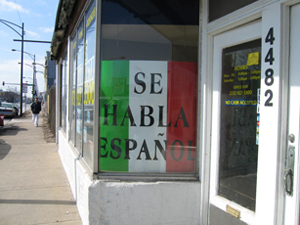
Bilingual


Chicago, Illinois, USA

I was born in Perth Amboy, New Jersey, but my first language is Spanish. We moved to the Pilsen neighborhood in Chicago when I was about two years old. We only spoke Spanish at home. All our visitors spoke Spanish. As I recall, even my childhood playmates spoke Spanish. When we went to mass at our neighborhood church, the priest said mass in Spanish. I believe everyone around me always spoke Spanish until I started school. When I watched television, it was in English. Occasionally, I would go shopping with my parents where I heard languages other than Spanish. However, the only language I understood was Spanish.

Since I grew up in the neighborhood called the Back of the Yards, I heard many different foreign languages along with English. When I played outside with the other children, I never understood what they said if they spoke a language other than Spanish. Although I often heard English, I did not learn to speak any English until I entered Kindergarten. It was the sudden immersion method since I had never spoken more than a few words of English at a time. Suddenly, for hours at a time, I only heard English, and the teacher expected me to respond in English. We learned nursery rhymes and songs that used archaic English words. When I attempted to use some of the new English words that I learned from the nursery rhymes or songs outside of school, other children would laugh at me. For example, I was ridiculed when I called a female classmate a lassie. I learned “lassie” from the song, “Have you ever seen a lassie go this way and that way?”

I attended a Lithuanian Catholic grade school called Holy Cross Grade School in the Back of the Yards neighborhood. All of the priests and most of the nuns spoke Lithuanian and English. We were always conscious of the fact that our neighborhood was the setting for the Lithuanian family in the novel The Jungle by Upton Sinclair. During school hours, the nuns stressed the importance of learning English and we were not allowed to speak our native tongue whether it was Spanish, Polish, or Lithuanian. We had to master English if we were to function in a Catholic and American society.

What helped me learn English was the constant repetition of songs and prayers. Rote memorization was the norm. I improved my English vocabulary by writing down important words several times. This constant repetition helped me learn English. Every morning we went to church to attend mass in Latin before school. We prayed a “Hail Mary” before class in the morning. In the afternoon, we prayed the “Our Father” and the recited the “Pledge of Allegiance” before class. I often did not understand the lessons taught at school. When the teachers instructed the students to complete a task, I was usually the last one to comply because I didn’t understand the command in English and would belatedly obey it by watching what the other students did. Sometimes, my classmates made fun of me because I was slow to follow the instructions. Occasionally, the teacher would correct my English and students would make fun of me after class.

At home, my parents insisted that I speak English so that they could also learn English. The more English I spoke, the more Spanish I forgot. In the end, my parents realized how difficult it was to learn English, so they never really learned it well enough to become fluent. We ended up speaking these bilingual conversations where I spoke English to my parents and they spoke Spanish to me. Of course, certain terms were not translated from their original language. We often spoke in a mixture of English and Spanish: Spanglish. Once I knew how to speak English well enough to get by, I became the official family translator at age eight; I had to translate whenever we went out, and we needed directions or my parents had to conduct some sort of business. I was always self-conscious about the way in which I spoke English because of my Spanish accent.

When I was in the fourth grade, I felt embarrassed by the way I spoke English. I wanted to improve my fluency, so I read books to feel more comfortable with English. When I got my first library card, I spent a lot of time at the library reading books. I also borrowed a lot of books to read at home. I really loved the joke books because I learned the multiple meanings of many words. For example, “What did the ocean say to the beach? Nothing, it just waved.” These jokes and riddles helped realize that words had multiple meanings. This helped me to increase my English vocabulary while I also learned to enjoy the humor of the English language.

Unfortunately, I still had trouble comprehending the classroom lessons in the fourth grade. When we went to Mexico for two months during that school year, I had lost the little English fluency I had. In Mexico, I realized that I did not speak Spanish as effortlessly as my relatives in Mexico. When I played with my cousins, they made fun of my speaking that was part English, part Spanish. When I returned to Chicago, I realized that my classmates still made fun of my English. I did not speak either language very well. I also learned that I would fail the fourth grade because I missed two months of school due to our extended Mexican vacation. Since the teacher said that I failed in part because of my problems with English, I have always felt self-conscious about my English.

As I grew older, I wanted to be bilingual in English and Spanish and speak both languages fluently, like a native speaker. I often tried to read, write, and speak English and Spanish whenever possible. When I was in the Marine Corps, I studied English grammar books extensively. I read in Spanish whenever I came across something written in Spanish. However, it was not until I attended the University of Illinois Chicago that I felt that I really learned English and Spanish. To this day, I feel that I speak English with a Spanish accent and Spanish with an English accent.


caricature of author at end of post
DDR

Language jokes


Dr. D. laughing in Spanish.

As you may have noticed, I like jokes. Here’s a riddle. What do you call a person who speaks two languages? Bilingual. What do you call a person who speaks three languages? Trilingual. What do you call a person who speaks one language? American.

A Swiss man, looking for directions, pulls up at a bus stop where two American tourists are waiting.
Entschuldigung, koennen sie deutsch sprechen?” he asks. The two Americans just stare at him.
Excusez-moi, parlez vous francais?” he tries.
The two men continue to stare.
Parlare italiano?” No response.
Hablan ustedes español?” Still nothing.
The Swiss man drives off, extremely disgusted. The first American turns to the second and says, “Y’know, maybe we should learn a foreign language.”
“Why?” says the other. “That guy knew four languages, and it didn’t do him any good.”

A man tells his friend, “I’m going to learn German.” His friend says that German is a hard language to learn. The man replies, “How hard can it be? I’ve heard three-year-olds speaking it.

“I’m glad I wasn’t born in France.” “Why’s that?” “I don’t speak French!”

A man gave his wife a parrot. The next day, they’re eating dinner and the man notices that the parrot isn’t in its cage. He asks, “Where’s the parrot.” The wife says, “We’re having it for dinner.” “What? That parrot spoke three languages!” “Well, why didn’t it say something?”

A student fell asleep during an English professor’s lecture on pronouns. Upset, the professor wakes up the student by asking him to name two pronouns. The student replies, “Who? Me?” “Very good,” says the professor.

This linguistics professor was lecturing the class. “In English,” he explained, “a double negative forms a positive. In some languages, such as Spanish, a double negative is still a negative.” “However,” the professor continued, “there is no language wherein a double positive can form a negative.” Immediately, a voice from the back of the room piped up: “Yeah … right …”

DDR

Hispania


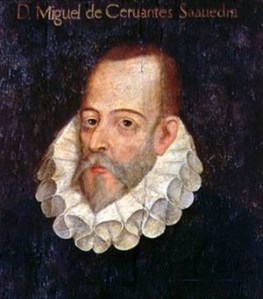
Miguel de Cervantes Saavedra

Well, it’s all about imperialism. And Phoenicians, Greeks, and Romans. So, what do they all have to do with Mexicans? It’s a long story that goes way back. I am often amazed by how events of thousands of years ago still affect us today. We should never forget the past because we are always repeating it! For example, history has a long, long history of repeating itself through imperialism and colonization. That is, one nation conquering another and then imposing their laws and culture upon the conquered (colonized) nation. Eventually, that empire is, in turn, conquered by another newer, bigger, “better” empire. So, what does all this have to do with Mexicans in the United States? A lot!

On the one hand, not all Mexicans physically resemble other European races or African Americans. However, Mexicans assimilate into the work force without much rebelliousness or resentment. Mexicans come from a culture that has European roots. They come from a Judeo-Christian-Greco-Roman culture, much like most citizens of the U.S. It all started when Spain arrived in the New World that was “New” to the Europeans, but not to the local inhabitants who had already lived there for thousands of years. It’s all a matter of perspective. The Spaniards mixed with all the indigenous people they met in the New World resulting in the fusion of races and cultures that still affects us today. The reason the Spaniards could create their own melting pot was because they had a history of thousands of years of mixing with other races. However, since Spain was also colonized many times throughout its own history by the Phoenicians, Greeks, Romans, Visigoths, and Moors, among others, Spain merely applies the lessons they learned to the New World.

But let’s look at Spain’s name. The country’s official name of España is derived from the Phoenicians who arrived there about 1100 BC and saw rabbits. They named their new colony “i-saphan-im,” meaning “coast or island of the rabbits.” When the Greeks arrived about 500 BC, they called the tribes the met “iberos” after the Ebro River, hence Iberia. Being fond admirers of the Greeks, the Romans also colonized Spain beginning in 218 BC giving the region the name of “Hispania” because the Romans didn’t bother to learn the local language and couldn’t pronounce the Phoenician name. (Does this sound familiar?) It seems like native residents always hate when foreigners come and don’t bother learning the language.

But getting back to Mexicans, what does all this have to do with the U.S. today? Well, by analogy, Spaniards–and Europeans in general–have a lot in common with Mexicans when you look back far enough in history. For example, when the Spaniards came to the New World, not everyone wanted to leave Spain to make their fortune. But some of those who left Spain did make their fortune and sent money back home. And that occurred for generations, including other Europeans who came to what would eventually become the United States of America. And Mexicans are no different. Except for some Mexicans in America’s southwest who never left Mexico but somehow found themselves living in America when the U.S. took over the northern part of Mexico, some Mexicans want to come north to America to make their fortune. Those who do come have many goals such as improving the living conditions of their family, here and in Mexico. If we examine previous generations of European immigrants to the U.S., not everyone learned to speak English. Usually, the first generation learned just enough English to get by, the second generation learned their native tongue at home and then English when they entered school, and most of the third generation only learned English. However, more Mexicans than other ethnic group seem to continue being bilingual due to the constant influx of Mexicans from Mexico who are actually related to them, and therefore, have an actual need for speaking Spanish.

DDR