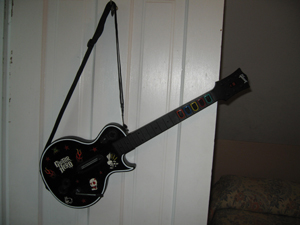
He sure plays a mean guitar. Guitar Hero, that is!
When I lived in Back of the Yards, I met a wide variety of Mexicans. Rubén Martínez was an unusual acquaintance of mine in that he was more the friend of a friend rather than a direct friend. He always seemed so full of energy for someone who was always high. He looked like your typical drug burnout with shoulder length hair that he parted down the middle.
In the seventies, no one wanted to part their hair in the middle lest anyone think that they smoked pot. Rubén, however, always parted his hair down the middle to flaunt the fact that he was a burnout and smoked pot. And he wore a miniature coke spoon around his neck just in case the occasion to get high on cocaine presented itself. Because of the thousands of people like Rubén, McDonald’s had to change their coffee stirrer from a little spoon on a long stem because people like Rubén used it to snort coke, to a flat paddle and later a small straw. Needless to say, he was always high and always looking to get higher. Sometimes he wouldn’t even respond to his own name. I once had to explain to him that he was Rubén and that’s why people who wanted to talk to him called his name. He was too high to understand me, though.
Anyway, thanks to Rubén, I attended my first rock concert. Led Zeppelin came to Chicago in January of 1975 and word was out that all the tickets would sell out immediately. We went to old Chicago Stadium box office about two hours before it opened at 10:00 a.m. We didn’t want to oversleep the time of the first ticket sales, so we stayed up all night drinking wine. We also contemplated doing immoral and illegal deeds, but we decided against that in order to buy the Led Zeppelin tickets without incident.
When we arrived at the ticket office at 8:00 a.m., we were tired, but determined to obtain tickets. I drove my 1975 Pontiac Firebird as close to the box office as the police permitted me. Rubén collected our ticket money and ran toward the Stadium like a deranged lunatic. Several policemen tried to stop him, but he dodged them, jumped onto the hood of their unmarked police car, then to the car roof, before leaping to the front of the ticket line. When he dissolved into the crowd, the police stop chasing him. We waited patiently for him in my Firebird that was parked a block away, but within view of the ticket office. An elderly woman, perhaps the grandmother of one of the expectant concertgoers, passed out hot chocolate from a thermos into Styrofoam cups. About four hours later, Rubén emerged from the ticket office with six concert tickets! We were going to see Led Zeppelin in concert!
When we went to the concert, I was shocked that everyone was smoking pot. I had never smoked pot in my life, but I got high just breathing in the concert air. I’ll never forget my first concert!
The last time I saw Rubén was at that Led Zeppelin concert, partying, getting high, and bouncing his head to the music. Years later, I heard that he was arrested several times for drug sales. He finally made the big time and was arrested for a million dollar drug bust. For me, he just vanished into the crowd of drug dealers and addicts, never to emerge again.
Labas. That’s right. Labas. To all my Lithuanian friends: Labas! In fact, I’d like to greet everyone reading my blog: Labas! That’s hello in Lithuanian. My Lithuanian friend Vito taught me that word because he always insisted that we greet each other by saying Labas. Now, I always greet Lithuanians with Labas and they always smile. I especially love to greet them with Labas especially if they didn’t think I knew they were Lithuanians. I’m not sure why, but they’re always thrilled to hear me say Labas. So, to all my Lithuanian readers: Labas! I guess sometimes I go on and on, don’t I? Well, my friend Vito taught me another Lithuanian word: tylėk. Sometimes we would go to the show, I would just keep on talking even after the movie started. He would keep telling me tylėk until I finally shut up. That’s right, tylėk means shut up in Lithuanian. But I never did. And I never will.
For as long as I can remember, I have always lived near Lithuanians in Chicago. In Back of the Yards, Holy Cross was the Lithuanian church I attended. At Holy Cross School, the nuns always praised The Jungle by Upton Sinclair because the protagonist was Lithuanian, and the novel was set in Back of the Yards. When we moved to Marquette Park, 2509 W. Marquette Road, many Lithuanians lived there, and they even had a street named Lithuanian Plaza Court. In fact, that neighborhood was the unofficial capital of Lithuania during the Soviet era. Maria High School, run by Lithuanian nuns, was at Marquette Road and California Avenue. Right on the same campus was the retirement convent for the Sisters of Saint Casimir at 2601 W. Marquette Road. The Lithuanians also had their own Holy Cross Hospital at California Avenue and Lithuanian Plaza Court. I met my friend Vito when I lived in Marquette Park. Vito and I used to eat at the Lithuanian McDonald’s at 68th and Pulaski. I don’t know if it was actually Lithuanian, but Vito told me that the tiles on the wall were typical Lithuanian colors, so it became a Lithuanian McDonald’s in my mind. When I moved to Bridgeport, there weren’t that many Lithuanians there anymore, but they did have a street named Lituanica Avenue. My favorite restaurant in Bridgeport was a Lithuanian restaurant named Healthy Foods at 3236 S. Halsted Street. When I saw the movie Chariots of Fire, I was thrilled to learn that the family of Harold Abrams were Lithuanian Jews.
When I was a student at Holy Cross, my best friend was Patrick McDonald, but when he moved away, I became friends with Adrian Stanislovaitis and Anthony Kivenas, both Lithuanians. Whenever I was with them, we spoke English, but when they were with their parents, they spoke Lithuanian. I never understood what they said, and it didn’t bother me at all. However, I never even learned one Lithuanian word from them. And when they came to my house, I spoke Spanish with my parents and grandmother. I envied Adrian and Anthony because they got to go to Lithuanian classes on Saturday morning. I wanted to go with them. I wished Mexicans would have Spanish classes for Mexicans. Anyway, Adrian and I spent a lot of time together. For school holidays, we used to take the bus downtown and just wander around, but he showed me a few points of interest, such as the Prudential Building because it used to be Chicago’s tallest skyscraper.
When we moved to Marquette Park, we met more Lithuanians. Marquette Park has a monument for Lithuanian aviators Captain Steponas Darius and Lieutenant Stasys Girenas. This is where I met Vito and other Lithuanians. I went to Lithuanian restaurants and bars with Vito. At one bar on Lithuanian Plaza Court, it might have been Knight’s Inn, we met a Lithuanian improv group that was named Second Village, which is Antras Kaimas in Lithuanian. It was inspired by the name of Second City. We talked to them for a while, and Jim, Vito, and I told them that we performed standup comedy. We ended up making a little skit/song/dance for them sung to the tune of “Skip to My Lou.” I still remember it, but don’t know how to spell it because it was in Lithuanian. Vito wrote most of the song. My contribution to the song? Labas and tylėk! No surprise there!
We once went to a Lithuanian festival on Western Boulevard near the Lithuanian V.F.W. Hall, which if I remember correctly was named after Darius and Girenas. Anyway, there were all kinds of Lithuanian food. One vender was selling empanadas, which really surprised me because as far as I knew, empanadas were Mexican food. The Lithuanian cook tells me that empanadas were invented by Lithuanians. He could tell that I didn’t believe him. He pressed on with his explanation and tried to convince me that I really didn’t know Mexican food. He was so convincing that I almost believed him. Almost, but not quite. Finally, he told me that he learned to make empanadas in Argentina. During WWII, his family went to Argentina before they came to America.
That’s how I think of Lithuanians. They’re always ready to play a friendly practical joke on you. Vito was always the joker and had a great sense of humor that not everybody got. I could tell he got it from his father. Once I went to Vito’s house so we could go to the show. His father answered the door and I asked for Vito. He knew very well that I was asking for his son, Vito, my friend, but he said, “You’re talking to him.” I said, “No, Vito Junior.” He said, “I am Vito Junior!” This went on much longer than was comfortable for me, but Vito’s father was really enjoying this. Finally, he said, “Vito’s not home.” Why didn’t he just tell me that in the first place? Well, he wanted to play a joke on me. I laugh now that I think of it. But that day I learned that both Vito’s father and grandfather were named Vito. What really made me uncomfortable about them was how they greeted each other and how they said good-bye. Vito would always kiss his father on the lips. Talk about culture shock! For a while, Vito lived with his grandfather Vito. Before we would go out, Vito would kiss his grandfather on the lips before he went out. It wasn’t as shocking since I had finally gotten used to him kissing his father. But one day we were talking, and Vito told me that his father was adopted. Suddenly, it hit me. “Vito, you kiss your grandfather on the lips, and he’s not even related to you!” He thought nothing of it. I still can’t get over it!
When I was growing up, in an age before everyone tried to be politically correct, everyone told ethnic jokes. They were always insulting and mean-spirited to whatever group was targeted. Sure, some people were offended by these jokes, which only led to them being the target of more ethnic jokes. However, these jokes also brought a lot of joy and laughter among friends. For example, I worked in a peanut butter factory, named Derby Foods, with various ethnic groups who lived in the Back of the Yards neighborhood. In general, we all got along very well. Shirley, one of my Polish coworkers, loved to hear any kind of joke because she loved to laugh. Her real name was Ursula, but she preferred to be called Shirley. Anyway, she especially loved to hear Polish jokes. She always insisted that I tell her any new Polish joke that I heard. And when I didn’t learn any new jokes, she insisted that I retell her the old ones. Whenever I told her Mexican jokes, she told me she liked the Polish ones better. In this age of political correctness, I will not tell any Polish jokes lest I offend anyone. But I suppose it would be okay if I told some of the Mexican jokes that I still remember. I’m not doing this to propagate any negative stereotypes about Mexicans, but merely as a scientific exercise to preserve our humorous past. Now, I’m not saying that these jokes are funny anymore, but once upon a time, people laughed at these jokes. Some of them are quite dated. Okay, you have been forewarned!
Why can’t Mexicans be fireman? They don’t know the difference between José and Hose B.
Mexican weather report: Chili today. Hot tamale.
Why do Mexicans wear pointy shoes? To kill cockroaches in the corner.
What is the name of the Mexican telephone company? Taco Bell.
Why don’t Mexicans have barbecues? The beans keep falling through the grille.
How can you tell if you’re at a Mexican birthday party? There are more adults than children.
What do you call a Mexican basketball game? Juan on Juan.
What do you get when you cross a Mexican with an octopus? I don’t know, but boy can it pick lettuce!
Why doesn’t Mexico have an Olympic team? Because every Mexican who can run, jump, or swim is already in the U.S.
What do you call a Mexican in a BMW? A valet.
Upon further reflection, I retract the above listed jokes because they are in extremely bad taste. With apologies to Ursula, I mean, Shirley!
When I was in Holy Cross School, I had several paper routes and I really enjoyed delivering newspapers. My best friend in the fourth grade was Patrick McDonnell. One day he asked me to help him deliver newspapers on his paper route. One of his older brothers had the paper route, but when he got tired of delivering newspapers, he gave the paper route to his brother Patrick. In those days, it was almost impossible to get a paper route on your own. True to Chicago tradition, you even needed clout to get a paper route.
I helped Patrick deliver his newspaper, The Chicago American, for a few days. One day, he asked me if I knew who all the customers were. Of course, I did! “That’s good,” he said. “Because you can have the paper route!” He had gotten tired of delivering papers and couldn’t quit the paper route until he found a replacement.
Well, I was extremely happy to be his replacement because I loved delivering newspapers and I especially loved having some spending money. I’m not sure how long I had that paper route, but it was long enough to see the Chicago American become the Chicago Today. I loved reading the newspaper as I walked door to door delivering it. Then one day, the Chicago Today folded and I was out of a job. But it was fun while it lasted.
Months later, my friend Patrick asked me to help him with his paper route again. He had found another paper route and again he was tired of delivering newspapers on his bicycle. He immediately thought of me as his replacement. This route had many more customers than the other one and you needed to deliver the papers on a bicycle because this route covered our entire neighborhood. This paper route was the most memorable one for me. Paper route number 9! I really learned a lot about life while delivering newspapers on this route. And I also truly learned a lot about the Back of the Yards and its residents. On this route, I delivered the Chicago Daily News, the Chicago Zgoda, and the Chicagowski, the last two were newspapers published in Polish. I tried to read the Polish newspapers, but they seemed be written in a foreign language to me. And most of the Polish subscribers hardly knew English, but we always understood each other.
There were two facets to delivering newspapers. One was the actual delivery of the newspapers. Some subscribers wanted it delivered in a certain way. Folded without a rubber band, or with a rubber band. On the front porch, or on the back porch. Between the screen door and the door. There were considerate customers who didn’t mind if I just rode past on my bike and threw the paper on their front porch. And my aim was true, most of the time.
One day, as I was approaching a house next to the alley, I was about to throw the newspaper on the porch when suddenly a car sped out of the alley. I was shaken a little and when I released the newspaper, it broke the glass on the storm door. I was so scared that I kept riding and delivering papers. When I returned to the newspaper agency, the subscriber had already reported me to my boss, Ernest Pressman. I swear. That was his real name. She knew it was an accident and she only wanted me to pay for the broken window. I remember I had to pay about four dollars for a new window, roughly my weekly salary before tips.
Sometimes delivering the newspaper could be downright dangerous. One customer wanted the paper delivered in the rear hallway. What I didn’t know was that sometimes she kept her German Shepherd there. One day, I open the hallway door and saw the German Shepherd lounging at my hand that was attempting to drop the newspaper in the hallway. I quickly shoved the newspaper in his mouth and slammed the door shut. I was waiting for another reprimand from Mr. Pressman when I returned to the newspaper agency, but I was never reported for this.
The second facet was collecting the money for the subscriptions. Collecting money from some customers required an excellent memory, ruses, and stratagems. All this just to collect a measly fifty cents! I had to remember what day they got paid so I could go collect the money that day before they squandered it away on rent, food, utilities, and other such nonsense. And I also had to make sure I had enough change so they could pay, and I could give them change. They wouldn’t pay unless I gave them correct change.
One woman once asked me if I had change for a five. Of course, I did. So, then she upped it to ten dollars. I told her I had change for a ten, too. Then, she said for a twenty and I said yes. She then told me she had a fifty-dollar bill and I showed her that I had enough change. I was ready for her because she had tried this before. She then paid me in exact change and gave me a nickel for a tip.
I mean I got to know all of my customers very well. One woman told me to collect the money on Saturday morning at 8:00 a.m. and then wait for about ten to fifteen minutes until she opened the door. Not a problem, I told her. All I wanted to do was collect my money, and hopefully, a small tip. The reason she wanted me to knock on her door so early was that I was her Saturday-morning alarm clock. And she took so long to open the door because she went to the bathroom first. I always hoped she washed her hands.
I delivered the Daily News to a bar on the corner of 43rd Street and Wolcott. When the bartender paid for the subscription, he would tip me fifty cents and tell me to take a bag of Mrs. Vitner’s potato chips, any candy bar of my choice, and a pack of gum. One customer I never saw. She left me a note on her door in the rear hallway saying she would leave the money hidden in a crack in the wall. I was pleased by this arrangement because this mystery woman tipped well.
One little old Polish lady always wanted me to deliver both the Zgoda and Chicagowski directly into her hands. So, I had to get off my bike, go knock on her door, she would say something in Polish that I didn’t understand, I would say I was the paperboy, and then she would open the door. I did this every day! Actually, I didn’t mind doing it, either. Of course, she wasn’t a big tipper, either, even though she considered herself extremely generous. On the day I had to collect the money for the subscription, she would tell me to enter her apartment and lock the door behind me. She would give a crisp brand-new dollar bill to pay for her bill of ninety-nine cents. I would then give her her change of one cent, which she would give back to me immediately as my tip and insist that I put the penny in a different pocket because that penny was for me and not the newspaper agency. Most subscribers would tip a nickel or a dime and that was extremely generous in all reality. But I really loved going through this weekly ritual for my one-cent tip! Sometimes I had to run out of the apartment so she wouldn’t hear me when I couldn’t contain my laughter anymore. I really loved this little old Polish lady!
There was another little old Polish lady on paper route who received the Chicago Daily News, the Zgoda, and the Chicagowski. Her bill was about $1.50 per week. She wasn’t as demanding about her delivery, either. When I went to collect the money for her subscription, she would tip me 100%. I told her that $1.50 was way too much money for the tip, but she insisted. Well, being the polite Mexican boy that I was, I would pocket the money, in a different pocket, of course, so the Mr. Pressman wouldn’t get my tip. Sometimes, she would feel really guilty about the tip and slip me an extra nickel or dime before I walked out!
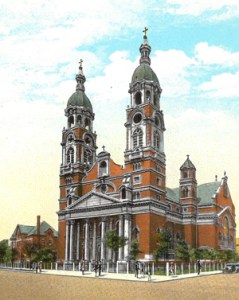
Holy Cross Church, Back of the Yards, Chicago, Illinois
I spent a significant number of years during my coming of age at Holy Cross Church and Holy Cross School. This parish was founded in the 1890s by Lithuanian immigrants. In the 1930s, there was a large influx of Mexican immigrants to Back of the Yards, which is one of the main reasons our family moved to the neighborhood in the 1960s after having lived in Pilsen.
I attended Holy Cross School from kindergarten through eighth grade and I graduated on June 6, 1971. The study habits I developed during this time served me well the rest of my years in school, especially college. Of course, it helped that all the teachers were strict Lithuanian Catholic nuns, with exception of Mr. Hovanec the history teacher. Nothing instills healthy study habits better than the fear of being disciplined with corporal punishment by a nun wielding a yardstick and a man’s name such as Sister Joseph or Sister Bartholomew.
Of course, during the 1960s there was a movement to convert U.S. to the metric system and move away from the English system of measurement that even the English didn’t use anymore. Our nuns participated in the metric system conversion by trading in their yardsticks for meter sticks when they hit us. That meant 3.37 more inches of pain. These nuns really wanted us to learn so we would go on to excel in high school and college. The school was very strict and if the corporal punishment didn’t straighten out a student quickly, expulsion was imminent. Once the principal, Sister Cecilia, lectured us on the importance of behaving well because our school record now could affect us later as adults. Recently, she told us, a former Holy Cross student applied to become an FBI agent and the FBI came to Holy Cross to see what kind of student he was. Well, that was enough to scare me into being a good student.
At school most of my friends were either Lithuanian or Mexican. Everyone had to learn English. Everyone had to become a good American citizen. In fact, the nuns constantly reminded us that any one of us could one day grow up to become the President of the United States. We always had to study hard and be on our best behavior. But somehow someone always got in trouble. I used to get in trouble for laughing at the class clown. When the nun would ask me what was so funny, I would tell her and she didn’t understand why I would laugh at such a thing. Looking back, I see her point.
Above all, they taught us to be good Catholics. We went to church everyday before going to school. If we were late for morning mass, we were considered late for school. Back then I thought the whole world was Catholic. Everyone I knew was Catholic. My parents, my brothers, my aunts, my uncles, my cousins, the nuns, our pastor, I mean everybody. Even famous people were Catholic. Mayor Richard J. Daley was Catholic and he was well-known for stopping at St. Peter’s on Madison Street to hear mass before going to City Hall. President John F. Kennedy was Catholic. The nuns would proudly remind us at every opportunity. To me, the whole world was Catholic. Even the Pope was Catholic! So why did he wear a yarmulke?
Of course, attending a private school meant paying tuition and having fundraisers. As I recall, we had one fundraiser after another all year, culminating in the parish carnival in June. We had raffles for everything. One year, the raffle prize was a brand new station wagon, and miraculously, one of the nuns had the winning ticket. There were bake sales, rummage sales, Christmas card sales, movie showings, and sometimes just outright petitions for donations for certain goals either at school or church.
I remember that I liked selling the Christmas cards door to door. My brother Tato and I teamed up one year on a cold, snowy day. We carried our boxes of Christmas cards with us and didn’t have much luck selling them at first. Then, we were at one house on the icy porch of a woman who had just refused to buy a box of Christmas cards from us. As my brother started walking down the stairs, he accidentally slipped on the ice and rolled down about eight stairs all the way to the bottom. Well, the woman asked if he was okay–he was because we always bundled up in multiple layers on cold days like this. Then she bought a box of Christmas cards from us. I think she was afraid of a civil lawsuit. At the next house, the woman didn’t want any Christmas cards either, until my brother “accidentally” fell down the stairs again. This was my brother’s brilliant idea and he kept falling until we had sold all our Christmas cards!