The Jungle


Back of the Yards, Chicago, Illinois

I just finished rereading The Jungle by Upton Sinclair. This is a book I knew about since about the third grade because the Lithuanian nuns also mentioned it at Holy Cross School. The nuns always wanted to remind us that we didn’t always have life so easy. They would often describe the squalid living conditions of our neighborhood, The Back of the Yards, and the horrendous working conditions at the Union International Stock Yards. They stressed that education was the best way to improve our lives and that we should excel in grade school, to get into a good Catholic school, to prepare us for college. I always recall the incident about the boy who drowns in the street. Several nuns over the years described that scene. And we were so lucky to live in a neighborhood with concrete sidewalks, paved streets, and a sewage system. No one from our neighborhood ever drowned in the street–that I know of.

When I worked at Derby Foods, we didn’t have a union even though Chicago has always been known as a union town. And I didn’t realize it at the time, but we didn’t need a union because all the other factories around us were unionized. Our factory paid us above-average wages and we worked under better-than-normal working conditions. They followed bidding by seniority for different job openings in the factory.

Regardless, I hated working there because I was a lowly manual laborer. The money was good, but I was unhappy about not being able to go to college. I continued working there because … because–just because. When I started at Derby Foods, about three-hundred people worked there. But over the years, the company kept modernizing by buying machinery that would replace employees. By the time I had eight years on the job, I was still near the bottom of the seniority list of about 134 employees due to the lack of hiring because of the worker displacement caused by the new machinery. Since I was at the bottom of the list, I had to work an undesirable work schedule. In food production, the plant and machinery must be cleaned and sanitized on a regular basis. Well, I had to work the third shift from 11:00 pm until 7:00 am. Regardless of what anyone says, the human body never fully adapts to a nocturnal life. The schedule was bearable until Saturday when I would get off at 7:00 am but I would have to return at noon to clean and sanitize the plant at 11:00 am. Everyone else who worked the Saturday shift worked either days or afternoons, so they didn’t complain. Besides, they enjoyed working for time and a half because it was a Saturday.

I complained about my schedule to my foreman, the shift foreman, and the manager. No one thought it was a problem. I had no union with whom to file a grievance, so I called the federal labor law organization, and they told me that my employer was not violating any federal laws by requiring me to return to work an eight-hour shift within four hours of working an eight-hour shift. Well, I was happy that I tried everything possible to improve my working conditions.

Then, it dawned on me! I’ll read The Jungle! I’ll find scenes in the novel that compare to my present working conditions! So, during my breaks and down time in factory, I read the paperback edition of The Jungle that I always carried in my back pocket. When I was done, I was so grateful to be working for Derby Foods! I never realized how good I had it compared to the Stockyard workers in the early 1900s. Because of that book, federal laws were enacted, the Pure Food and Drug act in 1906 for one, to improve the lives of millions worldwide. The unions in Chicago and nationally became stronger. I had forgotten the lessons of my dear Lithuanian Catholic nuns at Holy Cross School. But upon rereading The Jungle, I was grateful, nay, thankful, to be working for Derby Foods. I never complained about my employer ever again.

DDR

Fourth of July


U.S. of A.

Independence Day has to be the most patriotic of all American holidays. For as long as I can remember, we celebrated the day by going on picnics, pigging out, playing soccer, volleyball, baseball, or badminton at a state park, city park, or at the beach on Chicago’s lakefront. My favorite part was always the fireworks.

The last few years, everyone has been more conscious about protecting our environment. So we try not to litter and not to pollute the air. However, the Fourth of July is the one day that it’s permissible (though not legal) to set off illegal fireworks in Chicago. The streets are littered by the remains of fireworks and the air quality is clearly polluted for a day or two. Independence Day is a day when hardly anyone thinks green. Some people in Chicago even shoot off guns on this day. You don’t really want to be driving around while all the fireworks are in progress. It’s just too dangerous in Chicago. On the news you hear reports of people getting shot and/or getting injured by fireworks. There are also accidental fires caused by fireworks. But that’s how we celebrate Independence Day in Chicago. I find it hard to believe that no one I knew was ever injured by fireworks.

Growing up in Back of the Yards, everyone had illegal fireworks. We knew all about how to handle fireworks safely, but we used to do everything possible that would place ourselves in the most possible danger. Only adults were supposed to handle fireworks. But my friends and I have been lighting firecrackers since we were nine. You were supposed to set firecrackers on the ground and then light them, but we used to light them in our hands and then throw them at each other. Timing was especially important. You also had to watch the others as they lit their firecrackers in order to be able to dodge any and all firecrackers that came your way AND not let your firecracker blow off in your hand. Yes, I’m still truly amazed that no one was ever even slightly injured!

One summer, one of my friends got the idea of letting a firecracker blow up in our hand. We all thought he was crazy. But then he held his open hand palm up and let a firecracker blow up in his hand. We just stared at him in amazement. Then, he dared us to do the same thing. We all hesitated, but none of us wanted to be called chicken the rest of the summer so we all did it once. I must admit that it was scary watching the wick burn down until the firecracker blew up. It was loud because it was so close to my ear and my hand did sting a lot from the explosion, but I didn’t get burned or anything.

One summer, on the fifth of July, I woke up early and I walked all through the neighborhood picking up all the dud firecrackers that I could find. I carefully collected all the gunpowder from them and put it in a lead pipe about four inches long. I put a cap on one end of the pipe and a firecracker on the other. I wasn’t even sure if this thing would blow up. But if it did, I knew it would be a huge blast. All my friends wanted to see the explosion, but I told them that they had to hide until after the explosion was over.

We had a clubhouse in our back yard at our house at 4405 S. Wood Street. I set the pipe down by the clubhouse. My plan was to light the firecracker in the pipe and hide behind the clubhouse. I only had to take two steps to duck for cover. I made sure everyone was hiding before I even thought about lighting it.

Well, I lit it, I turned to run, and I took only two steps when the pipe blew up. I barely made it behind the clubhouse for cover. That is, most of me had made it, save for my left foot. I felt the blast on my foot and at first I thought I had blown off my foot. About a second later, I heard some of the shredded pipe pieces falling on the concrete in the alley. When the smoke cleared, I looked at my foot. I was wearing low-cut gym shoes and the blast had blown off the part of my sock that covered my ankle. But I was uninjured! By sheer luck!

Now, every Fourth of July, I keep a wary eye on my sons lest they injure themselves with fireworks. Of course, I never tell them any of the things we used to do with fireworks when we were boys. I don’t want to give them any ideas!

DDR

Patrick Fahey


International Union Stockyards, Chicago, Illinois

I met Patrick Fahey when I attended Tilden Technical High School in the Back of the Yards. We were incredibly good friends, but only when we were in school. I’m not even sure when and where I met him. He just somehow materialized at school, and we often sat together in cafeteria or the library. Sometimes when I walked home from school, I would walk over to his apartment because he only lived two blocks from the school.

His apartment didn’t have very much furniture, and no one was ever home. Patrick was Irish with brown hair and freckles. He was tall and thin. His face wasn’t exactly symmetrical, and it reminded me of Pablo Picasso’s portrait of Gertrude Stein. I often found myself staring at the dimensions of his face, but he never said anything. Perhaps he never noticed since he always was off in his own little world. He didn’t have a girlfriend that I knew of, other than his imaginary ones. Sometimes he would show me a model in a magazine ad and say, “I wouldn’t kick her out of bed.” But I couldn’t even picture him approaching any girl even to say hello to one since he was so painfully shy. I didn’t think he would ever attract a beautiful girl like the models in the magazines, or any girl at all for that matter, because of his extreme shyness.

But, one day, as I was putting my books in my locker between classes, I closed my locker door and I suddenly saw a girl standing there, smiling nervously. We were both speechless for a moment. She looked Irish to me. She was pretty in a plain sort of way and pleasantly plump. I finally said hi. She said hi, but then the bell rang, and we went our separate ways. The whole incident was overwhelming. I couldn’t fathom why this girl would be standing by my locker.

I forgot all about her until the next day when I saw her by my locker again. “Do you know Patrick Fahey?” she asked. “Yes,” I responded feebly. “Do you talk to him a lot?” “Yes.” Then, the bell rang, and we went to our respective classes. I told Patrick about the incident, but he didn’t even acknowledge what I had told him. That was quite normal for us because we didn’t always talk to each other. We often just sat there in the library, just reading. We were like Pedro and Napoleon in the movie Napoleon Dynamite, only I didn’t have a mustache then. Now that I think of it, we spent a lot of time together, but we hardly ever talked, even when we walked to his house together.

A few weeks later, the girl was at my locker again. This time she talked and talked so much that I couldn’t get a word in edgewise. Her name was Maureen, and she was in a history class with Patrick. She said she really, really liked Patrick, but he would never talk to her. So, she approached me to help her. I said I would talk to Patrick. When I saw him, I asked him if he knew Maureen. He did. But he wasn’t interested in her. End of conversation for the day.

I would see Maureen by my locker regularly and she would ask me for progress updates. What I gave her was more like lack-of-progress updates. Patrick just wasn’t interested in her, not even as a friend. I eventually broke the news to her gently, but she was in denial and only tried harder. Finally, it was the end of the school year, and it was time for the spring dance. Maureen came to my locker and asked me if I was going to the dance. Then, she asked if I knew if Patrick already had a date for the dance. I knew he didn’t because we both confessed that we weren’t going. Maureen then told me to ask Patrick to take her to the dance. She stood there by my locker, the epitome of woeful lovesick misery, so I agreed to talk to Patrick about her. Patrick immediately said no. When I saw Maureen again, I told her his response. She cried and said, “But I love him!” She begged me to talk to him again. To ask him to please take her to the spring dance. I felt uncomfortable because she had her arms around my neck and everyone in the hall was staring at us.

I told Patrick everything that had transpired between Maureen and me, but he was unmoved. He said he wouldn’t go to the dance with Maureen. He just wouldn’t. Just because. For me that wasn’t a good reason. Somehow, I had to help Maureen. And by helping Maureen, I was also helping Patrick. “Just take Maureen to the dance!” I finally said. “I can’t.” “Why not?” “Because she’s fat!” “That’s not true!” Suddenly, I had to defend Maureen since I had gotten to know her a little better with all the time she spent talking to me by my locker.

Besides, to a Mexican, she wasn’t considered even remotely fat. “She just wants you to take her to the dance,” I said. “She’s not asking you to marry her.” Well, this sad tale eventually had a happy ending. Maureen, with all of her perpetual persistence–with a lot of help from me–, eventually went to the spring dance with Patrick. Afterwards, he wouldn’t talk about the dance or Maureen. In fact, Patrick acted as if the spring dance had never occurred, as if it were some sort of void in his life. But I knew they were happy together because Maureen would constantly update me on their relationship on her regular visits to me by my locker. I don’t know whatever happened to Patrick and Maureen because I transferred to Gage Park High School the next year. I like to imagine that they’re still together, happily married with children. Only Patrick doesn’t tell his friends about her.

DDR

Canaryville


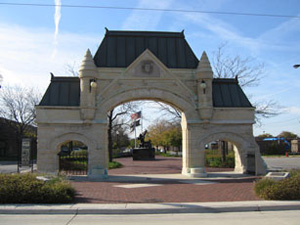
Gate to the Union Stockyards, Chicago, Illinois

Canaryville is a neighborhood that is south of Bridgeport and southeast of where the Union Stockyards used to be. I spent a few years there visiting friends who lived there.

I was from Back of the Yards, so not many people from Canaryville knew me. I was risking life and limb every time I went, but I liked the sense of danger I experienced every time I visited. When I left Divine Heart Seminary, I had to attend Tilden Technical High School at 4747 S. Union, right in the heart of Canaryville. As luck would have it, the school had a lot of daily racial fights between blacks and whites. But that was my school and I was stuck attending it. I made the best of a bad situation.

I lived about a mile and a half away from school. After the first snowstorm, it was too cold to stand at the bus stop to wait for the bus, so I started walking to school in order to stay warm. I planned on getting on the bus when it eventually showed up. However, I walked all the way to school without ever seeing the bus.

I didn’t mind walking at all since I used to walk seven and a half miles to town every weekend when I attended Divine Heart Seminary. The next day was even colder, so I left the house a little earlier and walked all the way to school without looking back over my shoulder for the bus. I ended up walking to school the rest of the year because I was able to spend the bus fare on magazines and books. A few months ago, I was talking to my cousins about high school and it turns out that they also walked to school so they could keep the bus fare for spending money.

I never had any trouble with anyone until I got near the school. Someone, they would either be white or black (I was an equal opportunity crime victim), would ask me for money, implying that I should comply with their request or they would use physical force if necessary. I never gave anyone any money. I always had a response for them. “If you need money, you should get a job!” Or, “If you want my money, you have to take it from me.” I would then give them my crazed look that implied they might get the money, but they would be sorry they did because I would inflict some pain on them in the process.

Surprisingly, no one ever accepted my invitation to take my money. Although I did get close once. Two Canaryville residents on their way to school saw me and told me to give them my money or they would beat me up, only not in those words but a rather more colorful vocabulary. They looked like they were really going to beat me up but good. I collected myself and focused deep within. I clenched my fists and gave them a deranged look that I hoped would scare them off. Suddenly, they looked at each other, and as if by silent agreement, they walked away from me. They continued looking over their shoulders at me as they walked away. Then a police paddy wagon passed me from behind. They had walked away from me because they had seen the police! The police asked me if the boys had threatened me. I said that we were friends. I don’t think the police really believed me, but I stuck to my story. Those boys never bothered me again. In fact, they were so grateful that I didn’t rat them out that they even protected me on a few future occasions when I really needed some help at school.

DDR

Duke


Duke

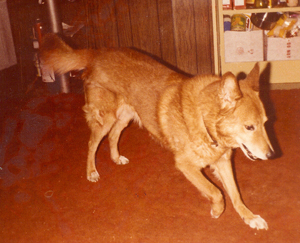
Duke was the best dog that our family ever had. When we lived at 4405 S. Wood Street, he followed my brothers and me home from school. He really did. At first, he followed us at a distance and that was fine with us because we weren’t sure if he would bite us. He was already full-grown, and he was at least part Golden Retriever and maybe a little bit German Shepard and Chow Chow. We were sure that, since Duke got along well with the whole family, he probably was also part Mexican.

He followed us into our backyard, and we went into the house. When we looked out the window later, he was still there. We gave him some bologna and went back inside. The next day, he followed us home again and we gave him some milk this time. He let us pet him and he seemed very friendly. He was too clean to be a stray dog and he didn’t have the battle scars of street dogs, but he didn’t have a collar or dog tags either. We never let him into the house because we knew our mother would get mad at us. But Duke kept following us home after school. He knew what time we got out of school, and he would meet us at the corner of our block and follow us home so we could give him something to eat.

One day, my mother came home from work and asked us about the dog on the back porch. “What dog on the back porch?” I asked, knowing we were about to get in trouble. We didn’t admit to anything. Eventually, my mother brought Duke into the house, and we all started playing with him. He was happy with us and never even growled when my little sister pulled his ears or fur. We asked our mother if we could keep it, but she said he belonged to someone else and they would eventually want him back. We could keep him until someone claimed him.

We were so happy to have a dog again. And the good news was that he was already house broken. At first, my mother would open the door to let Duke go out by himself thinking that he would eventually go to his real home. But he always came back. After a while, I started walking him without a leash. He always stayed close to me, and he would never run away. I walked him all over the neighborhood so that Duke would recognize his original home, but we never found his original owner. Soon I knew I was Duke’s master because one of the neighborhood bullies threatened me with Duke at my side and Duke growled at him ready to defend me.

Duke had some pretty good street cred, too, because when other dogs would see him, they would run away. I didn’t need a leash to control Duke because he so obedient that he listened to my every command. However, he loved to chase squirrels, but he would only do say when I gave him permission. Whenever he saw a squirrel at a distance, he ears would perk up and he would growl, but he would stay by my side until I said, “Go get him, Duke!” And he would run at full speed toward the squirrel. He never once caught a squirrel because the squirrels were usually too far away from us and too close to a tree that they climbed to escape. Only once did I think that Duke would actually catch a squirrel in his mouth. He was rapidly closing in on a squirrel that was foolish enough to try to outrun Duke instead of climbing a tree. I think that Duke slowed down to give the squirrel a running chance and the squirrel got away.

When we moved to 2509 W. Marquette Road, Duke moved with us. By then, he was part of our family. Somehow, I remained Duke’s master. My brothers and I had to be careful when we wrestled because Duke would attempt to bite my brothers in my defense. Even after I married and moved away from my mother’s house. Once I was visiting and I started wrestling with Tato, my brother Jerry, in the basement just like in the good old days. Duke just stood there watching. He was a lot older now and he didn’t growl at my brother as he once did. Well, I could still out-wrestle all my brothers even though we were all about the same size now. I managed to throw my brother down on his back on the sofa. I jokingly said, “Sic him!” and Duke ran and bit my brother’s face. I really didn’t think he would attack my brother. I immediately grabbed Duke by his collar, and he finally calmed down. My brother had some puncture wounds on his face from being bitten a few times. I apologized profusely to my brother. Neither one of us thought Duke would attack. But he did. I was still his master even though I had lived away from him for about a year. I still feel bad about this even now as I described the incident.

Duke lived to be incredibly old, but we never knew his exact age since he was already full-grown when he started living with us. Eventually, he had so many health problems that my sister had him put to sleep. He was such a great dog that I can still visualize him.

DDR