Could I actually live in a condo in a tourist area? I don’t think so.
Over the years, I have had one identity crisis after another. The identity crisis recurs most often is the one in which I can’t decide if I should live in Chicago or Mexico because I’m not sure if I’m Mexican or American.
Sometimes I feel as if I don’t belong here in the U.S. because I feel so Mexican and like a foreigner here. When I’m Mexico, I feel very comfortable there. Of course, that could be merely because I’m a guest there and the excitement and the newness of my being there hasn’t worn off yet. If I stayed much longer, everyone might not be as friendly toward me. I’ve mentioned to some of my friends that I was thinking of moving to Mexico and they immediately offered to help me pack! Wow! What friends!
I went to Mexico when I was 22 and I seriously considered staying there. But then I realized that I would have to get a job in order to support myself. But Mexicans don’t really want foreigners coming in and taking away their jobs. Besides, I didn’t really want to work a back-breaking job in Mexico when I already had a back-breaking job in Chicago. So I went back home to Chicago. However, I often daydreamed about living in Mexico.
Now, I am actually in a position where I can afford to move to Mexico since I have a small pension. I now have to work a job in order to live comfortably in Chicago, but I could live more than comfortably if I moved to Mexico. And I won’t have to work at all if I lived in Mexico. I could sit at home all day writing blog entry after blog entry. Wait, that’s what I’m doing now! But I have to teach in order to supplement my pension.
In Mexico, I would always find something to keep me busy since they do have the Internet down there. And I wouldn’t be lonely because I have a lot of family in Mexico in several cities. Our family, both on my father’s and mother’s side, was very prolific. That’s why Rodriguez and Martinez are some of the most common Spanish last names in the world. So I wouldn’t be lonely.
And even though I’m American, Mexicans–my family in particular–consider me Mexican, sort of. Since I’m American, everyone in Mexico was surprised that I spoke Spanish and ate tortillas. I’m glad that Mexicans thought of me as a Mexican, at least most of the time.
When I go back to Mexico in July, I’ll take another look at where I could possibly live in Mexico. I really love Celaya, Guanajuato, the home of my father’s family. It’s a fairly big city with a small-town feel to it. And, I have an uncle, two aunts, and fifteen cousins who live there! Plus, there’s a university in the city where I could possibly find a teaching position if I ever have the urge to teach again. That would be quite an adventure for me. So now I’m struggling to redefine myself and resolve my latest identity crisis. I’m sure that this time I’ll find myself. Or, maybe not.
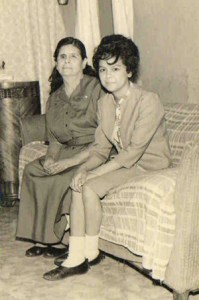
My tía Matilde was quite a character. Once when we were visiting México, we stayed with my abuelita who was blind. All our relatives would always visit abuelita, especially when we came from Chicago. Matilde was still single at the time, so she lived with my abuelita.
While we were there, my mother decided to fix up my abuelita’s place a little. That meant everyone there had to work, vacation or not! We cleaned and painted, and when my mother saw the freshly painted walls, she decided to hang up some family pictures. Only one problem. My abuelita didn’t have a hammer. So, my mother sent tía Matilde to get a hammer from a friend’s house.
That sounds easy enough, no? Well, not to a Mexicana. Somehow the simplest errands became a complicated quest. Tía Matilde sets off on the simple errand of bringing back a hammer so my mother could hang up some pictures. My aunt should have returned in ten to fifteen minutes tops. Well, a half hour went by and tía Matilde didn’t return.
My mother looked down the street and saw no sign of her sister. An hour passed, then another, and still no sign of tía Matilde. My mother sent me to the friend’s house to see if Matilde ever went there. No, they hadn’t seen her all day. No one really worried about her because in México sometimes people get distracted and forget their original mission, in this case, the quest for the hammer.
Tía Matilde finally returned about three hours later! My abuelita and my mother started interrogating her. “Where did you go? What took you so long?”
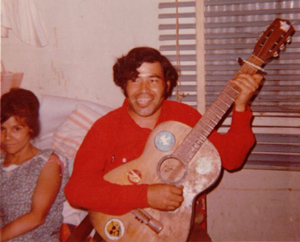
Well, she met this certain Samuel. He was standing on the corner playing the guitar and he started serenading her. They went for a walk and before she knew it, three hours had passed. Then, she remembered about the hammer! She returned, finally, but without the hammer!
My abuelita and mother were mad at my tía Matilde, but they also couldn’t help laughing at the whole situation. Matilde and Samuel eventually married and had six children.
My tía Matilde came to Chicago as part of the package deal when my abuelita came for eye surgery. Tía Matilde also needed surgery, so she came from México to have surgery on her ears. I’m not sure what exactly was wrong with her ears, but she was otherwise healthy.
My aunt was very young when she came, and she liked living in Chicago. She loved listening to pop music on the radio and she bought all the records by her favorite singer, Rick Nelson. She went wild when listening to his music.
What I remember most about my tía Matilde was how she did laundry. We, my parents, my three brothers, my abuelita, my tía Matilde, and me, all lived in a small four-room apartment. We had a washer and dryer in the kitchen next to the sink. When my parents were at work, tía Matilde would do all the laundry in the house, every handkerchief and sock. She would search everywhere in the apartment for dirty clothes. She found dirty clothes where I would never even think of looking. She just had to make sure that every last item of dirty clothing was clean when she was done doing the laundry. And so, when all the dirty clothes were in the washer, and there was a little room in the tub for more clothes, she would start taking off her clothes right at the washer and start putting them in the washer. She would be standing in the kitchen wearing nothing but her bra and panties, proud of the fact that all the dirty clothes in the house were now washed, obviously oblivious to my presence.
Back then, we always seemed to be either at home or at Cook County Hospital taking either my abuelita or tía Matilde to the doctors there. Anyway, my tía Matilde, who would undress at the washer, was very shy with the doctors when they asked her to disrobe. The day of her surgery, she refused to undress and refused to put on the hospital gown because it had no back to it.
I still remember her telling this story when she returned from her surgery. She absolutely refused to undress for the nurses and doctors. She thought she had won her battle, but after the surgery, she woke up in her hospital bed and immediately realized that she was completely naked! Whenever she told this story, she always sounded so shocked that this could have happened to her despite her precautions. She didn’t even remember when or why she lost consciousness. She always wondered who managed to see her naked. She would blush every time she told the story. She was truly traumatized by this experience!
She eventually went back to México with my abuelita.
There are good-byes. And then there are Mexican good-byes. By this, I mean that most people say good-bye and then they leave. Mexicans, on the other hand, say good-bye and think of many reasons for staying un poquito más. Such as telling the story they just remembered on the way out, upon touching the doorknob. Or, because they haven’t seen each other in such a long time, since like last week. I, too, of course am guilty of these long, extended good-byes. Perhaps, I didn’t say everything that I wanted because I couldn’t get a word in edgewise or the stories told were so good that I didn’t want to interrupt them.
While I was in Mexico, every good-bye was a despedida mexicana, but one long good-bye especially comes to mind. I was staying at my cousin’s house and we were going to visit her sister, also my cousin. My cousin, her husband, my aunt, and I went to my other cousin’s house. We would leave about three o’clock in the afternoon in order to avoid the afternoon rush hour traffic. I agreed because Mexico City’s normal traffic is horrendous and traumatic, even if you’re just a passenger, let alone driving during rush hour. So we visit my cousin, we eat at a restaurant called California, we go back to the house of the cousin we just visited, look at some old family pictures, and talk and talk and talk over old times since the last time I went to Mexico, which was twenty-nine years earlier. By the way, we started up the conversation right where we left off the last time I was there as if I had just left a few days before.
At 3:00 p.m. sharp, my cousin announces that we’re leaving immediately in order to avoid the rush-hour traffic. My cousin’s husband says that we can’t leave his house without first drinking some tequila together. That would reflect poorly on their hospitality. Besides, how could I go to Mexico and not drink tequila?
As the guest of honor, he served me tequila in his very own special tequila shot glass that was wrapped in specially treated tan leather with his name embossed on the leather. How could I say no to this shot of tequila? So we all had a shot of tequila as we were standing to leave. Sure enough, we all start talking about when my cousin came to visit Chicago in 1979. As luck would have it, I was in California in the Marines at the time. So we all sit down to hear about her trip to Chicago and how she almost saw snow because the weatherman predicted a snowstorm, but then there was only a light dusting of snow.
Of course, this called for another shot of tequila! Which no one refused, including me because I always try to be polite and eat and drink everything that is served to me. (You’d be surprised at how polite I can be when food or tequila is involved!) Then it occurs to our host that if you drink tequila you should drink it properly. So he serves us another shot of tequila, but this time he passes around a bowl of lime slices and a salt shaker. That’s how Mexicans really drink tequila! You squeeze some lime juice on the side of your fist, shake some salt on the lime juice, you drink the tequila shot in one gulp, and then lick the lime juice and salt afterwards. Well, we down a few more tequila shots the proper Mexican way and then our host said he had to go to work to take care of some business, but when he returned, he would bring back some food for supper.
The tequila had long ago been consumed and we were left to our own devices to entertain ourselves. Actually, for Mexicans like my aunt, my cousins, and I, we merely entertain ourselves by talking about what we did in the past since the last time we saw each other. In fact, I spent most of my trip just sitting around talking to my relatives bringing myself up to date on their lives. Well, it’s after six p.m. and our host still hasn’t returned. His wife calls him on his cell phone and it turns out that he’s stuck in rush-hour traffic. When he finally returns, he returns empty-handed. We’re all extremely famished by this time. So we all pile into two minivans and go to their favorite restaurant in town. We eat supper and spend a couple of hours talking over our food. By the way, we’re still saying good-bye since three p.m.! We eventually return to my cousin’s house about 9:30 p.m.! However, we did manage to avoid Mexico City’s infamous rush-hour traffic! I have to admit that it was my longest good-bye ever, even by Mexican standards. But it was also one of the most entertaining.
Okay, let me just blurt this out and be off. ¡Adiós!
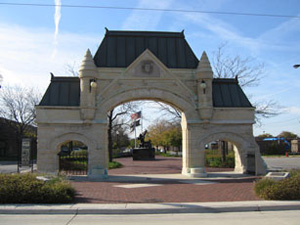
After we moved from Pilsen, our family moved to Back of the Yards where my tío Simón and tía Maricela lived. They lived at 4546 S. Marshfield and we moved to 4545 S. Hermitage. Back of the Yards was named thusly because it was literally located behind the International Union Stockyards if you headed southwest from downtown.
They were made famous, or infamous depending on your point of view, in Upton Sinclair’s novel The Jungle. In grade school, the Lithuanian nuns always mentioned the novel proudly because the protagonist was Lithuanian. They always talked about the man who drowned in the unpaved street and when I finally read the novel I convinced myself that I had deduced exactly where he drowned. The Stockyards where ever-present in our consciousness because many of our parents worked there in one of the meat-packing plants, we had to drive past them to go downtown or to the lakefront, or mainly, because of the pungent odors produced by a fertilizer company ironically named Darling and Co. The stench produced in the fertilizer-making process was inevitable if the wind blew in the direction of our neighborhood–even if we were indoors. My friend Patrick McDonnell used to take me there to play because it was the ideal playground for boys with over-active imaginations. But we had to look out for security guards, Patrick told me, and run if we saw them in order to avoid getting shot by their pepper guns. Luckily, we never saw any. One day Patrick told me where there was a swimming hole and we went swimming there. It was dirty, smelly water, but Patrick talked me into jumping in. The next day when I told one of our neighbors where I had gone swimming, he laughed uproariously. He finally told me we swam in the pool that they used to wash the pigs before they were slaughtered! Well, we never swam there again.
Our neighborhood was typical of any Chicago neighborhood in that there was a surplus of neighborhood bars. There was at least one bar on every corner. But there were some corners that actually had two or three bars. And usually there was at least one or two bars in the middle of the block. The whole theory behind having so many bars was that if the man of house went out to tipple a few beers, everyone would know where to find him. Every payday, I had to make the rounds of the bars within a two-block radius to find my father before he spent too much of his salary before he got home. Later, I got the brilliant idea of taking my shoeshine box with me when I looked for my father in the bars. I would first go to the bars where I absolutely knew my father would not be and ask for him. Some of bar patrons whom I thought were surely upright citizens would see my shoeshine box and then ask me for a shoeshine. I made some pretty good spending money this way. One day, my father didn’t recognize me because I didn’t get to him in time and he paid me for a shoeshine. And he gave me a generous tip, which I dutifully gave to my mother when we returned home.
The neighborhood served as a port of entry for many ethnic groups. When we moved there in the 1960s, the Mexicans were just starting to move in, but there were plenty of us to go around. I had friends who were Lithuanian, Polish, German, Irish, Italian, and of course, Mexican. I remember going to many a friend’s house and not hearing any of their parents speaking very much English. In my neighborhood, there were three parishes within four blocks of my house. I attended Holy Cross Church because they also had a grade school. There was also Sacred Heart of Joseph that was the Polish parish also with its own school. Immaculate Heart of Mary was the Mexican parish, but they didn’t have their own school, which is why we attended Holy Cross. The main reason I attended Holy Cross School was because it was the closest Catholic school in the neighborhood. In fact, we lived right across the street from the school.
I remember my first day at Kindergarten. My tía Maricela and her daughters Lourdes and Jane came for my mother and me and we all walked to school together. After school, I went out to the schoolyard with my cousin Jane who was in my class. We saw her mother, but my mother wasn’t there for me and I started crying. How would I get home, I wondered, even though I only lived across the street. My tía Maricela told me not to cry. My mother showed up a few minutes later. She said that she had forgotten all about picking me up and I started crying again. The next morning, my mother woke me up to go to school. I was surprised. I said, “I have to go again?” I didn’t realize that Kindergarten would get so involved. But I agreed to go only if my mother remembered to pick me up this time.
Back then, no one sent their children to a Chicago public school if they could afford to send them to a private school. Holy Cross had Lithuanian nuns and they were very strict, but it was an education that lasted me a lifetime. I remember we had to go to mass everyday before we went to school. Back then the masses were still in Latin, but I liked the old masses better. Of course, I rarely go to mass now, but I haven’t forgotten what it is to be Catholic. I still feel guilty if I even think of committing a sin. Anyway, some of the Holy Cross students, namely the Mexicans, began attending mass at Immaculate Heart of Mary because the priest said the mass in Spanish. Well, this didn’t go over well with our Lithuanian nuns. They insisted that we attend mass at Holy Cross and started taking attendance at mass by keeping track of the envelopes that we gave during the offering at mass. We had to sit with our class at the 9:00 a.m. mass. Attendance was mandatory! Unless we could bring documentation that we were hospitalized or that something more serious had occurred to us. Because of this new rule, I often went to mass twice on Sundays. My mother would send me off to mass at Holy Cross and when I returned home, we would all pile into the car, go to Immaculate Heart for the Spanish mass, and then do our Sunday visits.
Our neighborhood was very territorial. Everyone knew where everyone belonged. Territorial transgressions where sometimes retaliated with physical violence. I remember once during our school lunch, my brother and I went to the candy store that was more or less between Holy Cross School and Sacred Heart School. My brother left the store before me. When I went out, I noticed my brother was crying. It so happened that two students from Sacred Heart had beat him up. As the older brother, it was my moral obligation to defend my little brother. So I chased the two kids and I started punching them and telling them never to hit my brother again. Just then, a nun from Sacred Heart grabs me by the collar because I’m a stranger in a strange land. They take my brother and me to their principal’s office. One phone call to my school and my brother and I are in really big trouble so I try to be polite to the nuns. Luckily, I didn’t accidentally punch the nun who grabbed me. All we got was a lecture! But not a very good one. The principal, also a nun, said my brother and I reminded her of Cain and Abel. I couldn’t help it, but I absolutely had to correct her. I told her, “Cain killed his brother. I was defending my brother!” The principal told me not to talk back and she released us.





 Chicago USA