Ese


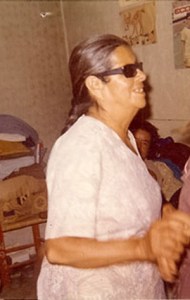
Mi abuelita

I’ve had a few of my Spanish students ask me were the Spanish term, ese comes from.

Well, now it can be told! I really believe my abuelita, my grandmother, started it. When we had our holiday parties, say for Thanksgiving Dinner or Christmas at my uncle’s house, more than one-hundred family members and friends would show up. We didn’t always know everyone’s name. This was before the invention of nametags. I remember asking people there, “And how are we related?” “I’m your cousin Agustín. You met me in Mexico when we were four.” “Oh, yeah, now I remember you,” I would lie. At every party, I would always meet a new family member whose name I would forget by the next party.

I have never been good at remembering names, but my abuelita had an even worse memory for names. I do believe I inherited this deficiency from my abuelita. At dinner, everyone would have to eat in shifts in the kitchen. She would make sure that everyone at the party ate in a smooth, systematic manner.

With my abuelita coordinating everyone and controlling the distribution of food, no one went hungry. Of course, that would involve everyone in close proximity of my abuelita to participate and obey her direct commands to the letter. The punishment for disobeying was a rap to the hand with a wooden spoon! Everyone entering the kitchen was on their toes.

So if you were standing by the stove and she didn’t remember your name, she would point at you and say, “Ese, dame el arroz.” [That one, give me the rice.] Since my abuelita couldn’t remember very many names, just about everyone in the house became ese. So now whenever I hear a Mexican say, “Oye, ese,” I think of my abuelita!
DDR

Men don’t cry!


Evanston, Illinois

Even as a young boy, I was always taught that men don’t cry. I never really saw the men in our family cry, except at funerals. I only saw my father cry when his mother died, his father died, his younger brother died in Viet Nam, and when my mother died. No one criticized the men for crying then. And the men never cried tears of joy.   

But when I was little, I was always reminded not to cry whenever I fell, I didn’t get my way, or someone hit me–even when my mother hit me with the belt. Either my mother or my abuelita would constantly say, “Los hombres no lloran” [Men don’t cry!]

Sometimes when I cried, my mother would hit me and say, “¡Para que tengas algo para llorar!” [So you have something to cry about!] Once when I was about nine, I got beat up by one of the boys on the block and I came home crying. When my mother saw me, she asked me why I was crying. I told her what had happened, and she started hitting me. She made go back out to beat up the boy who had beat me up. Well, I went back to the boy’s house, and I beat him up–and I beat him up good! He felt all the pent-up anger that I had built up inside of me from the previous two beatings–the boy’s and my mother’s. But I finally understood that men don’t cry.   

So, I learned to control my emotions. I didn’t cry when my paternal grandmother died; I was too young to understand. I didn’t cry when my paternal grandfather died; he died when he was 68 and he had fathered 18 children, so it wasn’t exactly a tragic death.

However, I did cry when my uncle Joseph Rodríguez died in Viet Nam; I cried because he was only 22. And I thought that I, too, would die in Viet Nam.

When my mother died, we had a lot of unresolved issues between us. I think the main reason I didn’t cry when she died was because I constantly heard her saying, “¡Los hombres no lloran!”   

DDR

Mexican hot chocolate


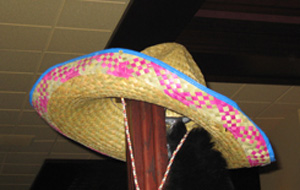
Mexican sombrero in a downtown restaurant

I have always loved Mexican hot chocolate. I mean real Mexican hot chocolate, made by real Mexicans. I generally drink it during the winter months, but I myself have never made Mexican hot chocolate in my life. In fact, I have never heard of a Mexican male making Mexican hot chocolate outside of a restaurant.

Usually, my mother or abuelita made it at home. They would bring the water in the pot to a rolling boil and then drop the brick of chocolate into the boiling water. Stir it with that wooden thing with the wooden rings–okay, I don’t know the Spanish name for it–that cosita until the chocolate brick melted. I loved the hot chocolate! Especially after all the TLC that went into it. You see, whenever my abuelita or mother made the hot chocolate, they would dip a spoon into it to taste it to see if it tasted good. They would dip the same spoon several times after removing it from their mouth. Not very hygienic, but full of TLC.

When I was married, my ex-wife would also like to make hot chocolate, too. Usually, unannounced. Using the same traditional Mexican recipe and Mexican TLC techniques. Well, our stove was next to the water heater and when my son was four years old, I would tell him the water heater was hot, hot, hot. “¡Ay! ¡Ay! ¡Ay!” And he would repeat “¡Ay! ¡Ay! ¡Ay!” and pull his hand back as if he had burned it.

Well, one day, I heard my ex tell my son, “Ask your father if he wants hot chocolate.” My son came into the living room and asked, “Dadá, you want ¡Ay! ¡Ay! ¡Ay! chocolate?” I had a tough time containing my laughter, but I could see the logic of his thought process and it made perfect sense! Now, I only drink ¡Ay! ¡Ay! ¡Ay! chocolate.

DDR