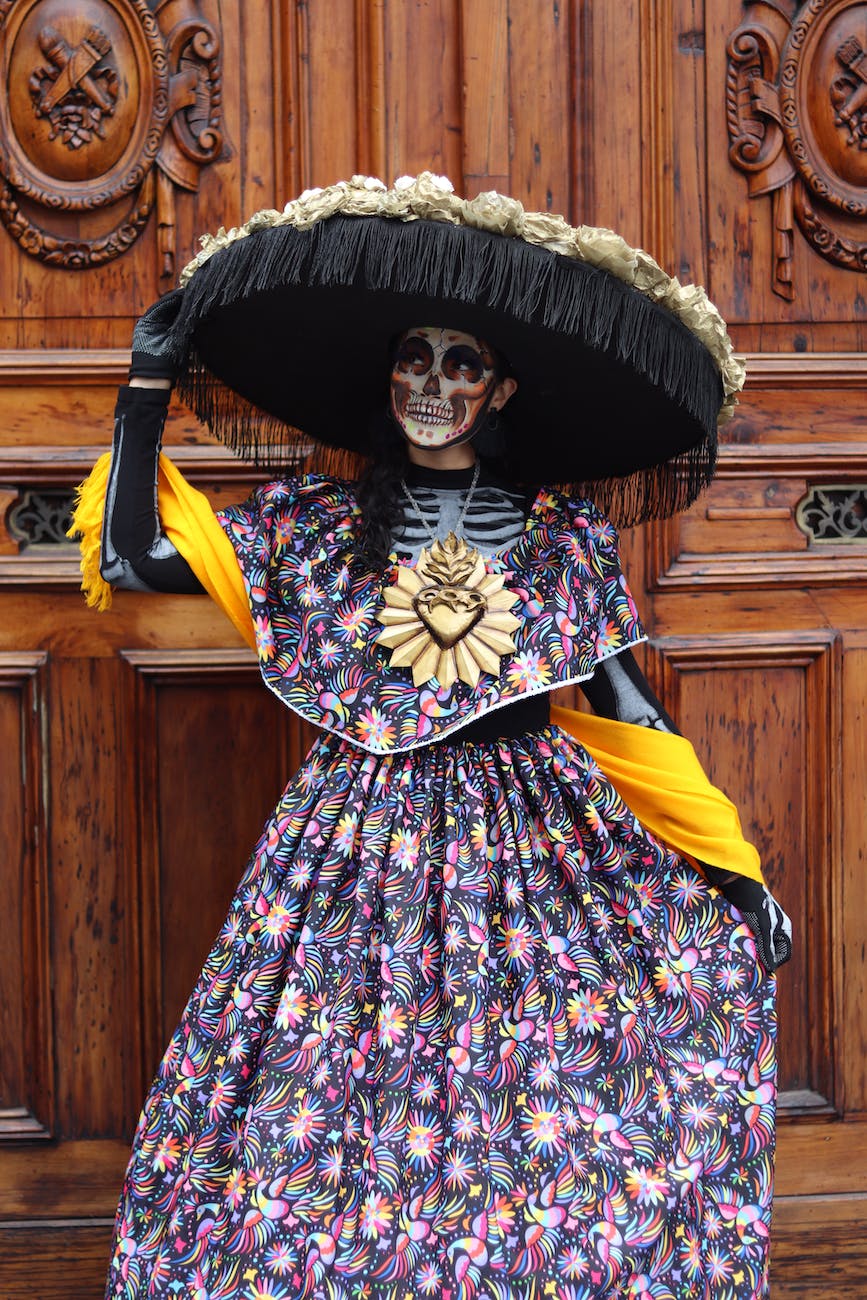
Kim was another memorable Spanish student. She had pierced lips and eyebrows, and she always wore these heavy metal concert T-shirts. She was an exceptionally good Spanish student who always got A’s on every exam. I especially liked the fact that she always laughed at my jokes. Even though she gave the appearance to rebel against any authorative figure, she always did as she was told in class. She always excelled on the Spanish compositions. The one composition I do remember involved her telling a story about something that their family did together. Well, from her composition, I learned that her family was really into heavy metal rock, which I kind of assumed by Kim’s concert T-shirts. Kim told about how her parents really like Ozzy Osbourne and so they took the whole family to Oz Fest. The whole family enjoyed their day together. She told the story quite nicely in Spanish and I could tell that the family enjoyed each other’s company. When the Day of Dead came, Kim painted her face like a skull! She looked really cool like that. All the students in the class liked her skull. My only regret is that I didn’t have a camera to take her picture.
Bridgeport is a neighborhood unlike any other in Chicago. Actually, there are two Bridgeports: the mythical, political Bridgeport that every Chicagoan hears about since starting school and the earthy, gritty Bridgeport that contrasts sharply with the mythical, political version.
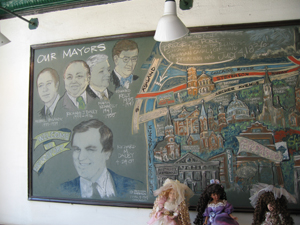
In grade school, we learned all about Bridgeport, which is the birthplace of five Chicago mayors, including the present Mayor Richard M. Daley (Richard da Second). Bridgeport didn’t invent machine politics; they merely perfected machine politics, reaching its apogee in Mayor Richard J. Daley (Richard da First). Bridgeport is also very near the geographical center of Chicago. Many south siders often went to the White Sox games at Comiskey Park in Bridgeport. When I was a student at Holy Cross School, no school field trip would be complete without first driving past Mayor Daley’s bungalow at 3536 S. Lowe Avenue. Bridgeport was the Mecca of the south side. Every Chicagoan made a pilgrimage to Bridgeport at some point in their life.
When I told my mother that I was planning to buy a house in Bridgeport, she cringed and told me that I would regret it. For some unknown reason, I was drawn to Bridgeport. Besides, this was the location of the only house I could afford using the GI Bill. But before I bought this house, I checked out the neighborhood first. I drove past the house several times, at different hours of the day and night. Every time I drove past my future home, the block was extremely quiet. I never saw any movement in this vicinity at any time. I was sure that I was moving into a good neighborhood. After all, this was Bridgeport. So, I bought the house, much to my mother’s disappointment, and I moved in.
This was when I saw the earthy, gritty side of Bridgeport for the very first time. You don’t really know a neighborhood until you move in, and you live there 24/7/365. It was only then that I saw the seedy side of Bridgeport. My house was situated next to an alley that ran alongside the length of my house, an alley that everyone in the neighborhood used as a shortcut. I always heard whoever walked through the alley talking, at all hours of the day. Then one day, I noticed that Bridgeport had a gang problem, and my house was right on the border between two gang turfs. My neighbor always tried to start a fight with me by pointing to my camouflage shirt, a remnant from my Marine Corps enlistment, and tell me, “Hey, man! The war’s over!” I would ignore him and walk past him quickly. It was about that time that I learned that there were two sides to Bridgeport. And I lived on the wrong side of Bridgeport! I lived on the side where the public housing projects were located, the only white projects in the whole city of Chicago!
While I lived in the Marquette Park neighborhood, I had developed certain habits and I thought I could continue them when I saw all the stores, shops, and restaurants that were available in Bridgeport. I really thought that I would enjoy all these places that were within walking distance of my house. I went to Lina’s Italian restaurant that was less than one block from my house because they served authentic Italian food. Or so I thought. When I entered the restaurant, I was greeted by Lina herself. I asked for the beef ravioli because I love authentic beef ravioli. Lina said, “It takes too long to make.” I said, “That’s fine. I’m not in a hurry tonight. I brought a book that I can read while I wait.” “Well, I’m not going to make ravioli just for you. Why don’t you order something else?” So, I did. But I went back a few times hoping to eat ravioli, but she always refused to make it.
I once needed a button sewn on my winter wool coat, so I went to a tailor on Halsted Street. The tailor said, “You want this button sewn on? Why don’t you buy yourself some needle and thread and sew it on yourself?” He didn’t understand that I didn’t want to sew it on myself and that I was willing to pay him to sew the button on for me. He continuously refused, so I left.
I went down the block to the barbershop that appeared to be in a continuous state of disrepair, since at least the 1960s, judging by the newspaper clippings on the wall. There were no customers in the store, so the barber was sitting in a chair. When I entered, he stood up and said, “How may I help you?” I told him that I wanted a haircut. Well, he wasn’t giving haircuts that day. So, I left.
Then, I went to the 11th Ward Office because I needed garbage cans for my house. They refused to give me garbage cans because I didn’t appear as a registered voter within their ward even though I had just moved there. I left without garbage cans. This was certainly a fine welcome to Bridgeport. I eventually adjusted to life in Bridgeport. You just had to learn not to have too high expectations.
Diego Rivera’s Typewriter, Guanajuato, Guanajuato, México
In order to write in Spanish on the computer, you need to set up a Spanish keyboard. If you don’t, you won’t be able to put accents over vowels or type the letter “ñ.”
Spanish students seem to resist typing in Spanish. They would rather go back and insert the accent marks and ñ’s by hand. But that takes extra time and it doesn’t look as good. I always insist that my students type up their papers properly. So, occasionally I have to send them an email from a computer that is not my own. Therefore, I cannot put accent marks and use the ñ.
However, as a Spanish professor, I want to be a role model for my students. In situations such as these, when I write in Spanish, I avoid Spanish words with accent marks and ñ. Most of the time, I’m successful. And, no one has ever noticed because I try to do this as inconspicously as possible.
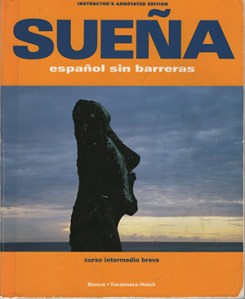
That’s the title of the Spanish textbook that I now use. I like it better than other textbooks I’ve used for the fourth semester of college Spanish. The students seem to enjoy the book better, too.
However, I often look at the cover and I’m intrigued. Why did the editors put the sculptures from Easter Island on the cover of a Spanish textbook? As far as we know, no one knows what civilization lived on the island and they probably didn’t speak Spanish.
If the editors wanted something ancient and at least slightly related to the Spanish-speaking world, they should have put a pyramid on the cover. The other thing that bothers me about the book is how they feature different Spanish-speaking countries, but not all of them. Notably missing is Spain!
How can they omit Spain? Spain is the mother country, the mother culture! But other than those two defects, the book is the best one I’ve used so far for fourth-semester college students.
Mi hermanita is a real Mexicana. My sister Delia Guadalupe changed many things about our family before and since her birth. For as long as I can remember, my mother never failed to remind me of my main failure, in my mother’s eyes, as her firstborn son. I wasn’t born a girl. Ever since she was a little girl, she always wanted to have a daughter. If only I had been a girl, my mother would always remind me, I would have been her little Debbie! My mother didn’t really want to have as many children as she did, but she kept trying to have the daughter that I never was. My sister finally gave my mother great satisfaction! Unfortunately, my mother had to endure four sons before she had a daughter. And just when she thought she was done having children, my youngest brother Joseph was born! And that’s while my parents in the process of getting a divorce!
So my sister’s birth was a great blessing to our family, but especially to my mother. I was always curious as to why my mother named my sister Delia Guadalupe, but she never told me why she didn’t name my sister Debbie. I was preparing myself to have a little sister named Debbie. From my sister’s birth on, my mother’s world revolved around my hermanita. My sister was born on September 29, so the 29th of every month, my mother would have a mini-birthday party for my hermanita. My mother really loved her only daughter and she wasn’t afraid to show who was her favorite offspring. My brothers and I didn’t mind the emotional neglect because we also loved having a baby girl in the house. And we got to have a little party every month on the 29th for my sister. Those were exciting times. Until February rolled along. You see, not being a leap year, February didn’t have a 29th day! My mother worried about what to do the entire week before, but then she had my sister’s birthday celebration on the February 28 even though it wasn’t really her birthday. Then, on March 1, my mother had another party for my hermanita because now she was officially one month older. My mother was so proud of having my sister that we went to Mexico to show her off to the family when she was three months old.
I, too, loved having a little sister. Occasionally, my mother would let me feed her, bathe her, change her diapers. Since I was six, I loved taking care of my little brothers, so I had plenty of experience by the time my sister was born. I always loved playing with my brothers, but having a sister was even more fun, although I’m not sure why. If I went to the store for my mother, she would always tag along. I would give her rides on my bike. If she had money, she would ask me to take her to the store for candy. Joe’s Store was directly across the street from our house, but my sister wasn’t allowed to cross the street. So she would ask me to take her. She only asked whenever she had money. One day, she wanted to go to the store and I took her. Only, I didn’t realize that she didn’t have any money until she asked, “What are you going to buy me?”
One summer, my mother went to Mexico with my brothers. I stayed home with my father and sister. She was about four years old then. I’m not sure why they went and we didn’t, but my mother always had these incomprehensible ways of thinking, and it was better not to ask. It was easier just to accept whatever decision she made. Well, my father would take care of us, and I would take care of my sister. I was solely responsible for my sister. I loved it. I delivered the newspapers early in the morning before she woke up. Then, when I returned home, I would “make” her breakfast of cereal with milk and toast with butter and/or jelly. Then I would give her a bath, dress her, and braid her hair. I fantasized about how someday I would have a daughter of my own.
I began to understand why my mother was so excited by having a daughter. One day, my sister told me that she didn’t want me in the bathroom while she took a shower. I was hurt by this, but I understood perfectly well what she meant. She suddenly became conscious that she was nude in front of someone else. So I left her clothes in the bathroom and left. Moments later, I heard her screaming. I ran into the bathroom, which was filled with steam, and I saw my sister cowering in the corner under showerhead avoiding the scalding-hot water pouring down near her. She was crying. I shut the water off until she calmed down. Before I left the bathroom, I turned the water on for her and adjusted to the temperature so that it would be warm, but sister kept telling me to keep making colder, colder.
When my wife was pregnant with our first child, I was hoping to have a daughter. I would have named her Veronica, not Debbie. My wife thought I was crazy (¡Estás loco!) because I didn’t want a son. I guess I always remembered how I always looked after my sister. Anyway, we ended up having three sons and no daughters. She didn’t want to keep trying until we had a daughter.
Years later, I lived with my sister for a while soon after I got divorced. I wanted to buy a new house, but I didn’t want to have two mortgages. I waited to buy a new house until I had sold my old house. So I lived with my sister while I was between houses. I always remember how I used to take care of her when she was little. While I lived with her, somehow we reversed roles. Somehow she became my caretaker, my mother. If she was out in the evening, she would call my cell phone to tell me about the dinner that she had left for me in the fridge. If I went out, she would ask me where I was going. When I came home late, she would ask me where I had been. My hermanita had become my mother! Well, it was even worse because I used to take care of her when she was little. I couldn’t wait to move out into my own house! Imagine that. Me, being bossed around by my little sister. ¡Mi hermanita!
One day, we were talking about anything and everything, as we usually did, and the topic turned to our preferred shower temperatures. I’m not sure why, but it did. She said she preferred cold showers. I asked her if she knew why. She didn’t. She couldn’t even think of any logical reason why. I told her I knew why she took cold showers. When I told her what had happened to her under the hot shower, she was amazed. She had forgotten all about that incident. But now she understood why she took cold showers.