Church


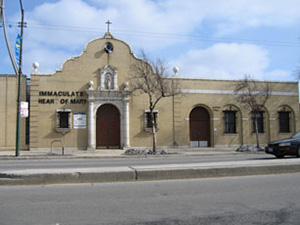
Immaculate Heart of Mary, Back of the Yards, Chicago, Illinois

I don’t often go to church, but when I don’t, I don’t feel guilty at all. When I was in grade school at Holy Cross Church, I went to church at least six times per week. We attended mass before going to our classroom on Monday through Friday. So, now, I don’t feel any real need to attend church.

If I average out my church attendance over the span of my life, I’ve gone to mass more times than many people who claim to be Catholic. Of course, I still go several times a year. This year, I’ve gone every time my son Alex went to mass before his football game. Last spring, I went to my second cousin’s confirmation. Last week, I went to my cousin Shirley’s funeral. But other than that, I haven’t gone to church. I’m not against going to church, but I never think of going on my own without any compelling reason for going.

I suppose the real question for me to answer is, “Do I believe in God?” Well, the answer is, “Once upon a time, I used to.” I was baptized a Catholic and I was confirmed by the time I was three months old. At one time when I was about twelve, I believed in God so much that I really wanted to become a priest. But then I saw the light. I realized that many Catholics were hypocrites, clergy included, and my faith in God was shaken.

When I was in the Marines, I used to go talk to the Catholic chaplain on a regular basis. I’ll be honest: I went to get out of my work detail, rather than discussing any true critical religious crisis. So I figured I had better make it good. I told the chaplain that I no longer believed in God. Which I didn’t at the time. And I still don’t. But I still feel Catholic. Since I was baptized and raised a Catholic, I plan to remain a Catholic and I will never convert to another religion. I’ve known Catholics who converted and became fanatical about their new religion.

I even baptized my sons as Catholics and sent them to a Catholic school. I’ve had friends ask me why I would do that if I’m not really Catholic. I like the sense of tradition. Two of my friends from Spain once grilled me about my Catholicism. “Are you Catholic?” “Yes.” “Do you go to church every Sunday?” “No.” “Then you’re not Catholic!” “I was baptized a Catholic!” “Are your sons Catholic?” “They were baptized Catholic.” “But you’re not Catholic! Why did you baptize them?” “If nothing else, we have something in common.” They were dumbfounded by my logic.

This morning I took my son Alex to his football mass at Most Holy Redeemer Church. I remembered most of the prayers, but there were some new ones. My mind drifted away from the mass several times. I recalled how mass used to be when I was a boy. Things were so different then. When I was an altar boy, only males were allowed near the altar during mass. Back then, there were no altar girls. Only altar boys. And about half of the Eucharist ministers today are women. And the dress code is no longer the stringent dress shirt with a tie and dress pants for males and nice dresses for females with their heads covered. I was shocked to see worshipers coming to mass wearing jeans, shorts, gym shoes, flip flops, and t-shirts. On the other hand, the church was fairly full and most people participated in the prayers and hymns. Overall, I got the feeling that they were true believers.
DDR

The Jungle


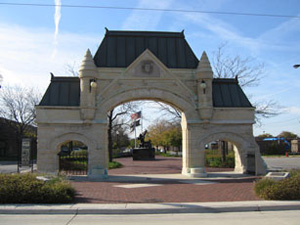
Back of the Yards, Chicago, Illinois

I just finished rereading The Jungle by Upton Sinclair. This is a book I knew about since about the third grade because the Lithuanian nuns also mentioned it at Holy Cross School. The nuns always wanted to remind us that we didn’t always have life so easy. They would often describe the squalid living conditions of our neighborhood, The Back of the Yards, and the horrendous working conditions at the Union International Stock Yards. They stressed that education was the best way to improve our lives and that we should excel in grade school, to get into a good Catholic school, to prepare us for college. I always recall the incident about the boy who drowns in the street. Several nuns over the years described that scene. And we were so lucky to live in a neighborhood with concrete sidewalks, paved streets, and a sewage system. No one from our neighborhood ever drowned in the street–that I know of.

When I worked at Derby Foods, we didn’t have a union even though Chicago has always been known as a union town. And I didn’t realize it at the time, but we didn’t need a union because all the other factories around us were unionized. Our factory paid us above-average wages and we worked under better-than-normal working conditions. They followed bidding by seniority for different job openings in the factory.

Regardless, I hated working there because I was a lowly manual laborer. The money was good, but I was unhappy about not being able to go to college. I continued working there because … because–just because. When I started at Derby Foods, about three-hundred people worked there. But over the years, the company kept modernizing by buying machinery that would replace employees. By the time I had eight years on the job, I was still near the bottom of the seniority list of about 134 employees due to the lack of hiring because of the worker displacement caused by the new machinery. Since I was at the bottom of the list, I had to work an undesirable work schedule. In food production, the plant and machinery must be cleaned and sanitized on a regular basis. Well, I had to work the third shift from 11:00 pm until 7:00 am. Regardless of what anyone says, the human body never fully adapts to a nocturnal life. The schedule was bearable until Saturday when I would get off at 7:00 am but I would have to return at noon to clean and sanitize the plant at 11:00 am. Everyone else who worked the Saturday shift worked either days or afternoons, so they didn’t complain. Besides, they enjoyed working for time and a half because it was a Saturday.

I complained about my schedule to my foreman, the shift foreman, and the manager. No one thought it was a problem. I had no union with whom to file a grievance, so I called the federal labor law organization, and they told me that my employer was not violating any federal laws by requiring me to return to work an eight-hour shift within four hours of working an eight-hour shift. Well, I was happy that I tried everything possible to improve my working conditions.

Then, it dawned on me! I’ll read The Jungle! I’ll find scenes in the novel that compare to my present working conditions! So, during my breaks and down time in factory, I read the paperback edition of The Jungle that I always carried in my back pocket. When I was done, I was so grateful to be working for Derby Foods! I never realized how good I had it compared to the Stockyard workers in the early 1900s. Because of that book, federal laws were enacted, the Pure Food and Drug act in 1906 for one, to improve the lives of millions worldwide. The unions in Chicago and nationally became stronger. I had forgotten the lessons of my dear Lithuanian Catholic nuns at Holy Cross School. But upon rereading The Jungle, I was grateful, nay, thankful, to be working for Derby Foods. I never complained about my employer ever again.

DDR

Pics


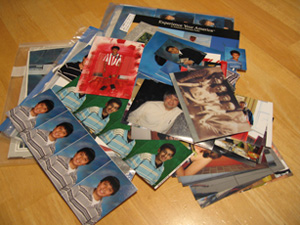
Dr. D.’s unorganized picture collection.

I have had several readers comment on the blog pics. Or to put it better, the lack of pictures in my blog. For some strange reason unbeknownst only to me, readers would like to see pictures on my blog. Well, I’ve been slowly, but surely been taking pictures and gathering them in order to post them fastly and furiously. But give me time. I now have thousands of pics, but I have to decide which are truly worthy enough to be posted. You shall soon see the results. But don’t rush me and don’t get your hopes up too high.

South side dinner


El Gallo de Oro Mexican restaurant, Chicago, Illinois.

Well, now it can be told. First, you must admit that you have a problem before you can solve it. My problem? I like to retrace my steps all the way back to my youth.

So tonight, I went to El Gallo de Oro, bought a steak burrito, and parked in Marquette Park by the Rose Garden to eat it, as I am wont to do. I used to do it all the time, but tonight I compared scenarios.

The first time I bought a burrito at El Gallo de Oro, I lived down the block at 3006 W. 64th Street and I only paid $2.25 with tax. But that was twenty-seven years ago. Today, I paid $6.06 with tax. Today, I barely finished my burrito, but twenty-seven years ago, I would also order two or three tacos or tostadas on the side. I would practically inhale all this food and I only weighed 140 pounds, compared to my 180 or so today.

And Marquette Park isn’t the same, either. No one cruises through the park like in days of old. This used to be the place to hang out, to see and be seen by everyone. I don’t think anyone even noticed I was there tonight. Not even the police car that drove past me driving the wrong way.

On the plus side? I felt very safe there in my solitude reminiscing about my days of old when I was young and naïve and didn’t realize that the grease from the burrito had dripped on my shirt until the person I was trying to impress would point out the grease stain. Okay, I don’t miss the dripping grease all that much. I’m much older and wiser now.

DDR

Béisbol


Chicago White Sox Promotion in Spanish.

I’m watching the World Series even though neither the White Sox nor the Cubs are playing. “World Series” is a misnomer because it’s not really a world competition at all. However, there are many players from many countries such Venezuela, Mexico, Cuba, Dominican Republic, and Japan among others.

When I read Ragtime by E.L. Doctorow years ago, he described a professional baseball game in the early 1900s. He noted that the ethnicity of the baseball players was representative of the immigration pattern of the period. Here’s the passage from Chapter 30 of Ragtime:

On the Giant side were Merkle, Doyle, Meyers, Snodgrass and Herzog, among others. The Boston team boasted a player named Rabbit Maranville, a shortstop who [sic] he noted roamed his position bent over with his hands at the end of his long arms grazing the grass in a manner that would more properly be called simian. There was a first baseman named Butch Schmidt, and others with the names Cocrehan, Moran, Hess, Rudolph, which led inevitably to the conclusion that professional baseball was played by immigrants.

If you look at the players of today’s Major League Baseball, you will see many Spanish last names. Of course, those, too, are representative of the migration patterns of Spanish speakers from Latin America to the U.S.

When I was in Mexico last July, I watched the All-Star Game with my cousin and her family. We laughed every time the announcer mispronounced a Spanish last name. Both announcers consistently mispronounced Evan Longoria. Well, tonight, I had to laugh when Jason Bartlett stole second base and the announcer let everyone know that Taco Bell had a promotion: Steal a Base, Steal a Taco for every stolen base. So next Tuesday, we can go to Taco Bell for a free taco. They even interviewed Taco Bell president Greg Creed who personally invited everyone to go to Taco Bell to get their free taco!

DDR