You suck!


Chicago Tribune, January 24, 2010

I saw this advertisement in the real estate section of the Chicago Tribune last Sunday. I remember when the word “suck” was a swear word! Perhaps I’m just on the verge of becoming a grumpy old man, but maybe that’s the reason I still remember when “suck” was offensive. So, imagine my surprise when I saw this ad.

When I was growing up back in the 1960s, an age before political correctness had swept the land, people would purposefully insult each other. No holds barred. If someone had a physical deformity or a mental defect, that was exactly what the insulting party focused on. Racial slurs were not only permitted, but wholeheartedly encouraged.

But getting back to the word “suck,” most people who use the word today don’t even realize why they’re using it. Once, one of my students said, “Exams suck!” and many of the other students in the class agreed. She had a quizzical look on her face after she said it. Then, she said, “What does that even mean?” No one knows what “suck” even means nowadays. No wonder I hear it on the radio and TV all the time. That’s because no one knows the history of the word “suck.”

But getting back to the 1960s, if someone wanted to insult you, they would–in so many words–say that you performed fellatio, back in an era when oral sex was frowned upon. The main offense was to insult someone’s manhood by implying he was homosexual. If someone did something stupid–and about everything qualified as being “something stupid”–the person who didn’t like what you did would say, “You blow!” Sometimes people would hurl the insult to pedestrians as they drove by. Sometimes it was incorporated into everyday conversation: “Why aren’t you inviting Alloycius to your party?” “Because Alloyicius blows!”

Somewhere along the line, “blow” received fierce competition from “suck.” Both words referred to the same sexual act of fellatio. The only point of contention seemed to hinge on the direction of air flow. But both terms were equally insulting in a homophobic manner. No one argued that! If you did, people would not only say, “You blow!”, but also, “You suck!” It was the great philosophical debate of my generation. Is it better to blow or to suck?

Well, flash forward to the present, and the people using the word “suck” are unaware of the history of the word “suck” whenever they use it. Just think about it. Can exams really suck? Who wouldn’t like oral sex to relax during a grueling exam. If exams literally sucked, students would love taking exams. And, then afterwards, the students would smile and say, “Yeah, that exam really sucked!”
DDR

The Proposal


In the movie The Proposal starring Sandra Bullock, Ryan Reynolds, and Betty White, there is a character of ambiguous Hispanic descent who appears as a waiter, a bartender, a stripper,and finally a minister. His name is Ramone, as played by Óscar Núñez. That’s right! Ramón with a silent “e” at the end despite the fact that the Spanish name does not end with an “e”! It’s just Ramón! He even spells out his name with an “e” when he’s stripping for Margaret (Sandra Bullock).

Sonia Sotomayor


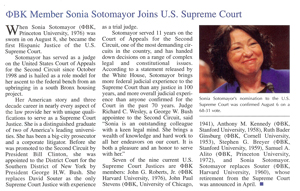
Supreme Court Justice Sonia Sotomayor graduated Phi Beta Kappa, The Key Reporter, Fall 2009

We live in a politically correct age. So, the media made a big deal when Sonia Sotomayor was nominated as a justice for the Supreme Court of the United States (SCOTUS). She grew up in the public housing and she’s Puerto Rican. The media and politicians always love to point out whenever someone achieves some sort of prominence despite not being a white male (dead or alive) from the privileged class. In that regard, Sotomayor is an overachiever, wise Latina or not. And that’s why she graduated Phi Beta Kappa.

The name Sotomayor is Spanish name composed of two Spanish words: soto and mayor. Soto means thicket, grove, or copse. And mayor means the bigger one. Adjectives generally follow nouns in Spanish. With a name like Sotomayor, you know she has Hispanic heritage.

DDR

hablar / charlar, idioma / lenguaje


Platicando con sor Elena.

“Hablar” is “to talk” or “to speak” in the general sense of emitting intelligible sounds from the aperture of the human brain housing group. “Charlar” is “to chat” or “to talk to someone.” “Platicar” is also a synonym of “charlar.”

“El idioma” refers to the language that we use to communicate. For example, “yo te expliqué la diferencia entre “charlar” y “hablar” en inglés. Pero, cuando dije ” in the general sense of emitting intelligible sounds from the aperture of the human brain housing group”, usé un lenguaje muy particular porque podría haber dicho lo mismo con otras palabras. O, sea, el lenguaje es la selección del vocabulario. No importa si fuera en inglés o español.

DDR

Hablar


Estamos charlando y divirtiéndonos.

“Hablar” is “to talk” or “to speak” in the general sense of emitting intelligible sounds from the aperture of the human brain housing group. “Charlar” is “to chat” or “to talk to someone.” “Platicar” is also a synonym of “charlar.”

“El idioma” refers to the language which we use to communicate. For example, “yo te expliqué la diferencia entre “charlar” y “hablar” en inglés. Pero, cuando dije “in the general sense of emitting intelligible sounds from the aperture of the human brain housing group”, un lenguaje particular porque podría haber dicho lo mismo con otras palabras. O, sea, el lenguaje es la selección del vocabulario. No importa si fuera en inglés o español.

DDR