Mexican Catholics


Mount Carmel Church, Chicago, Illinois

The Mexican stereotype is that all Mexicans are Catholics. And most of them are. However, when I met my ex-wife’s family, I was surprised, even shocked, that most of her father’s family were Mexican Protestants. And her family was Protestant in Mexico, too! Talk about culture shock. Even though I’m a Mexican Catholic, I, too, stereotype all Mexicans in Mexico as Catholics.

As a young boy I was a parishioner at a Lithuanian Catholic church, Holy Cross, where I also attended their grammar school. The church population consisted of mostly Lithuanians, but there were also a lot of Mexican families in the parish and school. We always went to mass on school days before we went to class and on Sundays we sat with our classmates and teacher for mass. All the Mexicans in the neighborhood went to mass, if not every day, at least on Sundays. My father’s family was extremely religious, so I had this image of all Mexicans being devout Catholics.

When I went to Mexico, I realized that my mother’s family wasn’t as religious as I had imagined. All my aunts, uncles, cousins, and other family members always said that they were Catholic. What a disgrace it would be not to be Catholic!

Anyway, once I went to Mexico to visit for a month. By the third week, I realized that we had not even gone to church even once. I wasn’t really a practicing Catholic then, but I was worried about what my family would think of me if I didn’t go to church or even suggest going to church. So, I asked them if they ever went to church. Immediately, my aunt told everyone to dress up nicely. We were going to church! Well, we went to church and there was no one there. There were no masses scheduled for that day, on a Sunday no less. We sat in the pews for a while attempting to pray, or at least pretending to pray, and then we went home.

So now that’s how I remember Mexican Catholics. People who want everyone to think that they’re Catholic. And, I guess, I’m no exception, either. Whenever someone asks me my religion, I say, “I’m Catholic!”
DDR

Doctor Tato


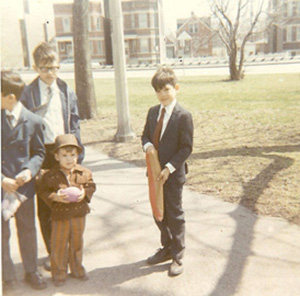
Danny, David, Dicky, and Tato.

When we were little, my father took us to the Shedd Aquarium not only because it was an educational trip, but also because it was economical. In fact, there was no admission charge back then. We spent the entire day there and saw every fish, shark, eel, turtle, and every form of sea life that was on display at that aquarium. I liked the transparent fish, while my brothers liked the fish that glowed in the dark. What my father liked the most were the tadpoles. Tadpoles! Well, in Spanish, tadpole is el sapo. Just hold that thought for a while. El sapo. I’ll get back to it.

But first I must explain about how my parents named their sons, meaning my brothers and me. When I was born my father wanted me to be named Diego after him. My parents always told me conflicting versions of this naming process. But my guess is that neither version is completely true. My mother did not want her firstborn son to be named Diego. Especially since my father’s name was also Diego. Let’s not get into the psychoanalysis of my mother just yet. We’ll save that for another day. Anyway, the best my father could negotiate in the naming rights was for me to be named David Diego Rodríguez. At least, his firstborn son had his name in there somewhere. Brother number two was born, and he was named Daniel Rodríguez. WITH NO MIDDLE NAME! I never received any conflicting stories about this naming ritual between my parents, but I attribute it to the fact that we were much poorer by the time Daniel was born and my parents couldn’t afford to give him a middle name. Then brother number three was born, and he was named Diego! No explanation is necessary! Right? My father had finally won an argument in the great Naming of the Sons debate. My third brother was named Diego Gerardo Rodríguez. From that day forward, Diego was my father’s favorite son! And my father was not discreet about showing his favoritism towards my brother Diego.

Well, going back to the Shedd Aquarium, when my father saw the tadpoles, he turned his head and said, “El sapo.” But he was now looking at my brother Diego. “Diego is my sapo!” From that day on, my father called him, “mi sapo, mi sapito,” etcetera. Everyone started calling him Sapo, even his friends. The only one who didn’t call him Sapo was my youngest brother Dicky. (How did he get that name? That’s a long story for another day!) He couldn’t say Sapo, no matter how hard he tried. His four-year-old mouth twisted and contorted whenever he attempted to pronounce Sapo. But all he could utter was Tato. We thought it was so funny that we started calling my brother Diego, Tato. After a while even my father called him Tato. Everyone loved this new nickname except Tato, but the nickname stuck. We didn’t know of anyone else in the neighborhood or Mexico who was also called Tato.

Tato was unique! Until one day, my brothers and I heard the song “Coconut” by Harry Nilsson on the radio. The song where “she put the lime in the coconut, she drank ’em both up.” Well, toward the end of the song, the words to chorus, “Doctor, ain’t there nothin’ I can take, I said / Doctor, to relieve this bellyache,” are slurred slightly by the singer so that Doctor sounds like Tato. You can clearly hear the singer sing, “I said, Tato” several times! My brother was world-famous in our neighborhood!!! We would often tell my brother as if we were singing the song, “I said, Tato, is there nothing I can take?” This was certainly much closer to his name than the Fred Astaire song, “Let’s Call the Whole Thing Off” in which he sings, “You say tomato, I say tomahto / You eat potato, I eat potahto.” Tato was in the Astaire song only if you forced it out, but in “Put the Lime in the Coconut,” Tato is there, loud and clear. It was a proud moment for our family, but especially for my brother Tato.

DDR

Chispirita


Yet another chihuahua with a Napoleon Complex.

My uncle named one of his chihuahuas Chispirita. But none of the family children could pronounce Chispirita. All the children called him Cheese Pizza instead.

Translated to English, Chispirita is the English equivalent for a common name for a dog: Sparky. I have known of several dogs named Sparky in English, but this was the first Sparky I knew of a Sparky named in Spanish. Chispa means spark. Adding the diminutive “-ita” or “-irita” to “chisp-” makes the name Sparky or Chispirita, a term of endearment.

All the children in the family loved Chispirita, even though he was a moody chihuahua. When my twin sons were three years old, my uncle warned me that Chispirita would bite them. Although I had warned my sons, they still petted Cheese Pizza, and of course, Cheese Pizza bit them. But my sons laughed as Cheese Pizza bit them and they told me to let Cheese Pizza bite my hand. When my uncle saw that Cheese Pizza was about to bite me, he came running over and said, “Watch it! Chispirita bites!” But, alas, Chispirita started chomping down on my fingers with his tiny mouth and I started laughing because my sons were right. Chispirita’s bite didn’t even hurt. Cheese Pizza’s bark was certainly worse than his bite. My uncle picked up Chispirita to put him in the house and told me, “I hope you learned your lesson!” I couldn’t believe the pain I experienced from laughing so hard with my sons!

DDR

Flor de Mayo


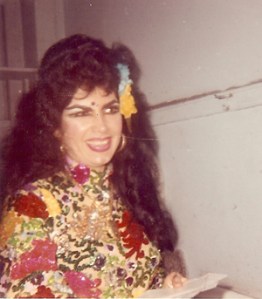
Irma Serrano, The Peoples Theater, Back of the Yards, Chicago, Illinois.

My mother always helped Mexicans who were new to Chicago. Whenever people threw away furniture, I would have to help her bring it from the alley to our basement until she could give it to someone who desperately needed furniture more than us. Many Mexicans came and went from my house because not only would my mother give them furniture, but she would also advise them on how to survive in Chicago.

My mother went to Mexico about once a year. She loved Mexico so much because the Mexicans in Mexico loved her and envied her because of her success in America. One year when she returned from her Mexican vacation, I overheard her calling the Spanish TV station and I asked her why. She had met a single Mexican mother with a one-year-old daughter. I don’t remember the woman’s name, but she also played guitar and sang songs she wrote herself. My mother had convinced this woman to come to Chicago because my mother knew people at the radio and TV stations. Important people!

So anyway, my mother told this woman she would have a promising musical career if she left Mexico and came to Chicago. Somehow, my mother convinced this woman to come to Chicago and she was scrambling to get her an appearance on the radio or TV. My mother was so sure that this woman was an extremely talented musician! I don’t know how she did it, but after a few days, my mother got her on the radio and on a TV show. I remember she rehearsed at our house a few times before her appearance. I was only about ten years old at the time, but I thought she performed very well, and she was so beautiful!

Sometime after her public appearances, she returned to our house to show us her new 45-rpm record. I don’t remember how well it sold, but she had a record! Her manager gave her the stage name of Flor de Mayo. We were all excited that Flor had made it, but none more excited than my mother who had exaggerated her connections to get Flor de Mayo to come to Chicago all the way from Mexico.

At my mother’s wake, many people, most of them Mexicans, came to pay their last respects to my mother. We had a three-day wake, which families no longer have. I saw a lot of people whom I hadn’t seen for years. The biggest surprise arrival was a woman who approached me, shook my hand, hugged me, and said in Spanish, “If it wasn’t for your mother, I wouldn’t be here in Chicago!” She was rather plump by then but still beautiful. I recognized her voice, but I couldn’t place her, so I asked her who she was. She said, “Flor de Mayo.”

DDR

Mexican hot chocolate


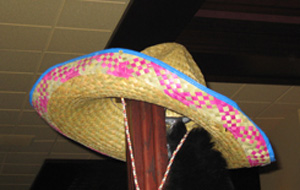
Mexican sombrero in a downtown restaurant

I have always loved Mexican hot chocolate. I mean real Mexican hot chocolate, made by real Mexicans. I generally drink it during the winter months, but I myself have never made Mexican hot chocolate in my life. In fact, I have never heard of a Mexican male making Mexican hot chocolate outside of a restaurant.

Usually, my mother or abuelita made it at home. They would bring the water in the pot to a rolling boil and then drop the brick of chocolate into the boiling water. Stir it with that wooden thing with the wooden rings–okay, I don’t know the Spanish name for it–that cosita until the chocolate brick melted. I loved the hot chocolate! Especially after all the TLC that went into it. You see, whenever my abuelita or mother made the hot chocolate, they would dip a spoon into it to taste it to see if it tasted good. They would dip the same spoon several times after removing it from their mouth. Not very hygienic, but full of TLC.

When I was married, my ex-wife would also like to make hot chocolate, too. Usually, unannounced. Using the same traditional Mexican recipe and Mexican TLC techniques. Well, our stove was next to the water heater and when my son was four years old, I would tell him the water heater was hot, hot, hot. “¡Ay! ¡Ay! ¡Ay!” And he would repeat “¡Ay! ¡Ay! ¡Ay!” and pull his hand back as if he had burned it.

Well, one day, I heard my ex tell my son, “Ask your father if he wants hot chocolate.” My son came into the living room and asked, “Dadá, you want ¡Ay! ¡Ay! ¡Ay! chocolate?” I had a tough time containing my laughter, but I could see the logic of his thought process and it made perfect sense! Now, I only drink ¡Ay! ¡Ay! ¡Ay! chocolate.

DDR