Well, I really did it this time! I was trying to fix my website so it would be even better than before. I saw that there was an update for WordPress software, so I tried to upgrade. Unsuccessfully! I’m not sure exactly what I did, but I seem to have deleted everything that I wrote before. I just couldn’t leave well enough alone! There was nothing wrong with my blog, but still, I tried to improve it. I really remind myself of my father now. Yes, luckily, I made a backup of everything. However, I can’t retrieve anything now. I know that I’ll eventually figure it out. In the meantime, I’ll just continue writing new entries in my blog. Hasta pronto.
Have you seen the new movie Bandidas? Have you even heard of the movie Bandidas? You haven’t? But it premiered in France on January 18, 2006, and in Spain on August 4, 2006. This movie stars Salma Hayek and Penelope Cruz! What do you mean you haven’t heard of Bandidas?
Actually, I’d be surprised if you had heard of Bandidas. I almost didn’t hear of it myself. In the direct to DVD phenomenon of movie magic for profit, I read about the Bandidas DVD release couple of months back in Hoy, the Spanish newspaper I get delivered to my house for free. I looked to buy the movie at the usual places where I buy DVDs, but I couldn’t find it anywhere. And I also thought it would be in Spanish because I read about the movie in Spanish in a Spanish newspaper, but not in any of the newspapers printed in English! Well, I couldn’t find the movie in theaters or at the store, and once I did find it, I was disappointed because it was English! I found the movie when I bought a hard drive for my home network that was bundled with three free movies that I could download as part of a trial service for home movies. One of the free movies that I downloaded was Bandidas, since I wanted to see it after reading about it. I hate to say this, but I am sure glad I didn’t pay for it.
Hayek and Cruz are great actresses who wanted to make a movie together for the longest time, hence Bandidas. However, this certainly was not one of their best acting performances. Hayek was much better playing Frida Kahlo. And Cruz, well, I will never forget her incredible performance as a pregnant nun with AIDS!
Anyway, the movie is set in Mexico in the 1880s or thereabouts. Hayek plays Sara Sandoval, a spoiled, European-educated Mexican woman, and Cruz plays María Álvarez, a poor Mexican peasant. I was disappointed that the movie was in English, but relieved that Cruz spoke English with a Mexican accent, rather than her usual English with a Spanish accent that sounds as if she’s from Spain, which she is, by the way. An evil American railroad magnate decides to buy the land in the path of their new railroad line by whatever means possible, including killing landowners who refuse to sell. The attempted murder of Álvarez’s father and the murder of Sandoval’s father sets the contrived plot in motion, which reminded me of those made-for-TV movies from the 1970s. So Álvarez and Sandoval learn to rob banks and save the day by stopping the evil American. Were you expecting a better ending? So was I.
I loved the panoramic Mexican scenery as Sandoval and Álvarez traveled across Mexico. Those Mexican mountains are quite beautiful! However, they were no match for the mountainous cleavage of Hayek and Cruz. What mountain climber could resist scaling those peaks? Talk about gratuitous cleavage scenes! Of course, it’s a well-known fact that the quality of a movie is directly proportional to the amount of cleavage shown. But deep down inside, I know that their cleavage was necessary for plot development. Otherwise, they would have never gotten the help they needed by enticing their male partner Quentin Cooke to join their bank-robbing spree.
The movie does portray Mexicans in a realistic light, including the social and class distinctions. There are good politicians who care for the general welfare of their people and bad politicians who are greedy and assist the evil American railroad magnate. But as far as Mexican realism, I preferred Nacho Libre because it pulled no punches describing Mexican poverty. I’m not sure I can recommend Bandidas. If you happen to run across it–but don’t go out of your way to find it–go ahead and watch it. But don’t say I didn’t warn you!
My mother and I had a love / hate relationship, but what I remember the best about her was her sense of humor. She always knew how to make me laugh when I was little. She always told me jokes, by way of acting them out, and I would always laugh; when she repeated a joke, I would still laugh because she would always tell it slightly differently and the joke would be funny to me all over again.
Whenever I heard new jokes, I would tell them to her. She would always laugh even after I told them several times. And she wasn’t faking the laughter, either. Jokes, especially her own, always made her laugh. Everyone in my mother’s family enjoyed laughing–a lot! Whenever we went to Mexico, we always sat around after a meal telling jokes. Everyone always had a joke to tell. And someone would always request to hear their favorite joke. Some jokes made everyone laugh repeatedly. My mother usually told a lot of jokes and would be asked to repeat some of her jokes. I don’t remember all her jokes because it’s been a long time since I thought of them, but I will do my best to recall some of them. Here are a few of her jokes:
A woman is on an airplane with her baby. The man sitting next to her is continuously making fun of the baby and repeatedly telling the woman how ugly her baby is. The woman finally breaks down in tears. The flight attendant notices the commotion and approaches the woman. “What’s wrong?” asks the flight attendant. The woman says, “This man keeps bothering us.” The flight attendant finds another seat for the woman and her baby. The woman is satisfied with the new seat and thanks the flight attendant who tells the woman, “Everything will be okay now. Just let me get a banana for your monkey.”
A motorcyclist wore his jacket backwards to prevent the wind from hitting his chest. He crashes into a tree and a passerby tries to help him. When the ambulance arrives, the paramedics ask, “How’s he doing?” The Good Samaritan answers, “He was doing fine until I turned his head to face the right way.”
I can’t remember exactly how this joke went and I probably won’t tell it well, either, but it’s about a man who lives in the rural area of the state of Veracruz in Mexico. He must go to the big city of Veracruz, Veracruz, for the first time in his life and take the train to visit his dying grandmother. He has never seen a train before, so he asks what it looks like. They tell him that it’s big and black and puffs smoke. When he arrives in the city of Veracruz, he sees a well-dressed black man wearing a suit and smoking a big cigar. So, he jumps on the black man’s back thinking that he’s the train.
Of course, just reading the jokes now, they don’t seem as funny. You must imagine mother acting them out. Part of what made them funny was how my mother tried not to laugh as she anticipated the punchline. When she finally reached the end of the joke, she would laugh the loudest. Those jokes still make me laugh when I imagine my mother telling them. ¡Ja, ja!
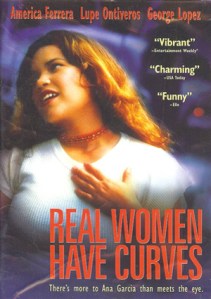
I really loved the movie Real Women Have Curves (2005, Directed by Patricia Cardoso) even though I’m not a woman and I’m not from Los Angeles. I laughed throughout the movie because I could identify with the Mexicans who were portrayed accurately in the movie. We could see the importance of family unity and how going to college could be perceived as a threat to this unity. Education is not viewed as a positive goal in a Mexican family that has relied on manual labor to survive. Carmen (Lupe Ontiveros) wants her daughter Ana (America Ferrera, as of late as Ugly Betty on TV) to work in her sister Estela’s dress shop instead of going away to college.
Ana finally gives in to her mother’s wishes, but you can see that Ana is not only unhappy there, but she really does not belong there because she has so much more potential than that of a laborer. But that’s how Mexicans think sometimes. Even though Carmen complains about how hard she has worked as seamstress throughout her life, she is willing to subject her daughter to the same punishment of manual labor.
Carmen also criticizes her daughter about her excessive weight, even though Carmen herself is overweight. However, beauty is in the eye of the beholder and Ana is beautiful in her own way. Her boyfriend Jimmy tells her that she’s beautiful and he seems genuinely sincere when he compliments Ana.
If she were in Mexico, many men would consider her beautiful simply because she has a nice smile, a nice personality, and is pleasingly plump. Once when I was in Mexico, my cousin saw a pleasingly plump woman and he flirted with her by saying, “Oye, esa gordita viene con atole?” Well, if you don’t know Spanish, I better explain that in this context gordita means both pleasingly plump with positive connotations and also refers to a food that is made of corn flour stuffed with chicken or beef; atole is a tasty, hot drink made from corn. I guess this sentence doesn’t translate well, so I’ll give you a similar example in English. Suppose an attractive woman, say dressed seductively in a short skirt, struts her stuff past you, jiggling all her assets, my cousin could say something like, “Does that shake come with fries?”
This difference in beauty standards reminds me of a story that Rosie O’Donnell once told on a talk show–I believe it was Johnny Carson’s–before she was really famous. She talked about how she went to Mexico with a thin, beautiful Hollywood actress, which at the time I wondered why she would go to Mexico with another actress. Well, now that she’s famous and I know a little more about her personal life, I know why she went to Mexico with a thin, beautiful Hollywood actress. Anyway, Rosie and her thin “friend” were at a bar where all the men were hovering around Rosie instead of her friend. Finally, Rosie asked one of the Mexican men why they found Rosie more attractive than the beautiful actress. One of the men said, and you must imagine Rosie saying this with a Mexican accent, “The bones are for the dogs. The meat is for the men!”
Well, this movie really got me to think about my mother again, whose name also happens to be Carmen. My mother never valued education and there was absolutely no possibility of college in my future. She always told me that I would work in a factory when I was old enough to work. But she would always complain about how factory work was wearing her down. She always came home sore and tired from working.
One day, she showed me her swollen hands and said, “Someday you’ll see what it’s like to work hard. One of these days you’ll be working in a factory just like me.” I didn’t plan to ever work in a factory, so I told her, “That’s why I’m going to college!” She said, “Why are you going to college if you’re only going to work in a factory?” She couldn’t imagine any other occupation for me.
She eventually found me a factory job–a job that would have been ideal for my mother, but not for me because I had such higher aspirations. However, since I lived under her roof, I had to live by her rules, so I began working the midnight shift in a peanut butter factory two days before my eighteenth birthday, while I was still a high school junior. I really hated this job! When I got out of work at 7:00 a.m., I immediately had to get ready to go to school even though I was ready to go to bed.
I was always tired in school and often fell asleep during my afternoon classes. I told my mother that I couldn’t work full-time and go to school full-time. She told me that if I didn’t work, I couldn’t live with her; I would have to move in with my father, which she had always described as being my worst possible destiny. So, I continued working at the factory, but when I couldn’t take the stress of working and going to school anymore, I dropped out of high school. My mother didn’t complain because I was still working, and I was contributing to the family financially.
In the movie, Ana gets accepted to Columbia University with a scholarship, but her parents are against Ana leaving the family in order to study in New York City. Her father finally gives his blessing to Ana, but Carmen doesn’t even say goodbye to Ana when she leaves for school. Carmen merely watches from her bedroom window. But you can see that not all Mexicans value education as much as most Americans who know the importance of going to college to get ahead in life.
When you consider this anti-education attitude of Mexicans in general, you can see why they have a high school drop-out rate of about 50%. At least the movie ends on a positive note with Ana going off to Columbia University and we get to see her walking the streets of NYC near Times Square.
What’s a Mexican meal without beans? I remember having beans with almost every meal, including breakfast. A meal that usually consisted of beans, rice, and tortillas, provided all the necessary proteins for a healthy diet. And so, meat wasn’t always necessary. Most Mexicans eat healthy diets until they come to America and start eating fast food. Mexicans must never forget to eat their beans, rice, and tortillas. When I say beans, I really mean frijoles. They were always frijoles to me. Even when I speak English, occasionally slip and I accidentally say frijoles instead of beans.
In Chicago’s Millenium Park, we have a sculpture by Anish Kapoor called Cloud Gate. But somehow, someway everyone started calling it the Bean. Everyone except me. To me, it’s ¡El Frijol! It’s a giant frijol to me. All the sculpture needs are the accompanying rice and tortillas. But I’m not the only one who associates Cloud Gate with something Mexican. In fact, in one of our downtown bus shelters, I saw a poster of El Frijol over the bottom half of the Aztec calendar forming a symmetrical circle. The two figures complemented each other.
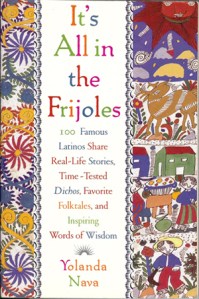
Anyway, I read this book called, It’s All in the Frijoles: 100 Famous Latinos Share Real-Life Stories, Time-Tested Dichos, Favorite Folktales, and Inspiring Words of Wisdom by Yolanda Nava. I must admit that the book has a very impressive, all-encompassing title, and at first, I felt too intimidated to read it. So, I bought it as a birthday present for my father for his eightieth birthday. After he opened his presents at his party, a few people started leafing through the book. My sister thought the book was interesting after reading some of the dichos (sayings); at least she didn’t judge the book by its cover alone, which is very pretty.
So, I bought myself a copy of the book and piled it on my stack of “to read” books. When I finally read it, I suffered from an identity crisis. I wasn’t like anyone of those Latinos in the book. Whenever I’d read about a person of Mexican descent, I’d think, okay, I’ll have something in common with this Mexican. But no! When I compare her life stories with mine, I question whether or not I’m actually Mexican!



 Chicago USA