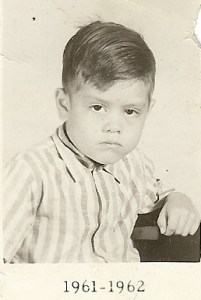
Since my parents came from Mexico, Spanish was my first language at home, and we never spoke English. When I started kindergarten at Holy Cross School, I didn’t know any English. So, when Sister Mary Joseph talked, I did what the other kids did. I sat next to Bridget, the smartest and prettiest girl in the kindergarten. I didn’t understand Sister Joseph’s instructions because she spoke English, so I watched Bridget’s every movement. When Bridget took out her crayons, I took out my crayons. When Bridget took a nap, I took a nap. Kindergarten was not that complicated. When Bridget got up and got in line, I got up and got in line. But I got in trouble. Sister Joseph walked me back to my desk. I noticed that the entire kindergarten class was laughing. I had followed Bridget to get in line to go the girls’ bathroom!
I always had a problem learning English. I didn’t quite understand everything correctly. I liked standing outside the corner bar on my block. You see, they had a sign that read, “3 IDs required. No minors allowed.” I was always waiting to see these miners wearing helmets with lights on top to come to the bar. And then they’d get really mad because they weren’t allowed in the bar and start a fight with the bouncer because he wouldn’t let them in. But I never saw any miners try to get in. I guess that sign really worked.
I will never eat at a certain Mexican restaurant again. I refuse to even mention its name or location. I met my girlfriend there for lunch one beautiful Sunday afternoon. Well, we ate, and we had a couple of Margaritas. Before I knew it, the manager asked us to leave so someone else could sit there. I was so insulted by their manager who asked us to leave.
The real killer was that he was Mexican. Sometimes your own kind will treat you the worst. When we said we would order something else, he said it was too late. We insisted that he serve us. We have a right to sit in a public place like a restaurant, especially since we were paying patrons. We didn’t get up and he called the police on us. He wanted us arrested for criminal trespassing. The police showed up and my girlfriend said that she felt intimidated by them. I can honestly say the police officers did their job professionally. However, I understood that the manager wanted us arrested. I didn’t want to be arrested so we eventually left.
As I discussed this with my girlfriend later, I became more upset. How could they do this to us? I called the restaurant and asked to speak to the owner. The first time, I was told to call after 4 p.m. The next time, I was told the manager, Larry, was in a “meeting.” When I called back after the “meeting,” I was told that the manager would call me back, but I was allowed to voice my complaint to call taker.
Of course, Larry never called me back. So, I called Larry back two weeks later. He claimed he never received my message. I explained to him that I received bad service there because the manager called the police on us. Of course, he heard that my girlfriend (at first, he thought she was my wife) was making a scene and that’s why they asked us to leave. I had to correct him. The manager working that day told us we had to leave. Then my girlfriend became upset. I really didn’t blame her. I was upset, too, but I didn’t want to be arrested for something as silly as this. Who wouldn’t be upset when you plan to eat supper at a nice restaurant and then the manager calls the police threatening to arrest you for criminal trespass?
In the movie Napoleon Dynamite, we see Mexicans in, of all places, the state of Idaho! As a bonus, you may also listen to the movie dubbed in Spanish. The first time I saw the movie, I thought, “But there are no Mexicans in Idaho!” Then I met a Mexican name Irene from Idaho. So, I guess there really are Mexicans in Idaho. In the movie, Pedro the Mexican is viewed as a foreigner by the high school principal who tells Pedro on his first day of school, “You do understand English. This isn’t really that complex.” And Pedro just stares at the principal, so the principal asks Napoleon Dynamite to show Pedro where his locker is. Pedro is the only boy at the high school with a mustache, which impresses Napoleon.
Napoleon and Pedro become friends because they’re both outsiders in this cliquish world of jocks and cheerleaders. They get along so well because they complement each other very well. Napoleon accepts Pedro for what he is, and Pedro listens to Napoleon’s stories and lies without questioning them. Pedro speaks English, but sometimes it’s not perfect. For example, Pedro plans to ask the cheerleader Summer Wheatley to the dance. When Napoleon asks how Pedro will get Summer to go to the dance with him, Pedro says, “I’ll build her a cake or something,” with a heavy Mexican accent. When Summer says no, Pedro asks Deb, Napoleon’s prospective date, to go to the dance. So that leaves Napoleon without a date. Pedro offers advice and Napoleon follows it. Napoleon is on his home turf in that high school, but Pedro exudes more self-confidence than Napoleon throughout the movie.
Pedro even has the courage to run for school president. Napoleon uses his skills to help Pedro for the school election. Later when Pedro runs for school president, Napoleon tells a kid who is being bullied, “Pedro offers you, his protection.” When one of the school bullies tries to take that kid’s bike, Pedro’s cousins, listed as Cholo #1 and Cholo #2 in the final movie credits, show up in their low rider that says, “Vote 4 Pedro” on the door, and they gesture to the bully to stop. The bully runs away without the bike. Of course, Pedro’s cousins look like the stereotypical gangbangers from East L.A. who would beat up the bully if necessary. The two cholos merely shake their head and the bully gets scared and runs away. The movie purposely plays into these Mexican stereotypes. By the way these cousins are eventually cast in the series Breaking Bad.
When Pedro makes a piñata of Summer Wheatly and the students break it, the principal calls Pedro into his office “Look, Pedro. I don’t know how you people do things down in Juarez … Smashing in the face of a piñata that resembles Summer Wheatly is a disgrace to you, and me, and the entire Gem State.” But Pedro doesn’t understand why not since they do it in Mexico all the time. Pedro and his family represent the foreign element in the otherwise homogenized American society of Idaho. Pedro really stands out at the high school as being an outsider because he hasn’t assimilated yet.
In the end, there is a school assembly for the presidential candidates Summer Wheatly and Pedro Sánchez to address the school. In Summer’s campaign speech, she promises two new pop machines in the cafeteria, new cheerleader uniforms, among other things, and then asks, “Who wants to eat chimney-changas next year? Not me! With me, it would summer all year long. Vote for Summer.” Of course, Summer, too, uses the Mexican stereotype for the purpose of fear mongering. For his speech, Pedro promises, “I think it would be good to have some holy Santos brought to the high school to guard the hallway and to bring us good luck. El Santo Niño de Atoche is a good one. … If you vote for me, all of your wildest dreams will come true.” Pedro doesn’t change his speech despite the fact that Summer Wheatly made Pedro look like an undesirable foreigner.
In the end, Pedro wins the election and becomes school president with the help of Napoleon’s skit. Well, the students accept Pedro and Napoleon for being themselves. Pedro’s family celebrates by having a picnic for Pedro. Of course, there’s a cake with red, white, and green stripes that says, “Presidente Pedro! ¡Felicidades!”
This movie illustrates how people have accepted Mexicans without realizing it. Until the immigrant marches last year, Mexicans were invisible. No one saw them as individuals doing landscaping, housekeeping, working in factories, among other jobs. And they accepted Mexicans exactly for who they were. Whether America admits it or not, a lot of people are voting for Pedro.
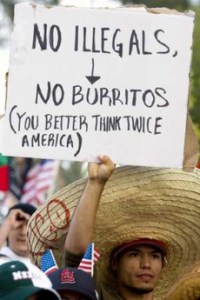
America, you better think twice. ¡No Mexicans, no burritos! Next time you’re about to bite into that burrito, will you ask yourself, “Is this burrito here legally?” Of course not! You crave that tasty burrito, and you’ll enjoy every bite of it.
Not many people really think about citizenship in their day-to-day existence, unless of course, they’re not U.S. citizens. No one really thought about how many Mexicans were in the Midwest until the immigration marches last year. Since then, everyone seems obsessed by a person’s state of citizenship, whether or not they’re here legally. It’s an immigration version of the House Un-American Committee, or the Don’t Ask, Don’t Tell policy in the military. Now whenever I read about Mexicans in the news, there’s no doubt if the subject is a citizen because the author will state their citizenship status. Or, if not a citizen, we read something like, “does want to give last name because he/she is not a citizen.”
On the July 4, I read “Squeegee economics” in the Chicago Tribune about Chicago skyscraper window washers from Mexico. For example, Salvador Mariscal of García de la Cadena, México, cleans the windows of the John Hancock Center and he’s a legal immigrant. Juan Ortiz, who worked illegally in Chicago for three years, is mentioned by name because he is now living in México again. Would you believe the Tribune reported that there are illegal immigrants washing skyscraper windows in Chicago?
Maybe we should work on the immigration reform bill a little harder. If we deport all the illegal Mexicans, we won’t have burritos and we’ll have dirty windows to boot.
I’ve had a few of my Spanish students ask me were the Spanish term, ese comes from.
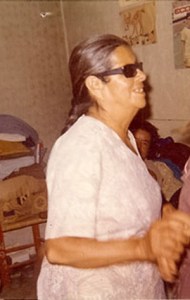
Well, now it can be told! I really believe my abuelita, my grandmother, started it. When we had our holiday parties, say for Thanksgiving Dinner or Christmas at my uncle’s house, more than one-hundred family members and friends would show up. We didn’t always know everyone’s name. This was before the invention of nametags. I remember asking people there, “And how are we related?” “I’m your cousin Agustín. You met me in Mexico when we were four.” “Oh, yeah, now I remember you,” I would lie. At every party, I would always meet a new family member whose name I would forget by the next party.
I have never been good at remembering names, but my abuelita had an even worse memory for names. I do believe I inherited this deficiency from my abuelita. At dinner, everyone would have to eat in shifts in the kitchen. She would make sure that everyone at the party ate in a smooth, systematic manner.
With my abuelita coordinating everyone and controlling the distribution of food, no one went hungry. Of course, that would involve everyone in close proximity of my abuelita to participate and obey her direct commands to the letter. The punishment for disobeying was a rap to the hand with a wooden spoon! Everyone entering the kitchen was on their toes.
So if you were standing by the stove and she didn’t remember your name, she would point at you and say, “Ese, dame el arroz.” [That one, give me the rice.] Since my abuelita couldn’t remember very many names, just about everyone in the house became ese. So now whenever I hear a Mexican say, “Oye, ese,” I think of my abuelita!





 Chicago USA