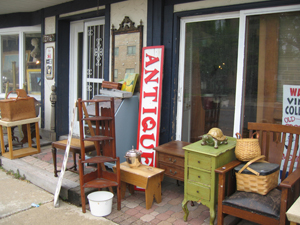
Once, while traveling in the country, Mark Twain saw a sign that read, “Junk bought, antiques sold.”
To my mother, junk wasn’t merely just junk. To this day, I realize that there’s junk, and then there’s Mexican junk–there is no Spanish word for junk, although I did see a sign that read “Yonke” in my travels through Mexico).
My mother managed to salvage just about everything she found in the alley. No chair was so splintered, no dresser was missing too many handles or drawers, no bed frame was so rusty or bent that they could not be repaired, refurbished, or rehabilitated with a little paint, elbow grease, and TLC. If my mother found something that was too heavy or bulky for her to bring home, she would come home to get me and between the two of us we would put it into the back of her red Volkswagen Squareback station wagon.
My mother always knew some Mexican or an entire Mexican family who had just come from Mexico and needed furniture. She would help them set up a home by giving them whatever furniture she had found. She genuinely loved to help people and she would never ask for any money in return. Occasionally, someone would offer money, but she would refuse it saying that they could repay her when they were settled down. People would come from Mexico and look for my mother because they knew that she would help them.
When I bought my four-flat house in Bridgeport, I attempted to help Mexicans on a smaller scale than my mother. I only helped my Mexican tenants and a few of their friends. When my brother lived in one of my apartments, he wanted to get rid of his living room set, but didn’t know what to do with it. I didn’t know anyone who needed furniture at the moment, so I told him to put it out in the alley only he didn’t want to throw it away. I explained to him that if we put it in the alley early Sunday morning, the Mexicans going to church would see it and take it home with them. Sure enough, all his furniture was gone within an hour.
When I got divorced and I needed to refurnish my new house, I got most of my furniture from my brother and sister. Sometimes I feel so Mexican!
I recently read the book ¡Ask a Mexican! by Gustavo Arellano. Even though I consider myself to be of the Mexican persuasion, I learned so much about Mexicans! I didn’t realize how little I knew about Mexicans despite the fact that I am Mexican. Well, after reading this book, I underwent another identity crisis about my being American and mi mexicanidad. I am fully fluent in Spanish and English, but I don’t feel that I speak either language like a native speaker! Perhaps that’s just me being me whenever I read about Mexicans writing about Mexicans.
Anyway, this politically incorrect book provides “questions and answers about our spiciest Americans” such as: Why aren’t there Mexicans on Star Trek? Will Mexicans eat anything without hot sauce? How come so many Mexicans send their money to Mexico? Why do Mexicans swim in the ocean with their clothes on? What part of illegal don’t Mexicans understand?
I really enjoyed reading the book because I learned a lot of new swear words in Spanish that only Mexicans use because they invented them. Mexicans are known worldwide for using the most profanities of all Spanish speakers in their everyday speech–I really should learn this new vocabulary so that I may curse fluently the next time I go to Mexico.
Actually, there’s a very good chance that I’ll probably meet a Mexican before I come back home tonight, so I should memorize these words immediately. I find it ironic that people who don’t speak Spanish listen to the busboys, landscapers, or laborers swearing at each other and then think that Spanish is a beautiful language. I’ve listened to these Mexicans “communicating” and at least every fourth word is a profanity! However, the language does sound beautiful and elegant because they are speaking a romance language.
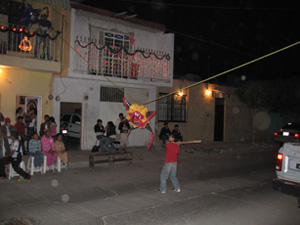
No Mexican party or picnic is complete without a piñata. Piñatas are usually store-bought nowadays, but once upon a time they were made at home by the hosting family. At some point during the party or picnic, after everyone has eaten, one of the drunk uncles remembers about the piñata and struggles to hang it from a nearby tree. The children form a circle around the piñata while watching one blindfolded child attempting to strike the piñata with a stick.
Of course, the fix is in because no one wants one of the first few children to break the piñata right away. Every kid should get a turn to hit the piñata. Before a child gets a turn, he or she must be blindfolded and spun around a few times. This child is so disoriented by then that he or she must be pointed in the direction of the piñata and starts swinging wildly at the piñata. Meanwhile, everyone sings the piñata song: “Dale, dale, dale, / No pierdas el tino / Porque si lo pierdes / Pierdes el destino.” Everyone sings the piñata song repeatedly until the child swinging the stick gets so sick of hearing it that he or she finally breaks the piñata.
I have broken a few piñatas in my lifetime. But I definitely enjoy watching children break them a lot more. When I was in Mexico as a boy, my aunt made a piñata from a clay pot that she filled with candy. I was so fascinated watching her make it. Ever since, I have believed that this is the truly authentic way to make a piñata. However, when the piñata breaks, those flying shards could seriously injure someone. Never mind the swinging stick that’s still swinging as the children are diving toward the falling candy! Perhaps the new supermercado piñatas are safer for everyone involved.
Once, before my sister went to Mexico, she asked me if I wanted her to bring me back anything. I knew I was supposed to ask for something, anything, so that she would feel useful and wanted. Finally, I said, “Yes, I’d like a piñata bat.” “What is a piñata bat?” she asked. I wasn’t actually sure if there was such a thing as a piñata bat, but surely some ingenious Mexican must have invented one since there are so many piñatas in Mexico. My younger sister has always looked up to me, so I didn’t want her to think I was as soft as the tortilla of a tostada after sitting on the buffet table at the birthday party all day because the kids found out it was made with tongue. “What!” I told my sister, “You never heard of piñata bat? What kind of Mexican are you?” She was visibly embarrassed. “Okay, I’ll bring you back a piñata bat,” she promised.
Imagine my surprise when she returned from Mexico proudly waving a piñata bat over her head. “You don’t know how much trouble I went through to get this!” she said. “I hope you appreciate it.” And then I realized she was actually swinging the bat at me. But I dodged it since I never had the ambition to be a piñata. Apparently no one in Mexico had ever heard of a piñata bat, either. However, my sister actually found one. And a beautiful bat it was! Someone had carved designs in the bat and painted it in many bright colors. The bat is so beautiful, I have never actually brought it out of storage to break a piñata! At every party, my sister keeps asking about the whereabouts of my piñata bat.
When I was a boy, my mother made a piñata so indestructible that not even a crowbar could break it! But it always looked like it was just about to break. So, everyone took several turns trying to break it. After the third turn, no one even wore the blindfold, and we were using a Louisville Slugger baseball bat. But alas, the piñata would not yield its precious cargo.
When it was Lupe’s turn to break the piñata, she insisted on wearing the blindfold and using the stick. We tried to talk her out of it, but she insisted. So, we spun her around a few extra times after she was blindfolded and we didn’t point her in the direction of the piñata. We started singing the piñata song and Lupe started swinging. And swinging and swinging. And missing and missing. Then, someone shouted, “Go to your left” and Lupe turned to her left and swung. And missed, of course, because there was no piñata there. “Go straight,” someone else shouted. And Lupe moved forward a few steps and missed again.
All the children started giving her different directions and she would follow them. Someone had the brilliant idea to have her go outside of our backyard. No matter what direction we gave her she obeyed it. Soon she was going around the block blindly swinging wherever she imagined the piñata to be. We all tried not to laugh to make this last as long as possible. We actually went around the block on this beautiful Sunday afternoon.
Lupe was followed by all the children at the birthday party and quite a few adults, too. Soon some of the neighbors also started following. At least a hundred people where now following Lupe, who was oblivious to all this excitement. We finally led her back to our yard and everyone else came into the yard. Finally, we told Lupe where to swing and she broke the piñata! She never even knew that she left the backyard. Even after we told her several days later, she didn’t believe the story!
In the late 1950s, my parents and I lived in Perth Amboy, New Jersey, where I was born. My mother told my father that she would only marry him and come to America if she could visit her family in Mexico every year. My father agreed even though he would never return to Mexico ever again.
About 1957, my mother learned that her father was dying in Mexico. She bought plane tickets to visit her father on his deathbed. My mother took me with her even though I was still a baby. My father drove us to the airport. He always had trouble driving anywhere without getting lost. When he asked for directions, he would only confuse himself even more. Well, my mother and I were supposed to fly to Mexico from Newark. My mother told me this story several times. However, I remember the story became more exciting and compelling every time she told it.
Well, my father asked for directions to the airport in Newark. At that time, neither my father or mother understood English very well and they spoke English even more poorly. So, when my father asked for directions to the airport in Newark, the man misunderstood my father and gave directions to the airport in New York, . Well, my parents and I ended up going to the wrong airport. By the time we arrived at the right airport, they told my mother that our plane had already departed. She began crying because she would not be able to see her father before he died. Someone with a private plane heard her crying and when she told them why, he arranged for us to fly on a charter flight to Texas. From there, we flew to Mexico.
When we arrived at her father’s house in Mexico, my mother saw vigil candles lighted all over the house. When her family answered the door, they started crying even more when they saw us. My mother started crying thinking that she had arrived too late to talk to her father. “Did he die already,” my mother asked. “No,” my aunt answered. “He’s still alive?” my mother asked. “Yes,” my aunt said. “Then why is everyone crying?” my mother asked. “We thought you were dead. Your plane crashed!”
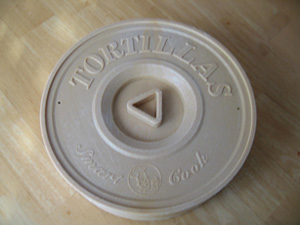
A Mexican meal without tortillas is not really a Mexican meal. You can mix and match different entrees, but you always need tortillas with every meal. Tortillas have been around since Aztec times and are the equivalent of bread in many cultures. The tortilla, tlaxcalli to the Aztecs, is flat, round, made from corn, and may serve as a plate or an eating utensil such as a fork or spoon. When the Spaniards first encountered them, they called it a tortilla because it was circular like their Spanish dish of the same name.
Tortillas have always been part of my life. My father could eat a bowl of soup using only corn tortillas! My abuelita and mother were always heating up tortillas at the stove for every meal. They even made their own. They would use a rolling-pin to flatten the masa out, or in case of an emergency, a Coke bottle. My mother once bought an aluminum contraption that flattened the masa into a tortilla, but everyone agreed that they didn’t taste the same.
When we went to Mexico, I used to like going to the Tortillería to buy tortillas. They had a giant machine that would just make hundreds of hot tortillas for the customers waiting in line. You didn’t need directions to find the Tortillería because you would find it by following your nose. I would always eat at least one or two before I took the rest home.
Tortillas were also good for an after-school snack. I’d sometimes come home and heat up some tortillas on the stove and eat them with butter. I rolled them up very tightly like a flauta. Sometimes I would eat them with just salt inside. Sometimes I would just heat them up and eat them plain. I really loved tortillas. When we kept the tortillas too long and they got hard, my mother would fry them and use them to make tostadas or chilaquiles. No tortilla was ever wasted in our home.
Occasionally, we ate flour tortillas, tortillas de harina, but they were always store-bought. We just preferred the taste of corn tortillas. Mexican restaurants use giant flour tortillas to make burritos. Other restaurants use them to make chicken wraps, where the “wrap” is actually a flour tortilla. Tortillas also evolved into the tortilla chips in Mexican restaurants, Frito’s corn chips, Tostitos, Doritos, thanks in no small part to capitalism.
I still have a comal to heat up my tortillas. Occasionally, I’ll eat them with cheddar cheese inside. Or I’ll eat them plain when I feel like reminiscing. But I definitely eat them when I make huevos con chorizo. I always keep a dozen corn tortillas in the freezer, so I’ll have them whenever I crave them. They keep very well in the freezer and thaw out quickly in the microwave before I heat them up on my comal.



 Chicago USA