New Year’s Eve


Making tamales with TLC

I have many fond memories of New Year’s Eve beginning in my childhood when our entire family would go to my Uncle Simon’s and Aunt Mari’s house. The party always involved eating a lot of  Mexican food and real hard play among cousins. At midnight, everyone, I mean children, too, toasted with a glass of champagne. That was the only time of the year I drank alcohol–until I became an altar boy and my friend once talked me into taking a sip of altar wine before mass.  But I only indulged that once because I felt so guilty and sinful afterwards.

Once, we were in Mexico for New Year’s Eve and we celebrated by making tamales and eating them. In Chicago, my mother made the masa during the day and then made buñuelos at midnight as a way of ringing in the new year. I think that New Year’s Eve wasn’t as exciting once we stopped going to my aunt’s and uncle’s house. I don’t really remember too many of those later celebrations now. When I was married, I was content to stay home with my wife and son and watch the festivities in Chicago on TV. When I lived in Bridgeport, I used to take my oldest son to the attic window at midnight where we could see the fireworks downtown. When the twins were born, we moved farther away from downtown, so we could no longer see the fireworks from the window. But we watched them on TV, although not quite as dramatic.

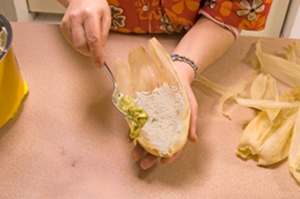
Later, after my divorce, my Mexicana girlfriend decided that we would make tamales for New Year’s Eve. She bought a giant pot for the tamales and lots and lots of masa. We would make tamales together, just the two of us. Actually, I enjoyed making the tamales. In Mexico, I only got to watch the women of the family make the tamales; males weren’t allowed to touch the masa. My girlfriend showed me how to mix the meat into the masa and stuff the masa into the corn husk. She had made tamales a few times and actually knew what she was doing. We even made some sweet tamales with raisins. We had about six different kinds of tamales. We literally did this for at least two hours and the giant pot was still only half-full. However, she insisted that we fill the pot all the way to the top. We filled the pot at about 3:00 a.m. And I was exhausted!

But wait! She put a penny at the bottom of the pot where there was boiling water to steam the tamales. The flame underneath had to be at just the right temperature and you could tell if the temperature was just right because the penny would keep making noise as the boiling water moved it. The only time I really saw tamales made was in Mexico as a boy, but my mother and aunts cooked the tamales over a bonfire.

Well, I went to bed about 6:00 a.m. because I couldn’t stay awake anymore. She stayed up to keep adding water and ensuring that the tamales cooked properly. I didn’t realize they would involve so much work. She woke me up a few hours later when they were done. She had stayed up the whole time! We then ate the tamales and they were so delicious! We ate them later that day. And the next day, too. There were so many tamales that she put some in her fridge and froze the some in her freezer. And there were still some tamales leftover! So I took some home and put them in my freezer. We ate tamales until the Fourth of July! And we never got tired of them. We loved them!

¡Happy New Year! ¡Próspero Año Nuevo!

DDR

Mexican Doritos


Nacho chips.

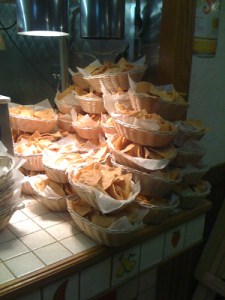
There are Doritos. You’ve eaten them before. Nacho flavored tortilla chips, which some people complain are too tangy or too hot.

And then, there are Mexican Doritos. In Spanish, they are totopos de maíz con queso y chile. They even have their own website: http://www.sabritas.com.mx/. These Mexican Doritos are more potent than American Doritos. You do not need to dip these tortilla chips into any kind of salsa. Mexicans added jalapeño peppers and other spices to the recipe, so these chips are very, very hot! Of course, a true Mexican would still add salsa and / or a whole jalapeño pepper.

As I was driving home from Mexico, I had to buy gas. So as long as I was in the gas station, I decided to buy some snacks. I naturally grabbed the familiar name brand of Doritos since they are based on the Mexican food of tortillas. But I was surprised to discover that Mexicans would sell an Americanized version of a Mexican food. So, I’m driving in Mexico enjoying the scenery, looking at the cacti, watching for drivers who speed up to my rear bumper, so I move out of there way, etcetera. I decide to eat some of these Mexican Doritos. Wow! What a surprise! They were spicy. However, since I had been eating so much hot stuff anyway, they tasted just right. But I have a feeling that I once I eat American Doritos, they will taste rather bland.

DDR

¡Feliz Navidad!


¡Feliz Navidad!

When we went to Mexico when I was little, I remember that Mexicans didn’t really celebrate Christmas. The day for giving gifts to children was January 6, el Día de los Reyes. Occasionally, small gifts were given for Christmas, but the big gifts were given on January 6.

So, I was surprised to see that many Mexicans were Christmas shopping when I was in Mexico before Christmas. I asked my cousin about all the Mexicans Christmas shopping, and she told me that more and more people were giving the big gifts on Christmas and the smaller ones on January 6.

I attribute this to American cultural imperialism and capitalism. Mexico as a country that is adapting to better function in a global economy. And of course, when Mexicans watch television, they get to see all of the American Christmas movies that stress gift-giving on Christmas Day, especially by Santa Claus.

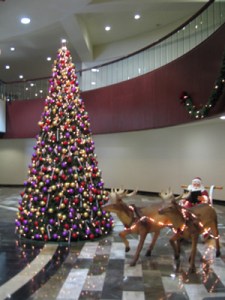
While in Mexico City, I noticed the traditional Christmas decorations featuring a Nacimiento (Nativity Scene), but I also saw other Christmas decorations like Santa Claus, Rudolph the Red-Nosed Reindeer, and Frosty the Snowman, which was ironic since it hardly ever snows in México City. The street vendors even sold reindeer antlers and noses to attach to your car. I was surprised to see that people drove around in these “reindeer” cars.

Meanwhile, my family in Celaya celebrated Christmas in the traditional way by gathering on Noche Buena (Christmas Eve), going to mass at the catedral, and then eating a big dinner. We went to mass and my cousin took a baby Jesus surrounded by candy on a tray that she placed near the altar for the priest to bless during the mass.

After mass, we walked back home with baby Jesus and then ate dinner. Then we took baby Jesus to the Nativity Scene, and everyone prayed and sang songs to him. Everyone then kissed baby Jesus and took a piece of candy from the tray. After this, I placed baby Jesus in the Nacimiento. My cousin later started a bonfire that the children enjoyed because they placed inflated balloons over the flames and watched the balloons fly away. No one received gifts on Christmas morning because in Celaya the children still receive their gifts el Día de los Reyes.

DDR

My Mexican relatives


María del Carmen Martínez Valdivia

Well, I sure learned a lot about my family on this trip to México. For one, most of the stories that my mother told me about her family weren’t true! While talking to my cousin, I realized that none of the facts matched most of the stories my mother told me when I was a boy.

For example, my mother would often tell me how when she was a girl, she wanted a life-like doll for her birthday. One that cried like a real baby, drank a bottle, and wet her diapers, etc. And on my mother’s birthday, my tía Jovita was born. That was the birthday present my mother really wanted! Well, I told my cousin this story and she said that tía Jovita’s birthday is on December 24. So, this doesn’t match up to my mother’s birthday on April 27! Later, I discovered that my mother did get her birthday present, but it is my aunt Matilde, not Jovita. I had forgotten the birthday present’s name.

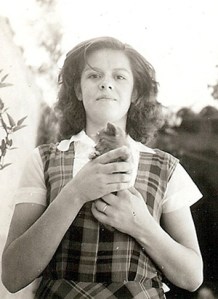
Also, everyone in México always knew my mother as Helen. When I was little that’s what my father called her. I always knew her as Helen, too, until she became a U.S. citizen, and she changed her legal name to Carmen M. Rodríguez. When my mother died, I was surprised to discover that her real name, based on her birth certificate was María del Carmen Martínez Valdivia.

When I was little, my mother always told me how she and her sisters didn’t like their given names, so they changed them to something that they really liked. Mariana Anita became Esthela, María del Carmen became Helen, María became Marusa, Rebeca became Jovita. Unfortunately, I can’t remember her sister Laura’s original name. Their brother Alfredo always remained Alfredo. Go figure!

My cousin also told me that her mother told her how my mother used to dress in boy’s clothes and insisted on being called Alejandro. Of course, I’m not sure how true this story is because it turns out my tía also liked to embellish her stories. But if it is true, what a coincidence that I also liked the name so much that I named one of my sons Alejandro!

DDR

Mexico City


Don’t leave home without it!

Mexico City is the largest city in the Western Hemisphere. The traffic is a nightmare that I somehow managed to survive. And I did it at night.

My relatives in Celaya told me not to go to Mexico City just because of the traffic. Of course, that only served to make me even more determined to go. My aunt told me if the traffic scared me to turn around and go back to Celaya. But my cousin did give me some good advice: If you can’t find the address you’re looking for, ask a taxi driver to go there and follow him.

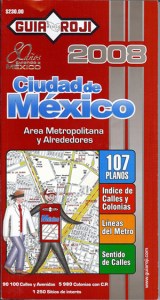
I was going to my cousin’s house in Mexico City, but I had no idea where in the city she lived. When I got to Mexico City, I’m driving in heavy rush hour traffic trying to read the map that didn’t really help me as other drivers were weaving all around me. Then, I see the sign for Paseo de Reforma, which I remember from my previous trip to México City 29 years earlier. So, I exit there and head to the Angel de la Independencia. There, I bought a map of the city and found her neighborhood and street address.

However, once I attempted to find her house, I couldn’t find her street. I circled the area several times before I finally gave up. I saw a taxi driver and asked him if he knew where la Calle Miguel Ocaranza was. He, a native Mexican, had never even heard of the street! I showed him the map and he said that he could find it. He led me there and I paid him 25 pesos plus tip. What an adventure it was driving in Mexico City! And I still have to drive through Mexico City to head home!!

DDR