Despedida mexicana


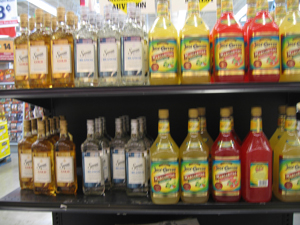
Why are these tequila bottles so blurry?

There are good-byes. And then there are Mexican good-byes. By this, I mean that most people say good-bye and then they leave. Mexicans, on the other hand, say good-bye and think of many reasons for staying un poquito más. Such as telling the story they just remembered on the way out, upon touching the doorknob. Or, because they haven’t seen each other in such a long time, since like last week. I, too, of course am guilty of these long, extended good-byes. Perhaps, I didn’t say everything that I wanted because I couldn’t get a word in edgewise or the stories told were so good that I didn’t want to interrupt them.

While I was in Mexico, every good-bye was a despedida mexicana, but one long good-bye especially comes to mind. I was staying at my cousin’s house and we were going to visit her sister, also my cousin. My cousin, her husband, my aunt, and I went to my other cousin’s house. We would leave about three o’clock in the afternoon in order to avoid the afternoon rush hour traffic. I agreed because Mexico City’s normal traffic is horrendous and traumatic, even if you’re just a passenger, let alone driving during rush hour. So we visit my cousin, we eat at a restaurant called California, we go back to the house of the cousin we just visited, look at some old family pictures, and talk and talk and talk over old times since the last time I went to Mexico, which was twenty-nine years earlier. By the way, we started up the conversation right where we left off the last time I was there as if I had just left a few days before.

At 3:00 p.m. sharp, my cousin announces that we’re leaving immediately in order to avoid the rush-hour traffic. My cousin’s husband says that we can’t leave his house without first drinking some tequila together. That would reflect poorly on their hospitality. Besides, how could I go to Mexico and not drink tequila?

As the guest of honor, he served me tequila in his very own special tequila shot glass that was wrapped in specially treated tan leather with his name embossed on the leather. How could I say no to this shot of tequila? So we all had a shot of tequila as we were standing to leave. Sure enough, we all start talking about when my cousin came to visit Chicago in 1979. As luck would have it, I was in California in the Marines at the time. So we all sit down to hear about her trip to Chicago and how she almost saw snow because the weatherman predicted a snowstorm, but then there was only a light dusting of snow.

Of course, this called for another shot of tequila! Which no one refused, including me because I always try to be polite and eat and drink everything that is served to me. (You’d be surprised at how polite I can be when food or tequila is involved!) Then it occurs to our host that if you drink tequila you should drink it properly. So he serves us another shot of tequila, but this time he passes around a bowl of lime slices and a salt shaker. That’s how Mexicans really drink tequila! You squeeze some lime juice on the side of your fist, shake some salt on the lime juice, you drink the tequila shot in one gulp, and then lick the lime juice and salt afterwards. Well, we down a few more tequila shots the proper Mexican way and then our host said he had to go to work to take care of some business, but when he returned, he would bring back some food for supper.

The tequila had long ago been consumed and we were left to our own devices to entertain ourselves. Actually, for Mexicans like my aunt, my cousins, and I, we merely entertain ourselves by talking about what we did in the past since the last time we saw each other. In fact, I spent most of my trip just sitting around talking to my relatives bringing myself up to date on their lives. Well, it’s after six p.m. and our host still hasn’t returned. His wife calls him on his cell phone and it turns out that he’s stuck in rush-hour traffic. When he finally returns, he returns empty-handed. We’re all extremely famished by this time. So we all pile into two minivans and go to their favorite restaurant in town. We eat supper and spend a couple of hours talking over our food. By the way, we’re still saying good-bye since three p.m.! We eventually return to my cousin’s house about 9:30 p.m.! However, we did manage to avoid Mexico City’s infamous rush-hour traffic! I have to admit that it was my longest good-bye ever, even by Mexican standards. But it was also one of the most entertaining.

Okay, let me just blurt this out and be off. ¡Adiós!
DDR

Chicano


The story of Chicago, Illinois

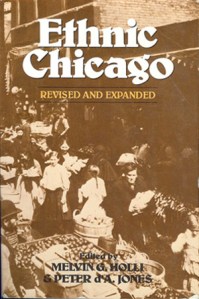
When I was growing up I never heard the word “Chicano.” No one in my family used it and I never heard it in the neighborhood even though there was a sizable Mexican population in the Back of the Yards neighborhood. I’m reminded of this because I was just reading Ethnic Chicago edited by Melvin G. Holli and Peter d’A. Jones, Grand Rapids, Michigan, William B. Eerdmans Publishing, 1984.

What reminded me of never having heard the word “Chicano” was Chapter VIII written by Louise Año Nuevo Kerr titled, “Mexican Chicago: Chicano Assimilation Aborted.” She uses “Chicano” throughout the chapter to refer to Mexicans who came from Mexico illegally, who were part of the bracero U.S.-Mexican agreement during WWII, were from Texas and therefore were American citizens, or had ancestors from Mexico.

So I’m thinking back to the very first time when I heard “Chicano” and I remember I first heard it at Divine Heart Seminary in Donaldson, Indiana, when I was a freshman. There were only three Mexican students out of 130 at DHS: Fred Casillas from Gary, Indiana, Tony Hernandez from Los Angeles, California, and me, from Chicago. There was also Hiram De Jesus, a Puerto Rican from Cleveland, Ohio.

I remember Ken Jones, an African-American who was from Detroit, telling me when we had our first family visits that he wanted me to meet his mother. He insisted that I meet her for the whole week leading up to our first family weekend visit. Well, when I finally met her, I was surprised that she was Mexican. That explained why Ken wanted me to meet her so badly. Hiram also wanted me to meet his mother, whom I did. I was surprised that she was so young. She was only twenty-nine even though Hiram was fifteen. Fred and Tony were sophomores and Hiram and I were freshmen. Tony was my big brother when I visited DHS in eighth grade. Hiram and I were in Enrico Mordini’s Spanish II class with other sophomores.

Anyway, one day, Fred calls me a Chicano, but I had no idea what he was talking about because I had never heard the word before. He then explained it to me. None of this made any sense to me at first. I attended a Lithuanian Catholic school with mostly Lithuanian and Mexican students in a neighborhood that was home to Lithuanians, Mexicans, Germans, Italians, Poles, and other ethnic groups that in general maintained their ethnic customs, but got along well with everyone else. This Chicano movement that Fred described to me was something that was entirely new to me given where I had grown up.

One day after Fred returned to DHS from a weekend visit home, he wore a brown beret with a patch that said “Chicano Power” and a picture of brown clenched fist with an iron manacle with a dangling chain that had a broken link on the end. He also wore a white T-shirt with the same exact message and image. Fred made me feel like I was some sort of traitor for not having the same feelings as him about the Chicano movement.

Well, when I went home one weekend soon after, I had my father take me to Old Town to Bizarre Bazaar where I bought the same beret, “Chicano Power” patch, and T-shirt that Fred had. My father didn’t understand why I wanted these items, but he bought them for me anyway. He asked me to explain what they meant, but he didn’t seem to understand and didn’t give them too much importance. When my mother saw me wearing the beret with the patch and the T-shirt, she thought I had joined a gang. None of my friends understood why I would wear “Chicano Power” even after I explained it to them. All their parents thought that I had joined a gang, just as my mother did. Everyone misunderstood me. Luckily, I was only home for the weekend.

When I returned to DHS, Fred was so proud of me. Tony didn’t think much of my commitment to the Chicano movement. Since Hiram was Puerto Rican, it really didn’t affect him in any way. Surprisingly, none of the priests or brothers acknowledged my new apparel, much less reproach me for it. In general, unless you violated the seminary rules or you committed a sin, everyone pretty much left you alone. The only one who was really excited about all this was Fred. I was disappointed that I went through all this trouble to buy these items and no one, other than Fred, really cared.

After a while, I stopped wearing the beret and the T-shirt. When I returned home for the summer, they stayed in my dresser drawer. I never again heard anyone in Chicago mention the word “Chicano.” Everyone I knew in Chicago was American.

DDR

Olivia Maciel


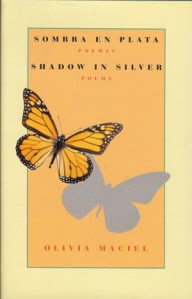
Sombra en plata por Olivia Maciel

Olivia Maciel is a poet who was born in Mexico City, but has lived in Chicago a long time. She has written several collections of poetry over the years. She writes poetry in Spanish, but her books include an English translation on the facing page. I recently read two of her collections: Sombra en plata [Shadow in Silver], Chicago, Swan Isle Press, 2005, and Luna de cal [Limestone Moon], Chicago, Black Swan Press, 2000. All her books are available for purchase on Amazon.com.

I first met Olivia in one of my graduate classes at UIC. We took several classes together while earning our master’s degrees. She graduated from the University of Chicago with a Ph.D. When Octavio Paz died, she published an article about her reactions to his death that appeared in the Chicago Tribune. We occasionally bump into each other at UIC because we are both Spanish lecturers there. I really enjoy talking to her because she’s so creative. Sometimes, she begins writing poems as we speak. She says that I inspire her when we talk. I asked her if she would hire me as her muse.

DDR

Cordi Marian


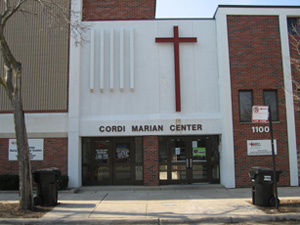
My oldest son went to daycare at Cordi Marian, 1100 S. May Street in Little Italy for three years. They accepted all children provided they were potty trained. My son was hardly qualified, but they accepted him anyway. These three years were quite a learning experience for me because of series of unbelievable coincidences, the kind you couldn’t include in a novel or a movie. First of all, I learned that my aunt Concha also sent her son Peter there for daycare. Peter and David didn’t really know they were related because they had never met before. One day, I recognized my aunt Concha as she was leaving Cordi Marian with her son. Our sons soon became good friends and since Peter was a year older he kind of looked over my son to make sure he was fine.

Another surprise was that the nuns who taught at the school knew our family. In fact, the nuns were all from Mexico. So were all the lay teachers and teacher aids. All the parents liked the fact that the children were learning Spanish. Since most of the teachers spoke very little English, most of the children were speaking Spanish. One day, Sister Teresa, the principal, asked me how my father was. She knew my father by name. We talked a while and then she told me how she knew not only my father but also his brothers and sisters and their parents, my grandparents. Since my grandfather was a carpenter, he did some carpentry with his sons at Cordi Marian. Sister Teresa showed me some of the shelves and bookcases that they had made for the school. And three generations later, my son is using these cubby-hole shelves to store his backpack and blanket.

One day my father told me to me that his sister, Sor Ancilla, had come from her convent in Texas where she is Mother Superior. I go to Pilsen to pick up my father and I ask where we have to go to pick up my aunt. He asks me if I know how to get to 1100 S. May Street. Of course, I do! That’s were I take my son to daycare, I tell him. Well, I get there and sure enough, my aunt Sor Ancilla is staying at Cordi Marian for the weekend. What a coincidence! Or rather, what a series of coincidences that no one would believe if I wrote them into a novel.

DDR

My father’s vocation


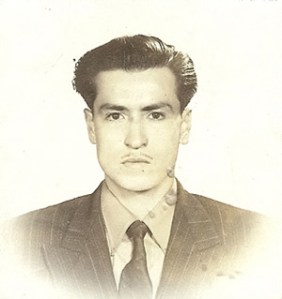
José Diego Rodríguez Rosiles

When I was in Celaya, my tío Timio told me about how all his brothers studied at the Montezuma Seminary in New Mexico. Tío Timio was the only brother not to attend the seminary. My father was at the Montezuma Seminary in New Mexico for eleven years. My father wanted to become a priest, but they advised him to go back home to Celaya for a while. They told him to get to know the world before he made a final decision. So, he returned to Celaya and while there he met my mother. Needless to say, my father never became a priest. Pues, como quien dice, en Celaya, se la halla.

DDR