El Gallo de Oro


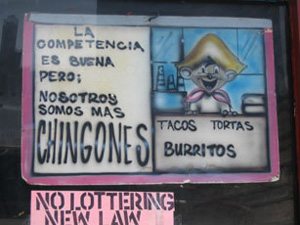
El Gallo de Oro, 2952 W. 63rd Street, Chicago, Illinois

When I lived at 3006 W. 64th Street, I always used to eat at this great Mexican restaurant that was exactly one block away. El Gallo de Oro, 2952 W. 63rd Street, 773.737.8101, has been there since at least 1981 when I moved back to Marquette Park after being honorably discharged from the Marines.

This Mexican restaurant serves real Mexican food cooked by real Mexicans to other Mexicans who patronize the restaurant. That’s how you can tell if a Mexican restaurant is really good: by how many Mexicans eat there. I remember once going to Milwaukee and my girlfriend suggested that we eat at a Mexican restaurant, either La Perla or La Fuente, but she didn’t know which one was better. We ate at the one where all the Mexicans ate! And it was great Mexican food! So, are you wondering which restaurant was better? Well, I honestly can’t remember because I drank a few too many bottles of Negra Modelo. Anyway, El Gallo de Oro has great Mexican food, and I say this after having come back from having eaten Mexican food in many Mexican restaurants and Mexican homes in Mexico. Well, lately, I’ve been going to different Mexican restaurants in the Chicagoland area, or Chicagolandia as I like to call it since we have so many Spanish speakers here, and I’ve been ordering the enchiladas de pollo. Today, I tasted the enchiladas at El Gallo de Oro, and they were ¡sabrosísimas! This is a great Mexican restaurant.

When I still lived in the neighborhood, I ate there several times a week. Of course, everything I needed in the neighborhood was within a two-block radius. The cleaners, the gas station, the locksmith, the used bookstore, my barber Aldo of Italy, and of course, El Gallo de Oro. I went to the locksmith exactly once, but it was nice to know that he was always available even though I dreaded the day that I would actually need him. Aldo of Italy cut my hair once a month before I ate at El Gallo de Oro. Aldo always loved speaking to me in Spanish while he cut my hair until I fell asleep. Anyway, again, I loved the attitude of the Mexican cooks at El Gallo de Oro. They were typical Mexicans who loved to brag about their food and service. I especially loved their sign in the window: “La competencia es buena, pero nosotros somos … ¡más chingones!” In English, “The competition is good, but we are … ” Okay, I’m not sure how to translate the last two words, but you could tell who was Mexican and who wasn’t by how they reacted to the sign. Of course, at that time the FCC let a lot of profanity get aired on all the Mexican radio stations. So the sign remained in the front window for many years until about two years ago. I rather miss that sign. That’s the thing about Mexicans. They have chutzpah!

One time, I told my father, brothers, and sister that I had a special surprise for them for our Thanksgiving dinner that year. They were so curious that I caved in to all their questions and told them my surprise beforehand. “We are eating Thanksgiving dinner at … ” and I paused for dramatic effect … “El Gallo de Oro!” “But we want turkey,” my sister shouted. “Yo quiero guajolote,” said my father. “Un momento,” I said. “El Gallo de Oro is serving turkey burritos on Thanksgiving Day!” After a little grumbling, they finally agreed to my Thanksgiving dinner plans! Everyone got to eat turkey, I got to eat at El Gallo de Oro, and my father got to eat so many jalapeño peppers that sweat poured from his forehead profusely and he had to keep asking for more and more water. Well, El Gallo de Oro managed to satisfy yet another finicky Mexican family–again!

DDR

Machos


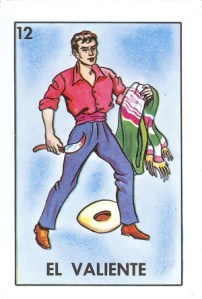
Lotería playing card.

I just saw the play Machos written and directed by Coya Paz and performed by Teatro Luna at the 16th Street Theater in Berwyn, Illinois. Teatro Luna is the only all-Latina theater group in Chicago area, and I have seen many of their previous productions that were incredibly good, but this one is by far their funniest, and, also their most serious.

Machos is based on interviews with men about how they feel about being men. The men in the play describe what it’s like to be a man and how much pressure society, family, and peers place on them in their quest to be men. This play truly analyzes all aspects of society’s expectations of men in general and the Hispanic expectations of being macho, as the play’s title implies. Since all the men are portrayed by women dressed as men, there’s a tongue in cheek attitude about the whole analysis. They honestly complain about how they don’t understand women without sounding like a David Mamet rant against bitches.

If men were to put on this play, the tone would certainly come off as more hostile toward women. However, since the play is written and directed by a woman, the men portrayed seem more human and their problems and behavior seems more plausible. The play is a comedy about many serious subjects such as love, infidelity, sex, and homosexuality, but there also many poignant scenes also, like the one about the Mexican father who drinks alone at home listening to old Mexican music on vinyl LPs. Even though he’s at home with his family, he’s also alienating himself from them and therefore drinking alone instead of eating supper with family. It’s a vicious circle of which he’s oblivious.

Okay, my favorite scene occurred after the play was over near the restrooms. A cast member stood between the doors to the Men’s and Women’s room and said, “Which one do I use?” She, I mean He, I mean, S/he went into the Women’s room. I highly recommend this play.

DDR

Mexican jokes


My business card in 1986

When I was growing up, in an age before everyone tried to be politically correct, everyone told ethnic jokes. They were always insulting and mean-spirited to whatever group was targeted. Sure, some people were offended by these jokes, which only led to them being the target of more ethnic jokes. However, these jokes also brought a lot of joy and laughter among friends. For example, I worked in a peanut butter factory, named Derby Foods, with various ethnic groups who lived in the Back of the Yards neighborhood. In general, we all got along very well. Shirley, one of my Polish coworkers, loved to hear any kind of joke because she loved to laugh. Her real name was Ursula, but she preferred to be called Shirley. Anyway, she especially loved to hear Polish jokes. She always insisted that I tell her any new Polish joke that I heard. And when I didn’t learn any new jokes, she insisted that I retell her the old ones. Whenever I told her Mexican jokes, she told me she liked the Polish ones better. In this age of political correctness, I will not tell any Polish jokes lest I offend anyone. But I suppose it would be okay if I told some of the Mexican jokes that I still remember. I’m not doing this to propagate any negative stereotypes about Mexicans, but merely as a scientific exercise to preserve our humorous past. Now, I’m not saying that these jokes are funny anymore, but once upon a time, people laughed at these jokes. Some of them are quite dated. Okay, you have been forewarned!

  1. Why can’t Mexicans be fireman? They don’t know the difference between José and Hose B.
  2. Mexican weather report: Chili today. Hot tamale.
  3. Why do Mexicans wear pointy shoes? To kill cockroaches in the corner.
  4. What is the name of the Mexican telephone company? Taco Bell.
  5. Why don’t Mexicans have barbecues? The beans keep falling through the grille.
  6. How can you tell if you’re at a Mexican birthday party? There are more adults than children.
  7. What do you call a Mexican basketball game? Juan on Juan.
  8. What do you get when you cross a Mexican with an octopus? I don’t know, but boy can it pick lettuce!
  9. Why doesn’t Mexico have an Olympic team? Because every Mexican who can run, jump, or swim is already in the U.S.
  10. What do you call a Mexican in a BMW? A valet.

Upon further reflection, I retract the above listed jokes because they are in extremely bad taste. With apologies to Ursula, I mean, Shirley!

DDR

Matilde


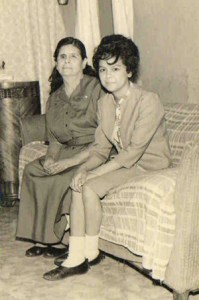
Mi abuelita y tía Matilde

My tía Matilde came to Chicago as part of the package deal when my abuelita came for eye surgery. Tía Matilde also needed surgery, so she came from México to have surgery on her ears. I’m not sure what exactly was wrong with her ears, but she was otherwise healthy.

My aunt was very young when she came, and she liked living in Chicago. She loved listening to pop music on the radio and she bought all the records by her favorite singer, Rick Nelson. She went wild when listening to his music.

What I remember most about my tía Matilde was how she did laundry. We, my parents, my three brothers, my abuelita, my tía Matilde, and me, all lived in a small four-room apartment. We had a washer and dryer in the kitchen next to the sink. When my parents were at work, tía Matilde would do all the laundry in the house, every handkerchief and sock. She would search everywhere in the apartment for dirty clothes. She found dirty clothes where I would never even think of looking. She just had to make sure that every last item of dirty clothing was clean when she was done doing the laundry. And so, when all the dirty clothes were in the washer, and there was a little room in the tub for more clothes, she would start taking off her clothes right at the washer and start putting them in the washer. She would be standing in the kitchen wearing nothing but her bra and panties, proud of the fact that all the dirty clothes in the house were now washed, obviously oblivious to my presence.

Back then, we always seemed to be either at home or at Cook County Hospital taking either my abuelita or tía Matilde to the doctors there. Anyway, my tía Matilde, who would undress at the washer, was very shy with the doctors when they asked her to disrobe. The day of her surgery, she refused to undress and refused to put on the hospital gown because it had no back to it.

I still remember her telling this story when she returned from her surgery. She absolutely refused to undress for the nurses and doctors. She thought she had won her battle, but after the surgery, she woke up in her hospital bed and immediately realized that she was completely naked! Whenever she told this story, she always sounded so shocked that this could have happened to her despite her precautions. She didn’t even remember when or why she lost consciousness. She always wondered who managed to see her naked. She would blush every time she told the story.  She was truly traumatized by this experience!

She eventually went back to México with my abuelita.

DDR

Abuelita


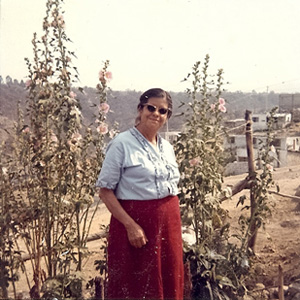
Mi abuelita en México.

I remember when my abuelita came to live with us in Chicago back in the 1960s. I liked having my grandmother living with us because she used to take care of me when both my parents went to work. She even protected me from my mother when she hit me a little too hard or a little too long.

I remember once for homework in the first grade I was supposed to read aloud from our reader to one of my parents. My father wasn’t home, so I went to my mother. She said she was too tired from work to help me do my homework. I told her that all she had to do was listen to me read. The reader was quite simple: “See David. See Ann.” And so on. I didn’t even know that much English at the time.

Anyway, my mother didn’t want to be bothered by me. I kept begging her to listen to me. Finally, my abuelita said that I should read to her. I wasn’t sure if she could help me to read this book. At first, I hesitated because not only did she not know English, but she was also blind. One of the reasons she came to Chicago was to get eye surgery.

DDR