My Spanish classes are always nervous about how they, the students, should address me. When I first started teaching at Morton College in 1995, I always told my students to call me David in Spanish, as opposed to David in English. Whenever someone called me Profesor in Spanish, or worse yet, Señor Rodríguez or just plain Señor, I corrected them and insist that everyone call me David in Spanish. But no matter how many times I corrected students, not everyone called me David.
Last year, I stopped telling students what to call me. Now, I respond to whatever name they call me. If they call me Señor or Señor Rodríguez, I know that they recently studied Spanish in high school. So within any one class period, I may be called David (in English or Spanish), Diego, David Diego, ProfesorRodríguez, Señor Rodríguez, or just plain Señor. Señor in Spanish means “mister” or “Lord”, which reminds me of when I was little and I prayed, “Señor nuestro, que está en los cielos …”
I really don’t want my students to treat me like God. I don’t handle power and authority very well. Señor also used to bother me because it made me feel so much older to be called Señor Rodríguez, but now I kind of like it. 🙂 Perhaps, I’m finally mellowing out.
I did have one Spanish class that always called me Dr. D. and I kind of liked that. The students really enjoyed calling me Dr. D., too, because it made me sound cool. Every single time any student spoke in class, he or she would insist on calling me, “Dr. D.” before speaking. After a while, I would walk into the classroom and say, “Dr. D. is in da house!” And they loved it!
So, you’re studying Spanish in high school or college. Is Spanish class easy or hard for you? Do you wonder what you can use all that Spanish that you learned? Or are you afraid that you will forget all your Spanish after the last exam? Well, my friend Mike (he doesn’t actually know I exist, but I like to attach myself to successful people) used his one semester of Spanish very successfully. The One semester of Spanish Spanish Love Song on YouTube.com has more than one-million hits. It’s very popular. I found it by accident on YouTube.com one day while procrastinating instead of grading compositions. I must have listened to it about twenty times before I actually got back to grading compositions. Then, I sent the link to the video to all of my Spanish students. They loved it. And just for grins and giggles, I also sent it the UIC Department of Spanish, French, Italian, and Portuguese. I wasn’t sure how all these professors at a research university would react to such a silly video as this. Was I ever surprised! One Spanish professor even suggested making it our department theme song. That is, until a French professor then sent a link for a similar song in French, which she suggested become the official department theme song. Not to be outdone, an Italian professor sent a link for a very lame video by what appeared to be some extremely inebriated Italian 101 students sputtering Italian infinitives. No word from the Portuguese section yet since we don’t have a Portuguese professor. Well, here’s the link to YouTube.com in case you’re interested in watching “The One Semester of Spanish Spanish Love Song”:
Here are the lyrics to “Spanish Love Song.” Granted they’re not profound and they don’t provide any new insights to the meaning of life, but they are fun to hear. I love all the non sequiturs. You can actually learn some Spanish listening to Spanish Love Song. Who ever said learning Spanish wasn’t fun?
Spanish Love Song
Hola, señorita. ¿Cómo te llamas? Me llamo Mike. Me llamo Mike. ¿Dónde está el baño? ¡Feliz cumpleaños! ¿Qué hora es? ¿Qué hora es? La ra ra ra ra Me gusta la biblioteca. Vivo en la casa roja. Yo tengo dos bicicletas. Muchas gracias y de nada. ¿Cuántos años tienes? Un momento, por favor. It’s “The One Semester of Spanish Spanish Love Song.” Mi mamá es bonita. Mi gato es muy blanco. Perdóneme. ¡Perdóneme! La ra ra ra ra Uno, dos, tres y cuatro. Cinco, seis, siete, ocho. ¡Nueve, diez! No remembro how to say eleven. Antonio Banderas, Nachos grandes y Cinnamon Twists. It’s “The One Semester of Spanish Spanish Love Song.” Au revoir.
I hope you enjoy this video. So, you see? Spanish is a very fun language. Please share it with everyone who teaches or studies Spanish!
I love the movie Napoleon Dynamite with Jon Heder so much that I’ve seen it at least twenty times. I saw it for the first time because my oldest son wanted me to rent it from Blockbuster. I thought I would end up seeing it all by myself as when I’ve rented other movies for him that he really, really wanted to see, like the Lords of Dogtown–and I ended up watching it alone, which I really loved by the way!
Anyway, I knew I had to own Napoleon Dynamite on DVD! When it first came out on DVD, it was only available at a clothing store called Hot Topic. Once I bought it, my twins started watching it repeatedly because they loved the movie, too. Well, I couldn’t walk by the TV without stopping to watch Napoleon and his misadventures. So, I watched it repeatedly along with my sons. Once we watched the movie all the way to the end and I told my sons not to start it over until I had read the credits; I don’t why, but I like to read the credits to see who the key grip is. (This goes back to the days of my youth when my friends Jim, Vito, and I would go to show and sit through all the credits so we could applaud for the key grip.) So, after the credits were completely over–yes, I read them all–there was another scene in which Kip marries LaFawnduh! My sons and I were pleasantly surprised!
Of course, this made me wonder what other surprises were in store for us on the rest of the DVD. Surprise, surprise! Not only does the DVD have subtitles in Spanish and French, but the movie is also dubbed in Spanish! I started watching it with Napoleon speaking Spanish, but my non-Spanish-speaking-Mexican sons wouldn’t watch it in Spanish!
Anyway, sometimes the topic of the movie Napoleon Dynamite comes up in Spanish class because the new student Pedro at Napoleon’s high school is Mexican. I often tell my students that they should watch the movie in Spanish someday. I was planning to watch it all the way through in Spanish one day. Since I’m always open to suggestions in Spanish class, last week, a student recommended that we Napoleon Dynamite in Spanish. I agreed if we didn’t use the subtitles. They resisted, but I insisted. Then, we reached a compromise: We would watch the movie dubbed in Spanish with Spanish subtitles. Since the students were fourth semester Spanish students and most had already seen the movie, I knew they would understand the action and plot development of the movie. I was amazed at how much the students laughed!
Napoleon Dynamite is much funnier in Spanish, especially when Napoleon says, “¡Idiota!” I was wondering how they would translate words like “liger,” which is half-lion, half-tiger. Well, Napoleon says that he’s drawing his favorite animal, “el legre,” which is “medio león, medio tigre.” However, lost in the translation is, “But my lips hurt really bad!”, which is translated as, “Pero mis labios están resecos” and Pedro’s “Maybe I’ll build her a cake or something.” The Spanish used is standard Spanish and doesn’t really capture the slangy colloquialisms of high school teenagers.
Also, the subtitles don’t always match the Spanish dubbing. In the beginning Napoleon says, “¡Rayos!”, but in the subtitles, we read, “¡Cielos!” Obviously, there were two translators at work. Overall, the Spanish captures the feel of the original movie. I would recommend for all Spanish teacher to watch this movie with their high school or college students in Spanish. It was definitely a very entertaining way to reinforce some of the Spanish lessons learned in class.
I was curious as to who was actually reading my Blog. So, I did some snooping around, I mean some investigating. For some unknown reason, I keep getting hits from Russia. I can’t quite figure it out. My most viewed Blog entry is the one about Enrico Mordini, my Spanish teacher at Divine Heart Seminary. I guess I should go back and actually finish writing it and editing it since so many people are reading it. Now I feel embarrassed that I didn’t fix it up sooner. Another thing that really surprised me was the fact that people in Spanish-speaking countries are also finding my blog. I was wondering how they would read it since I mostly write in English. I went to the referring page and found that an automated translator could actually translate my blog into Spanish with a link on the search engine page. Wow! I mean, ¡Ay, ay, ay! The webpage is automatically translated into Spanish, but in very poorly-written Spanish at that. Upon reading the translation, I realized that people in Spanish-speaking countries will think that I don’t know Spanish!
Let me give you a sample of some of these translations. Well, it actually starts out quite well. The title at the top of my blog is David Diego Rodriguez, Ph.D. without an accent mark on the “i” of Rodriguez because otherwise all these strange characters appear and distort my last name thanks to the mysteries of computers and the Internet. However, the translator actually put the accent mark where it belongs! The rest of the translations are rather sad. For example, under my name I write, “¡Hola! ¡Yo hablo español e inglés!” For some strange reason that phrase is translated as, “¡Yo hablo español electrónico español!”, which somehow fails to convey my original message. I suppose if someone really wants to read my blog, they will gladly plod their way through this computer-generated translation.
When my Spanish students write compositions, I ask them to do the best they can. I ask them to write the composition in Spanish right from the start. I know that the student will make plenty of mistakes, but that’s part of the learning process. Sometimes the original text is upstaged by all my corrections in red ink. That’s fine by me if they make a valiant effort to write in Spanish. However, I do not want a student to write the composition in English and then translate it into Spanish. That’s double the work! And of course, I can always tell when they write it in English and then use an internet or computer translator. Well, the output hardly resembles proper Spanish. In fact, in many cases, I cannot even decode what the student wanted to say in the first place. All the words are in Spanish, but the composition is incomprehensible! I always ask the student to rewrite such a composition, “but in Spanish this time.” About the only word that doesn’t lose anything in translation is the English word “no” that also happens to translate to “no” in Spanish. Even an automated translator gets this translation right!
Be careful with those translations! While I was still a police officer, I would have to take people to Mercy Hospital for medical treatment. Of course, that meant I spent plenty of time waiting in the triage area of the emergency room.
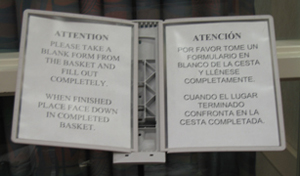
Since I love to read, I would read everything in sight. One notice to patients who were signing in always bothered me. In English, it read: “Attention. Please take a form from the basket and fill out completely. When finished place face down in completed basket.” Okay, the notice wasn’t exactly written in perfect English, so perhaps that’s why the translator had difficulty translating it into Spanish. However, no matter how many times I read the Spanish translation, I could never make any sense of it. And no one ever bothered to correct it.
Finally, after reading it for two years or so, I wrote it down: “Atención. Por favor tome un formulario en blanco de la cesta y llénese completamente. Cuando en el lugar terminado confronta en la cesta completada.” How, I wondered, did the translator arrive at this translation? And, what were the translator’s qualifications?
This reminds me of my Spanish student Elwood Chipchase who one day began telling me about July Churches. He was going on and on about July Churches and I had no idea what he was telling me. Finally, I had to ask him, “What are you talking about?” Well, it turns out that I didn’t understand him because he had translated the name of the Spanish singer Julio Iglesias into English!




 Chicago USA