The other day, one of my Spanish students asked me if he could be my friend on Facebook.com. Of course, I said yes. And we are now friends on Facebook. I’ve always gotten along with my Spanish students. That’s because I love my students. But not in the sexual harassment civil lawsuit kind of love. I’ve been teaching college Spanish for about twelve years now, so I remember a lot of students from over the years. Some students kept in touch with me for a while after taking my class and then eventually disappeared from my life. Other students occasionally run into me by chance. Some I will never forget.
I remember Elwood Chipchase and his wife Grace took Spanish 101 and 102 with me at Morton College. He was a minister in Cicero, Illinois, and his congregation was mostly Mexican. He was seriously studying Spanish so could better communicate with his parishioners. Both he and his wife were the students most dedicated to learning Spanish. At first, he didn’t tell me that he was a minister or why he was learning Spanish. One day, he asked me why when he asked Mexicans about their mother, they kind of paused before answering. Sometimes they gave him a pained look, as if they were offended. I asked Elwood how he asked them. He would greet them, ask them how they were, and how their spouse was in Spanish. Then he would ask about their mother, “¿Y tu madre?” I thought about it a while. Why would they hesitate to respond? Elwood’s Spanish was clear enough to understand. Then it dawned on me. But I felt uncomfortable explaining my theory to him since he was a minister. The problem is that all Mexicans refer to their mother as mamá or mami. The only time they use madre is when they swear at someone, as in, “Chinga tu madre.” Well, he was grateful for my explanation and said he would change his choice of words. The next week he reported that everyone responded more warmly to his inquiries.
As you may have noticed, I like jokes. Here’s a riddle. What do you call a person who speaks two languages? Bilingual. What do you call a person who speaks three languages? Trilingual. What do you call a person who speaks one language? American.
A Swiss man, looking for directions, pulls up at a bus stop where two American tourists are waiting. “Entschuldigung, koennen sie deutsch sprechen?” he asks. The two Americans just stare at him. “Excusez-moi, parlez vous francais?” he tries. The two men continue to stare. “Parlare italiano?” No response. “Hablan ustedes español?” Still nothing. The Swiss man drives off, extremely disgusted. The first American turns to the second and says, “Y’know, maybe we should learn a foreign language.” “Why?” says the other. “That guy knew four languages, and it didn’t do him any good.”
A man tells his friend, “I’m going to learn German.” His friend says that German is a hard language to learn. The man replies, “How hard can it be? I’ve heard three-year-olds speaking it.
“I’m glad I wasn’t born in France.” “Why’s that?” “I don’t speak French!”
A man gave his wife a parrot. The next day, they’re eating dinner and the man notices that the parrot isn’t in its cage. He asks, “Where’s the parrot.” The wife says, “We’re having it for dinner.” “What? That parrot spoke three languages!” “Well, why didn’t it say something?”
A student fell asleep during an English professor’s lecture on pronouns. Upset, the professor wakes up the student by asking him to name two pronouns. The student replies, “Who? Me?” “Very good,” says the professor.
This linguistics professor was lecturing the class. “In English,” he explained, “a double negative forms a positive. In some languages, such as Spanish, a double negative is still a negative.” “However,” the professor continued, “there is no language wherein a double positive can form a negative.” Immediately, a voice from the back of the room piped up: “Yeah … right …”
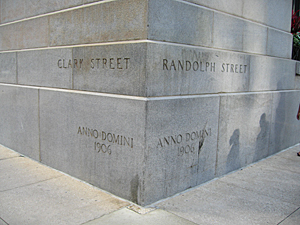
Traffic crash scene at the corner of Clark and Randolph.
Oftentimes, I will meet one of my present or former Spanish students unexpectedly. I’m always happy to see them again, but I usually meet them long after I’ve forgotten their names.
Once I was at the McDonald’s Playland near Midway Airport with my twin sons when they were about four years old and one of my former students greeted me with a loud and friendly, ¡Hola! I was happy to see her again, but this time she was with her young son and she was happy with her life.
Once while I was on duty as a police officer working in a patrol car, I was assigned to park my squad car with the blue lights flashing so other cars wouldn’t crash into a car that had crashed into the Cook County / City Hall building downtown. This must have been a slow news day because all kinds of cameramen came by to film the car that had crashed into the building while I just sat there in my squad car watching everyone come and go.
Then, I noticed that one cameraman was looking at me as he walked past. I couldn’t help but notice him, too. Then, we both recognized each other! He was in my Spanish class at UIC! He also recognized me. We kind of looked at each other with a look that could only mean, “This is what you do for a living?” I never imagined him as a cameraman. And he definitely never imagined me as a police officer.
Another time I was downtown where an employee of Dunkin Donuts was a theft victim. As I walked into Dunkin Donuts, one of my students saw me. We greeted each other and that was about it. However, I realized afterwards that he saw me in full police uniform walking into a Dunkin Donuts. How cliche! I was actually responding to a radio assignment, but I appeared to be acting like a typical cliché police officer going for coffee and donuts.
Last Saturday, as I was leaving the Burger King in Mount Greenwood with my twins, I saw a former Spanish student in the parking lot. We said hello to each other and then I noticed that he was with Mark Pera who is running for Congress so they gave me a flyer and asked me to vote for him. I responded that I would think about it. When I got home, just by chance, Mark Pera’s campaign office called me and asked me to vote for him. I told the caller that I had just seen him, but she didn’t believe me.
Mexicanismos are words or phrases in Spanish that are unique to México, but may not be familiar to other Spanish speakers, also known as Hispanophones. French speakers are Francophones and English speakers are Anglo-Saxophones.
Anyway, in Mexico, people use words and phrases that are unique to that region and are commonly misunderstood by other Hispanophones. At UIC (University of Illinois at Chicago), we have graduate students who come from all over the Spanish-speaking world, most of whom specialize in linguistics. They can spot the dialect and region of most Spanish speakers almost immediately. Some have trouble identifying me because I have my American accent and I use words and phrases from almost every dialect that I’ve ever heard. I’m like a sponge in this regard. Sometimes, someone will throw their hands up in the air and just ask me where I’m from. They’re often surprised to hear that my parents were from México. My cousin’s husband thought I spoke with an Argentine accent. Once, a friend and I were speaking, and then I didn’t hear something she said. So, I said, “¿Mande?” and she said, “¡Ajá! You’re from Mexico!” That simple little mande gave me away as a Mexican.
Once, at the end of the semester, a professor from Argentina told us that she would bring us a torta for the last day of class. To most Mexicans and me, a torta is a type of sandwich that is served on a bun with meat and other condiments. I didn’t eat before class because I wanted to be polite and eat everything that was offered to me. Well, she came to class with a torta, but it was a cake, as in a pastry for dessert. I left the classroom hungry that day.
Another time, I brought some Thanksgiving leftovers to UIC for lunch. A graduate student from the Basque Country in Spain asked me what I was eating. I told her guajolote and camotes. She didn’t know what I was talking about. For her turkey was pavo not guajolote and yams or sweet potatoes were patatas not camotes because they didn’t differentiate between the various kinds of potatoes in Spain.
I have a friend who grew up in Seville, Spain, and we once had a minor misunderstanding. He told me that his car had broken down: “Se me estropeó el coche.” Being the nice guy that I am, I wanted to be helpful, so I offered him a ride: “¿Quieres un aventón?” I could tell by the tone of his voice that he was a little upset when he replied, “¿Y yo qué te hice?” You see, to a Mexican, un aventón is a ride, but to just about any other Spanish speaker un aventón implies some kind of physical violence. I explained to him that I only wanted to help him by giving him a ride to wherever he wanted to go, and I am happy to say that we are still friends to this day.
Another graduate student from Spain taught a class that had many Mexican American students. She frequently used the word coger, meaning “to get” or “to pick up” when she spoke not realizing that to Mexicans coger is a profanity that refers to the act of sexual intercourse that begins with the letter “f.” So, one day, she talked about picking up her dog: “Cogí mi perro.” She was surprised when the class began to laugh until someone explained to her what she had said.
While I was in México, I learned a few more mexicanismos. My cousin used the diminutive “-is” instead of “-ito, -ita.” For example, she went to see her “amiguis” instead of her “amiguitas.” Before we went to visit my cousin David Rodríguez in Celaya, everyone refered to him as Davis.
In the U.S. we have Spanglish, which is the mixture of English and Spanish, but I only thought it existed north of the Rio Grande (In Mexico, they call it El Río Bravo). For example, you take an English word like “to check” and make it Spanish: chequear, instead of comprobar or some other Spanish word that already exists. Anyway, they have a similar word in Mexico: checar. Several street venders approached me and called me jefe, showed some product they were selling, and said, “Checa esto.” Or “Check this out,” in English. So, this word is a little different than the Spanglish word chequear because it’s a mexicanismo. Or maybe it should be called inglañolismo.
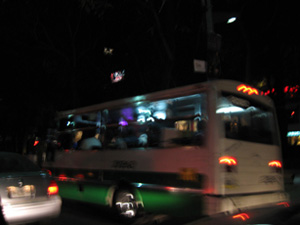
I always thought of an aquarium as un acuario, but to my cousin in Celaya it was el pecero. I had never heard the word before, but I knew exactly what he meant. Then when I was in Mexico City, when people talked about taking the bus they still called it el camión, but now a lot of people also called it el pecero. That made perfect sense because if you look at the buses with their large windows, they do look like aquariums with people swimming inside instead of fish.
If you park your car in México City, you’re likely to meet el viene viene. He is a self-appointed parker of cars and is often found on public streets and grocery store parking lots. He doesn’t officially work for anyone. He’s just there–and everywhere else. You can’t miss him. He pops up out of nowhere waving his salmon-colored mechanic’s rag as you park your car. As you back up, he tells you how far you can back up by saying “Viene, viene.” When you get out of your car, he’s standing next to you with hand, and you’re supposed to give him a tip of two pesos or so.
Then, there’s also the aguinaldo that is a bonus that most employees receive before Christmas and before el Día de los Reyes to buy holiday gifts or pay off debts. At Christmas, children received candy bags. They were told, “Come get your aguinaldo!”
Driving in México has been my greatest, and perhaps most dangerous, accomplishment ever. I almost didn’t drive there after my cousin warned me that no driver obeys the rules of the road. However, I was due for an adventure since I do live a very boring life. As soon as I entered México, I noticed the driving difference immediately. In Nuevo Laredo, the streets were narrower and street venders were at every major intersection peddling their wares. Most lane markings were nonexistent. All the drivers accelerated quickly and stopped even faster when necessary. In Monterrey, I was fascinated by the different configuration of traffic signals. The green light flashes three times before it turns yellow. Then, there are two, count them, two red lights side by side. I honestly thought this meant that I should stop at the red light. Boy, was I wrong! All the cars behind me beeped at me until I drove through the red light.
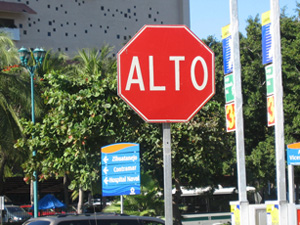
As I was driving on the highway, I was fascinated by the road signs so much that I began to write them down as I drove. Of course, this made me swerve several times and once I almost drove off the edge of a cliff. I liked the fact that these white rectangular signs appeared on both sides of the road. In the U.S., whenever I need to read an important road sign, I usually can’t read it because it’s obstructed by a passing semi. Here are some of the signs that I saw while driving in México.
PONGASE VIVO USE EL CINTURON DE SEGURIDAD In México, it’s the law for front-seat passengers to wear seatbelts. I always wear my seatbelt anyway since I believe it has previously saved me from serious injury in my previous accidents.
GUARDE SU DISTANCIA Don’t tailgate. However, if you’re in the fast lane and you’re not driving way over the speed limit, drivers will rapidly approach your rear bumper flashing their left turn signal (that means they want to pass you) and you better move into the right lane!
DISMINUYA SU VELOCIDAD Reduce speed. This sign appears whenever approaching a town or tollbooth. However, no one actually slows down.
RESPETE LIMITE DE VELOCIDAD Obey the speed limit. I’m not sure why someone posted this sign along all the highways. No one obeys the speed limit and traffic enforcement is virtually nonexistent.
RESPETE EL SEÑALAMIENTO Obey road signs. Once again, I’m not sure why these signs are posted. I see these signs more as suggestions than anything else.
CUANDO TOME NO MANAJE If you drink, don’t drive. In general, everone was afraid to drink and drive because of the consequences if arrested for drinking and driving. Besides, no driver can survive the driving habits of other Mexican drivers even if they’re only slightly impaired.
MANEJE CON PRECAUCION Drive cautiously. That’s just a given for every driver. No one gets behind the wheel in México without dreading pulling into traffic. In fact, there are many Mexicans who don’t have a driver’s license simply because they’re afraid of the Mexican traffic.
OBEDEZCA LAS SEÑALES Obey signals. I think this another one of those signs that is more of a recommendation than anything else.
NO DEJE PIEDRAS SOBRE EL PAVIMIENTO Do not leave rocks on pavement. I really didn’t understand this sign at all. As I drove, I attempted to decode this mysterious sign to no avail. I finally asked one of my cousins who told me that sometimes drivers use rocks to prevent the car from rolling when changing a flat tire and then leave the rocks on the shoulder.
TRANSITO LENTO CARRIL DERECHO Slower traffic, keep right. But be careful because the right lane sometimes contains traffic that is inexplicably at a complete standstill.
CARRIL IZQUIERDO SOLO PARA REBAZAR Left lane for passing only. Even if you’re passing another vehicle and a faster vehicle comes along, you better get out of the way!
LO MEJOR DE TUS VACACIONES REGRESAR A TU CASA The best thing about your vacation, returning home. Of course, they don’t mention what condition your mental state will be in after driving among countless reckless drivers, in the Mexican mountains, on roads with little or no road markings, no median protection, or the complete lack of guardrails on the edges of cliffs with precipitous drops.
PISO MOJADO Wet pavement. Luckily, the streets were dry the whole time I was in México. Driving was challenging enough without complicating things with wet pavement.
UTILICE EL CINTURON DE SEGURIDAD Use your seatbelt. Most people put on their seatbelt willingly due to the driving conditions and risks involved rather than fear of the law.
CON NIEBLA DISMINUYA SU VELOCIDAD Slow down in fog. I didn’t actually see any fog, but I’m sure drivers will slow down with zero visibility. At least, I hope so.
CON NIEBLA ENCIENDA SUS LUCES Turn on lights in fog. I’ve driven in fog in California and I know that if you turn on your headlights you still can’t see what lies ahead. And if you turn on your high beams, you will be blinded. However, other drivers may see your taillights and avoid rear-ending you. At least, I always hoped so.
CONCEDA CAMBIO DE LUCES Dim your lights if someone flashes their brights at you. Okay, their was enough traffic on both sides of the highway after dark that it was impossible to use your brights. Oh, yes, those drivers who want to pass you will flash their brights at you at night if you’re in the left lane and not going at least 40 KPH over the speed limit.
NO MALTRATE LAS SEÑALES Do not damage the signs. All the road signs I saw were in good condition, unlike in America where some signs have shotgun pellet markings caused by some good ol’ boy.
NO DAÑE LAS SEÑALES Do not damage the signs. Again, but with different wording. These signs must work because all the road signs I saw were intact.
NO PRENDA FUEGO SOBRE EL PAVIMIENTO Do not light fires on pavement. I’m not sure what this sign means, since I didn’t actually see any fires on the road, I did, however, see people living on the side of the highway in makeshift shelters with fires in front and people tirelessly waving down drivers for money. Some drivers actually stopped and contributed.
NO CIRCULAR POR EL ACOTAMIENTO Do not drive on the shoulder. I find this sign incredibly amazing because on many sections of the highway there is no shoulder at all!
NO TIRE BASURA Do not litter. In general, drivers didn’t litter. There are plenty of garbage cans along the highway that are well-marked in advance for you to stop in time and dispose of your garbage. I only wished that the gas stations were also marked as well. I missed one gas station because no signs announced its location and I didn’t see it because it was behind the side of a mountain.
NO MANEJE CANSADO Do not drive tired. This sign is totally useless. If you drive for more than an hour in México, you will be tired. Most drivers were always alert.
TRAMO SINUOSO Winding road. This stretch of road was actually fun to drive if you didn’t look over the edge of the cliff for too long and imagine your horrific death.
CURVAS PELIGROSAS Dangerous curves. Take this sign seriously. They really do mean dangerous curves, especially since chances there won’t be any shoulder or guardrails to save you if you veer off the road.
FRENE CON MOTOR Brake with motor. In the U.S., the roads signs prohibit engine braking, but in México if you don’t, you’ll probably wear out your brakes before you get to your final destination.
VEHICULO SIN FRENOS SIGA LA LINEA ROJA Vehicles without brakes, follow the red line. So I’m driving in the lane with the red line go down a very steep incline and I’m constantly looking in the rearview mirror for runaway vehicles with no brakes. I felt safer when I drove in the other lane. The red line eventually leads the vehicle off the main highway to an adjacent road that rises sharply, presumably to slow the vehicle down, and ends with a steep cliff at the end. Pretty scary!
VIAJE CON SEGURIDAD Drive safely. You must multi-task while driving. The only way to drive safely in México is to drive defensively AND offensively simultaneously.
CEDA EL PASO Yield. You must always be prepared to yield–at any moment, on any stretch of the road. I thought I was about to run over a bicyclist who made a u-turn in front of me as I was driving 120 KPH. This only happened to me once since bicycles are prohibited on the highway.
NO CIRCULAR POR FAJA SEPARADORA CENTRAL Do not drive on the median strip. This sign is totally unnecessary. If anyone is foolish enough to drive on the median strip, they will total their car and/or kill themselves.
TUNEL PROXIMO ENCIENDA LUCES Approaching tunnel, turn on lights. And you better turn on your lights because the tunnel is very, very long if they actually post this sign. And, there are no lights in the tunnel other than your own!
To me the scariest part of driving through México was this godforsaken stretch of highway in the state of San Luis Potosí where not one single AM or FM radio station was broadcast. The horror, the horror! In summary, you will never forget driving in México, even if just as a passenger. On the one hand, Mexican drivers are reckless and don’t respect the driving laws. On the other hand, I didn’t witness even one accident the whole time I was in México.
Click here if you would like to see more driving vocabulary in Spanish:



 Chicago USA